
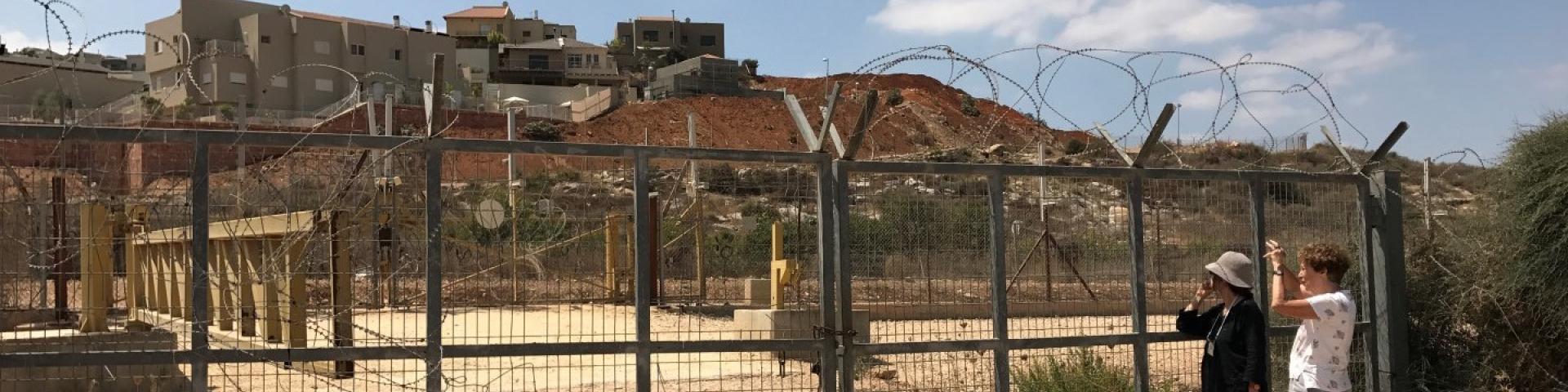
Abu Dis

30/01/2012 ,Afternoon
Rahel W., (reporting) a guest from Jerusalem


Anata 

It was a dismal, rainy, foggy afternoon.  We went first to the Anata checkpoint in time to see children from the Israeli side returning home to the other side of the checkpoint and vice versa.  There were no delays, however it was not pleasant watching the children having to walk over 100 meters to and from the checkpoint in the pouring rain on their way to their respective destinations

Al Ezariya 

When we arrived at Ezariya, we were somewhat apprehensive about taking the new road from the town center toward Wadi Nar because of the weather conditions.  Even in good weather, the new road can be treacherous – especially since vehicles of all sizes are known to ignore the one way direction and approach on coming traffic.  However, we wanted to get to Wadi Nar and were uncertain about getting there via the confusing roads of Ezariya and Sawahra so we took the new route.  PLEASE NOTE!  PERHAPS AS A RESULT OF THE INCLEMENT WEATHER, THERE ARE SEVERAL VERY BAD POTHOLES ON THE ROAD – ABOUT HALFWAY UP THE ONEWAY PART OF THE HIGHWAY AND AVOIDED HITTING ONE (WHICH COULD HAVE TORN A TIRE TO PIECES) ONLY AT THE VERY LAST MOMENT!.  For those taking that route, please drive slowly and keep your eyes peeled on the road ahead.

Wadi Nar 

There was very little traffic at Wadi Nar and, perhaps because of the weather, we saw no workers going through during the time we were there.  Traffic moved quickly and uneventfully.


__._,_.___
23/01/2012 ,Morning
Idit S., Liliane ( a new volunteer) Anat T. (reporting)


6:50 Sheikh Saed
 
Relatively few pupils crossing -- smoothly, with no delays.  The drivers at the top of the hill, bundled inside their vehicles against the cold, don't know whether there is a holiday for some schools (the Authority? Waqf?).  Garbage piling again on the slope close to the checkpoint.
 
7:40  Shuafat Camp Checkpoint
 
Two buses are parked in the inner parking lot, a group of older boys wait to embark, and the volunteers organising the transportation say that today checks of each school bus were prolonged (some 70 buses have crossed since 6:00), despite the agreement with the local residents' council whose responsibility it is to check, and only in the event of a specific suspicion would the buses be delayed and each student's documents checked.  A meeting will be held today with security officials regarding this matter, and if the situation does not improve, the pupils' pick-up location will be moved beyond the checkpoint, thus increasing pressure of pedestrian crossing, for which the checkpoint is not planned.   The council delegate tells us that around two years ago relations with the border police soldiers were excellent, but now there are cases of children beaten, followed by revenge, for example stone-throwing and violent encounters with soldiers.
 
At this checkpoint only those registered as residents of Anata/Shuafat, and possessing blue ID's or permits, are allowed to cross.  But the Civil Administration does not permit a change of address for couples when a spouse hales from some other location in the West Bank; spouses of residents of the camp must cross at Qalandia or Olive Terminal.  At the same time, very few Jerusalem residents of Shuafat are given Israeli citizenship following the usual procedure.  The criteria are not transparent, and these few are possibly members of old and respected Jerusalem families.  Is this a strategy in preparation for a municipal disconnection of the neighbourhood?
 
8:45 Olive Terminal
 
At this hour the terminal is fairly empty, but from a conversation with drivers and those crossing we learn welcome news: three weeks ago the DCO at this checkpoint began providing magnetic cards, humanitarian permits, and family reunion permits, for a year.  Also there is an x-ray machine for the palm of the hand.  The services are intended for all the central neighbourhoods of Jerusalem: Abu Dis, A-tur, Ras al Amud, Al Ezariya -- cards produced at the rate of c. 80 a day.  Until now, residents had to travel to Jericho for their magnetic cards, and a fresh x-ray of their palms to accompany the cards.


11/01/2012 ,Morning
Hanna B., Ronny P. (reporting)


Anata
 
We arrived just when the school-children's buses were leaving the small stop located above the large new and fancy checkpoint.
The orderlies told us that together with the parents they had decided it would be preferable to continue using the old bus stop, slightly distant from the checkpoint, as a calmer and safer location for the children.
 
The problem is that although people cross easily -- they are Jerusalem residents working in offices and shops in town, they shop in the downtown malls, they travel to Eilat for Id al Fiter -- there is now a threatening wall erect in the neighbourhood and at the entrance to the checkpoint, with posters of threatening warnings and instructions, that were not there before.


__._,_.___
10/01/2012 ,Morning
Idit S., Anat T., (reporting)


Sheikh Saed
 
Only little children crossing, little girls with scarves, probably from the elementary schools of the Waqf.  The rest are still on vacation, the residents tell us.  The two female soldiers on duty work efficiently and pleasantly, a definite improvement on previous shifts we encountered here.
 
7:20- 8:00 Drive through Silwan, Wadi Joz and Mount Scopus, to the new checkpoint in Shuafat
 
Work on infrastructure at the bottom of Ein Hilweh St. is proceeding apace.  At the top of the street local vehicles are double parked in certain places, allowing for one-way traffic only in the direction up to the Temple Mount.  And indeed, the stones separating the lanes have been dislodged.  No checks, or police, or border police.  At the new Shuafat checkpoint we are taken on a tour by the checkpoint commander. We are too late for the children's transportation, but we inquire about our colleagues'  report that the buses have returned to their old place above the checkpoint where the children, who have crossed on foot, are collected.  The commander tells us that this is a temporary measure, due to a disagreement between the municipality and the transportation company, and that the bus drivers refuse to  enter the parking lot beyond the checkpoint because stones had been thrown at them there.  We have no idea what the facts are, and how diligently the municipality is trying to resolve the issue, and decided we should not intervene at this point.  The commander says that the 2000 children who crossed this morning did not go past the checking booths, but directly through a gate that's opened for quick passage to the exit path from the checkpoint.  Only someone who looks older is asked to present a pupil's permit and birth certificate or an ID.
 
8:30 The approaches to Wadi Nar
 
In the wake of our teams' difficulties driving up the steep ascent from the new road south of  Al-Azariah to the checkpoint, we search for an easier approach.  From the new road, at the bottom of the wadi we turn right instead of left,  pass two left turns to Sawaharrah a-Sharkiya, and one more (not clear where it leads) -- both these options look pretty steep and narrow.  We turn left on the rooute that appears broader and less steep, and reach the centre of Sawaharrah a-Sharkiya which, to our surprise, is a fairly well-appointed township compared to what we know from the eastern part.  Children stroll in the streets, there are many grocery shops, and the atmosphere is tranquil.  We stop and observe the Sawaharrah a-Sharkiya checkpoint directly below us; this is also an unusual observation point on Sheikh Saed and the narrow road winding towards the neighbouring Sawaharrah.  Everything is close, but access is so inconvenient.
We continue on the road in an easterly direction hoping to reach the Wadi Nar Checkpoint quickly, but the route is very long and winding and we do not recommend it as an alternative to the steep but shorter route.
 
When we finally arrive, the checkpoint is operating without delays.  On return, we decide to try another descent to the wadi, the closest to the grocery shop.  The signpost is a Palestinian Authority poster about develpment of the road.  This is the place to turn right and descend back to the road leading to Al-Azariah.  The road is relatively less steep than the usual route, but narrow.  It's worth checking whether this is a possible alternative.  If the road-works are indeed done soon, it looks as though this may develop into a more convenient route.


05/01/2012 ,Morning
Rachel M., Yehudith S., Michaela R., (reporting)


In general: most school children are on holiday
 
6:45 Sheikh Saed
 
Few crossing; and crossing is swift.
 
Olive Terminal
 
Here too, few crossing, no lines inside.
 
Anata checkpoint
 
We began our observations near the exit for pedestrians.  But even before we got close, two civilian security guards descended upon us, shouting and trying to send us away. Their language was blunt and aggressive.  We did not give way.  When the checkpoint commander approached, the two withdrew and we complained about their behaviour.  For the duration of our stay, they never took their eyes off us -- waiting, like a cat stalking a mouse, for some "slip" on our part.
Remember: it's important not to be intimidated by the personnel of various security companies.  They have no precise authority vis-a-vis citizens.
This is a convenient spot for observing the inspection of vehicles.  Two positions were operating, at one only decuments were checked quickly, at the other both documents and trunks were checked and crossing was slower.  Buses were checked inside but passengers were not asked to descend.
Here too school children are on holiday, and the parking lot for buses was empty.
The pedestrian crossing was almost empty.  Those checking were sitting down in their stations.
 
There are preparations to activate an x-ray machine for objects.


.

29/12/2011 ,Morning
Rachel M., Michaela R., (reporting)


In general: Winter break, mainly for pupils
 
6:25 Sheikh Saed
 
Only adults crossing, and passage is very slow.  Waiting time is 5-6 minutes, with 10-12 persons in the line.  The person in the booth appears to be chatting most of the time. 
An interesting conversation with A., the DCO representative. Head of the Olive DCO now is T., who confirms that young children now also require a permit.  He doesn't think there's a problem with preventing children without special permits from crossing for the Christian holidays because "these are the regulations."
 
7:15 Anata
 
Crossing of vehicles is slower than in the past.  Only two checking positions are active.  Documents are checked, and occasionally trunks.  Public buses are checked.  The line stretches to the inner roundabout.  At its centre is a booth with broken windows -- evidence, it seems, of last week's demonstration.  At the entrance to the checkpoint there is a new booth draped in thickets of metal.  The lot for children's transportation is empty.
 
At the pedestrian crossing the soldiers sit around (don't stand) next to the turnstiles.  Crossing is quick due to the scarcity of people.
Entry and exit for handicapped in wheelchairs is still impossible.  However, after passing the first turnstile in the direction of the exit, there is a "humanitarian gate" which is not accessible.
In the area of the old checkpoint the wall grows higher, work proceding vigorously.
27/12/2011 ,Morning
Idit S., Shira V., Katia (a guest), Anat T. (reporting)


7:20 Sheikh Saed
 
Palestinian children are on a fortnight's winter holiday, with the exception of those attending institutions of the Waqf -- mostly little ones, as far as we could tell.  Even so, things move slowly at the checkpoint.  We are told this is because there's a new Company in charge since last week.  On our previous shift at Sheikh Saed (Hanna B, Idit S, and myself) we encountered a border policeman who created unnecessarily harsh confrontations with those crossing.  Hanna B. complained to the B.P. spokeswoman about his inappropriate behaviour, and we hope the matter has been dealt with.
 
When we disembark our papers are carefully examined, and we're sent off to fetch Shira's document forgotten in the car.  Meanwhile we miss the turning away of a 10 year old : a resident of Abu Dis with birth certificate and school permit, but without the DCO permit, who is not allowed to cross the neighbourhood  checkpoint.  He fails to meet the regulations twice over: neither a resident of Sheikh Saed, nor the carrier of a DCO permit.  We try to persuade the checkpoint commander that a 10-year old whose school-bag has been checked, is not a security threat, and how can he reach the Olive Terminal alone?  Unfortunately the child had left by then.  The commander retracted a little from his claim that orders are orders are order... but just a little.
 
8:00  Drive around the Abu Dis area and observation from the Olive Terminal of the expected traffic changes
 
 
From the shoddy American Route we turn west to Silwan and drive up Ein Hilweh St.  Major municipality work is proceeding on the slope (near the Shiloah spring).  It is only in the evening that we learn of the collapse two days ago of the tunnel for an archaeological dig near a mosque, and of the "Peace Now" request to stop all underground digs in Silwan until an exhaustive and independent engineering report of all the tunnels is made.  We also learned that today the local committe of the Jerusalem Municipality will consider two building plans submitted by the Elad organisation: a large building in the former Givati parking lot, and the development of "Beit Ha-ma'ayan at the bottom of Silwan.  Local residents are protesting.  After a short drive around the closed lazarus checkpoint (next to the monastery which houses a kindergarden), we continue to the Olive Terminal to observe the system of new roads breaking out of Az-za'ayyem to Hizmeh through the new intersection under construction opposite Issawiya.  We read about it in the piece by Haim Levinson in Friday's Ha-aretz, but it all becomes clearer after a short internet search in the "Ir Amim" site which shows a map of the planned Route 45 from 2009.  The idea is to created a separate system of roads for Palestinians, linking the south of the West Bank (Bethlehem) with the north (Ramallah) by means of bridges and tunnels, eliding the roads approaching Jerusalem, and thus allowing checkpoint-free passage for Israeli residents from Ma'aleh Adumim to Jerusalem, and enabling construction in E1 to create urban continuity between these places.  See map of roads planned on:
 
 
Drive along the new roads, the new Shuafat checkpoint, and Beit Hanina
 
We drove along the new roads as far as the spot where they are blocked with locked gates.  Through a checkpoint and an under-road crossing to As-za'ayyem we drove along Route 45 (the road with a wall in its heart) on the Palestinian side, and found it blocked, but continuing, further on, to Anatot.  We then returned through the vehicular crossing in Az-za'ayyem and continued towards French Hill on Route 1 as far as the new roundabout with the turning to Metzudat Adumim. We expect that this is where the road to the new vehicular crossing in Shuafat will pass, channneling Palestinian traffic allowed to enter Jerusalem by car. (Will that include Palestinians holding blue IDs? Probably)
 
We continued to the new Shuafat checkpoint, although it was already late, to observe morning traffic.  The checkpoint was fairly empty, the walk to it and back unreasonably long.   From a piece in the "Bamahane" link we learn that from March 2011 this is the site planned to be the largest crossing in the West Bank, built according the demand of the High Court to confirm the route of the separation fence, along which are planned offices of various delegations, government offices and more.  See
 
Meanwhile the military police check documents at the single pedestrian crossing operating, without benefit of x-ray machines.  We did not see any representatives of government offices yet, but the squeaky clean toilets were opened especially for our use.  In answer to our question whether Paletinians were allowed to enter these premises we were told "only if they desperately need to..."
 
We ended this survey in Beit Hanina.  We drove from the Shuafat checkpoint to Pisgat Ze'er, turned to Beit Hanina,  and at the first roundabout north of the Light Rail terminal we  found a roundabout from which the road will lead from Pisgat Ze'ev to the Begin highway (continuing from Route 443).  We reahed the large interchange under construction, the route changed because of one home which gets in the way and cannot be moved.  We reflected on how all these plans -- proceding stealthily and silently through various committees -- surprise us, and eventually come true, unlike dreams of a better life for both out peoples.
15/12/2011 ,Morning
Rachel M., Michaela R., (reporting)
 
6:45 Anata
 
Even before reaching the recesses of the checkpoint we could see the haste with which the main road was blocked with a wall and fence around the field above the old checkpoint, with curls of barbed wire.
 
At the new checkpoint we were met by an officer who was interested to know what the Palestinians thought of it. This conversation signals the present approach which is to try and avoid the anger of the residents.  And indeed, the checkpoint is, at present, spacious and clean, the checks efficient and swift.  But the place has not yet acquired its full appearance, some turnstiles have not yet been installed, and
some of the instruments are not yet operative.  Time will tell how things will develop.
 
We entered the pedestrian track into Anata.  The pedestrians walk on a sidewalk in a fenced corridor at the end of which is a turnstile -- only one, which does not allow for the crossing of the handicapped and children's strollers.   There is no so-called "humanitarian gate" and no bell to call for help.
 
On the right is a lot intended for children's transportation.  Ushers and a representative of the neighbourhood council work indefatigably directing the traffic.  Clean and tidy, a definite improvement on the previous arrangement.  Children are not checked, and their buses cross the checkpoint without delays.
 
We walked towards the main street which is blocked, as we mentioned, by a wall.  The stench and filth everywhere are beyond belief -- a true garbage dump. There seem to be no working garbage removal services.
 
There are three operating tracks for vehicles, and the possibility of a fourth.  Passengers display their documents from inside the cars, and we did not see any checks of trunks.  Crossing is swift, and long lines don't form.
Pedestrians wishing to leave Anata must cross in a corridor which starts with a turnstile.  Here too there is no possibility for a wheelchair or child's buggy to cross.  Inside there's a gate for the handicapped, but it is difficult to reach.
For the present, there are no booths, soldiers stand on the tracks and check documents.  Crossing is swift and flowing.
 
7:30 Olive Terminal
 
The lines are short, only two checking points are active.  Two little ones who tried to cross in the third checking point which was closed were turned back to the other lines.
13/12/2011 ,Morning
idit S., Anat T., (reporting)


6:50 Sheikh Saed
 
Pedantic registration of names today creates a lengthening line.  25, including children, were checked while we were here (more than 1 1/2 hrs.), a very slow pace for a small checkpoint through which a small number of familiar persons cross.  Children too are checked.  We notice a small boy, turning back with his schoolbag in the direction from which he came, and wiping tears.  He's a 10 year old from Sheikh Saed with a printed permit from his school in Jabel Mukhaber, but had forgotten his "kushan" at home.  With the assistance of the drivers, we ask he be left with us while we investigate what happened.  Meanwhile another 3 children who were turned back arrive: a girl of 12 with a permit from school, and a "kushan" confirming her age, a boy of 13 (ditto), and his 12 year old friend whose parents live in Jerusalem (Armon Ha-Natziv) and who had spent the night with his grandmother in Sheikh Saed, and has only the school permit.  All are prevented from reaching their school today.  The decision seems to be deliberate.  It appears that the soldiers at the checkpoint demand children under the age of 16 (even from the age of 5, we later learn) to carry a special permit from the Administration, in addition to the "kushan" and the official school permit.  We find this incredulous, and begin a round of telephone inquiries to help these anxious children get to their school on time.  We call the headquarters of the Jerusalem Envelope Civil Administration (02-9703762), and the Humanitarian Centre (responsible for the entire West Bank) -- both are manned at this hour by soldiers not qualified make decisions and need time to check with their officers.  The military police company commander of Sheikh Saed does not answer, and from Headquarters of the Jerusalem Envelope (police, border police and army) we are told after a short inquiry that they have spoken with the checkpoint and that crossing is according to regulations ("status"), and that all is in order.  The most promising link is Headquarters of Jerusalem Envelope Administration where, after 40 minutes, an efficient officer called A. begins to deal with the issue.  Idit also checks with headquarters at checkpooint 300 and is told that pupils up to the age of 16 do not require additional permits beyond the "kushan" and the permit from their school.
 
Time passes, the soldiers do not respond to our requests and those of the children running late, and in the meantime the headmaster of the school in Jabel Mukhaber arrives and rquests to take the child who slept at his grandmother's in Sheikh Saed.  He is the boy's uncle, and confirms that the boy studies in the school in Jabel Mukhaber and that his parents live in Jerusalem.  A fierce argument ensues, and the soldiers refuse: "How can we let the kid cross without papers, any one can come along and say they're his uncle, his grandfather ..."
 
More than 1 1/2 hrs. went by.  From Envelope headquarters they say a representative was sent to the checkpoint half an hour ago.  We call the cell phone of the Jerusalem Envelope DCO commander who sounds shocked by our report, never in his years of service has he encountered such a problem at the Sheikh Saed checkpoint, and promises to deal with it.  It begins to look as though the fuss we raised is beginning to filter through and, perhaps as a result, one border police commander arrives.  He allows the headmaster to take the child to school ("for this final time"), and explains to us the history of the "status" orders in Sheikh Saed:
 
Until recently children up to the age of 16 were allowed to cross with a school permit and a "kushan" testifying to their age. But there had been too many forgeries (too many Palestinian children from Sheikh Saed wish to study in the nearby Jabel Mukhaber, although not eligible), and therefore they are now required to produce the extra permit which the administration provides to the school with regard to these pupils, and without it they are not allowed to cross.  The order is in effect from the age of 5! 
He also tells us that exercise of judgement permitted to soldiers at the checkpoint is limited to unusual humanitarian and medical issues, and tells us of the case of resuscitation by a paramedic at the checkpoint, and the exceptional opening of the gate (always locked) to let an ambulance through.  All these cases are permitted for humanitarian reasons, but in other matters there is no permission to bend the rules.
At long last contact is made between the officer from the Envelope Admininstration and the checkpoint, and the border police officer is given permission to let the children cross.  After a few minutes he explains to all that a name-check on the computer would show whether they are indeed bona fide pupils at the school.  The soldiers at the checkpoint say this would be impossible for large numbers, but it's clear that a few could be checked and not turned back.  All it takes is a bit of good will and common sense.  We hope these can be found. As for the draconian measures regarding pupils from the age of 5, we feel this to be unacceptable, and requires renewed invetigation.  The fact is no such regulations exist at other checkpoints.
 
Btw, the Jerusalem Envelope DCO commander at Olive Terminal, A., an efficient man willing to help at any time, has been moved to another task, and his replacement is T.  So far we have not been able to get hold of his telephone number, but will continue to try. 
 

9:10 The new checkpoint at Shuafat Refugee Camp
 
The checkpoint was opened yesterday.  We arrived after the morning's activity was over to see its appearance, where and how one crosses now.  Fortunately we met the checkpoint commander who was courteous, nice and forthcoming, and who took us inside to see the investigation rooms for pedestrians.  There were almost no people crossing, and we did not see the representatives of the neighbourhood council who could have told us of what went on yesterday and today during crossing.
 
The good news: According to the commander, and judging by the
arrangements in situ: the buses collecting the thousands of pupils from Shuafat to schools in Jerusalem (financed by the community management of the Jerusalem Envelope and the Municipality, set up to care for all the tens of thousands of Jerusalem citizens left behind the wall) are supervised by a representative of the neighbourhood council in the large parking lot in front of the checkpoint; beyond that the soldiers only check that the passengers are all children.  This reduces the pressure on pedestrians crossing in the morning and improves the security of children who used to cross a busy road between speeding cars.  A fearful sight. The commander also said that other buses also cross in the same way, but this was not quite clear to us.  Will all the buses now leaving the checkpoint to all destinations in Jerusalem leave in front of the checkpoint?  Hard to believe.
 
The bad news: The pedestrian crossing abuts on the large crossing for
vehicles (5 crossing points, architecture like an airport), adding a long ditance to walk from beyond the exit from inspection to the not very large parking lot for vehicles and the road going to Jerusalem and Pisgat Ze'ev.  Also, not clear what will become of the area between the new and the old checkpoint.  Will it afford closer parking space for those returning to Shuafat?  If so, the distance for those returning will be shorter, if not, it will remain a long walk from the roundabout to the neighbourhood.
 
The inspection area:  The entrance to the hall ahead of the closed inspection
area (not large, a concrete grey) is through one turnstile only, as is the exit to Shuafat, raising fears of much pressure in the morning, similar to that at Checkpoint 300 in Bethlehem, and pressure on the return journey as well.  Why?
The waiting hall is trapeze shaped, two turnstiles on both sides for crossing to two inspection areas on each side.  At present only one side is open, with 4 inspection windows and one covered x-ray machine not operative.  The commander says the residents have been promised for now that checks will continue as in the past, i.e. without x-rays and biometric machinery.
 
 
Vehicle crossing: 
Spacious and seems intended for a great volume of traffic.  This is the enormous part of the checkpoint compared to which the pedestrian crossing is tiny.  The comander says that for the present only residents of
Shuafat and Anata cross.  Others from different part of the West Bank are not allowed to cross.  Will this regulation remain in the future?
 
Operational conclusion: A visit must certainly be paid, around 7:00, to check what happens, also in the afternoons to see how the return is managed.  We recommend the Wednesday and Thursday shifts, as well as others, to come regularly for the present.  We suggest to enter with the car into the inside of the checkpoint (as in Qalandiya) and then continue with the pedestrians to the inspection, after which to return, pick up the car, and return in it.


29/11/2011 ,Morning
Anat Toeg, Luna (a visitor from the U.S) Nava Jenny Elyashar (reporting)


.
 
We were detained for an hour on the Palestinian side of the checkpoint, trying to co-ordinate our return to the Israeli side.
 
7:30 Sheikh Saed
 
A cold morning.  We arrived with our American visitor, Luna, and were detained on the Palestinian side for an entire hour.
 
The sequence of events:
7:30: A border policeman tells us that "as I already told you in the past, if you enter Sheikh Saed, you will not be able to return without telephone co-ordination..." (we had no idea who to co-ordinate with).  Anat told him that we regularly cross through the checkpoint, and we have the right to enter and leave, because this is area B.
7:45  After surveying the empty checkpoint, and relating the history of the checkpoint to our guest, we wanted to be on our way.  Anat called the headquarters of the Jerusalem Envelope (the headquarters of the Civil Administration).  The female soldier had no idea who Machsomwatch might be, but promised to find an officer who would authorize our crossing.
Meanwhile, we were approached by some of the "taxi drivers" waiting next to their private cars in expectation of a local who might need a ride.  On a good day they can earn up to NIS 120.  Supply exceeds demand, and the prices are not so high.  One of the men led us to the grocery shop where they gave us three cups of piping hot coffee (not Arabic coffee, but the instant "mud" style made of Elite coffee).  He and his friends clustered around our beautiful guest, Luna, who smiled shyly.  An awkward and unpleasant situation.
7:55  The soldier at headquarters has not yet been able to locate her commander, and we are not allowed to cross back in the direction of Jerusalem.  In the meantime, three border policemen approach from the hill, and at closer quarters observe us from the other side of the fence.  To me, they appear very amused, as though their dreary daily routine has been broken.
8:05  Anat calls the humanitarian centre.  A., who knows us, answers the phone and tries to get hold of one of the officers.
8:10  Anat connects with S., an officer in the humanitarian centre, who asks her to call back in a few minute, after he gets hold of the DCO officer who will relay an order to the checkpoint.
8:15  Anat gets back to S. and tells him that unless we are allowed to cross through the checkpoint, we will have to take a Palestinian taxi to take us to the Olive Terminal, and asks if that is what they had in mind when they spoke of "co-ordination" and "protecting our security."
8:25 S. announces that there is co-ordination and that we try to cross.  When we reached the checking booth a different policeman sits there, he allows Anat to cross but stops Luna when she displays her American passport.
I am stuck behind between turnstiles, and fear we'll have to take Luna back in a Palestinian taxi with the enthusiastic young driver who has already made her an offer of marriage... I called out to the policeman in the booth, apprised him of my anxiety about possible complications should this be necessary.
8:27  Anat, still in conversation with S., explains that Luna is our guest and wears our identifying tag.  She says that in the past we had come with visitors carrying a foreign passport, and had never been stopped.
8:30  I am released from the turnstile and we leave the checkpoint.
8:35  We called S. from our car-phone to thank him for his help.  He apologized for the incident, and said this had been an anomaly which he hoped would not recur.  We ask him to give clear orders emphasizing our right to be there in the framework of our right (as a civil rights organisation which we represent), to cross and recross the checkpoint.
 
9:00  Silwan
 
Nothing has changed since our visit last week.  Along the way we pointed out, for the benefit of our guest, the landmark buildings flying the Israeli flag, dotting the Palestinian community.
 
9:15  Abu Dis
 
A tour along the wall, as far as the hotel, and back, through the houses remaining on the Israeli side but encircled from the back (at private expense) by a separation fence more attractive than the regular dreary wall.  The back balconies of homes abutting the border on their eastern side, are all blocked thickets of by iron railings from the ground to the roof.
 
9:30 Olive Terminal
 
In the course of our drive we told Hanna of the event with the border policeman at the Sheikh Saed checkpoint.  She told us that if the soldiers at the checkpoint insist on regulations, they won't allow Luna with her foreign passport to cross at the Olive Terminal, and she will be sent to the Bethlehem checkpoint (300) or Qalandia.  We therefore abandoned plans to enter the Terminal.  From the outside the checkpoint looked empty, and we observed no problems.
Syndicate content