
Jordan Valley: Shepherd accompaniment and 24/7 protective presence among shepherd communities
Because of the harsh reality in the Valley, we decided to go out every week—and so we went out today.
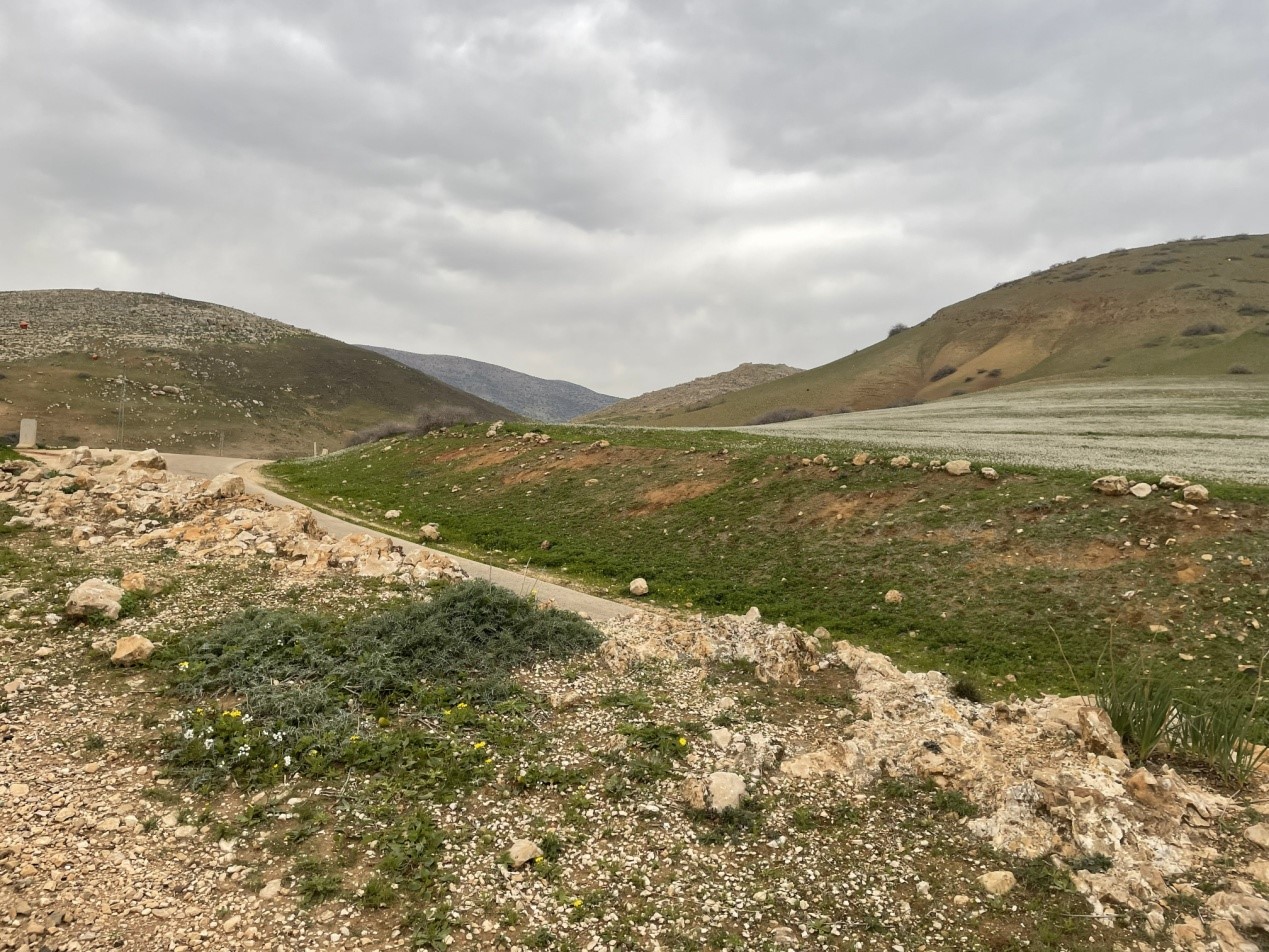
The Valley is green and overcast, with light, scattered drizzle.
The equipment (clothes, toys) in the car will be distributed to the families we meet—one in Ein al-Hilweh, from there we will continue to Hammam al-Malih to accompany a family this morning.
The settlers are already present in the area north of Tayasir Road. Hammam lies to the south. This morning they are building a fence.
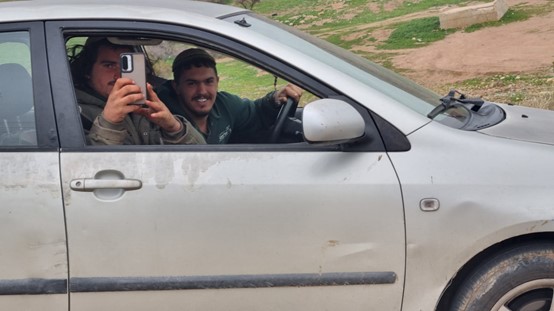
About nine settlers, a tractor, and a vehicle with trailers and construction equipment. They are coming from two new outposts (one close to Hammam across the road, and the other near the Tayasir checkpoint).
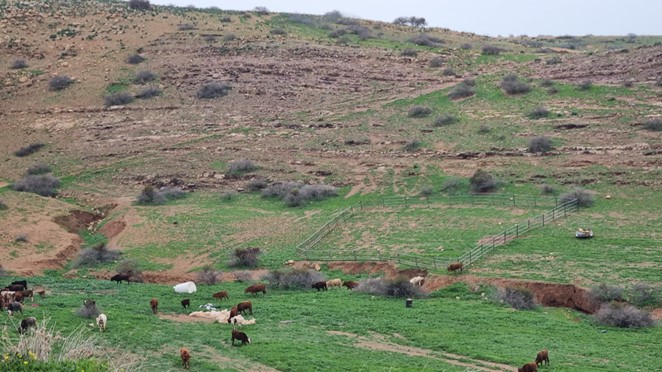
Within a few hours the area is already fenced and from now on will be used as an overnight enclosure for the settlers’ cows. During the day the cows will roam throughout the area, cross the road, and reach Hammam and Mita. We will travel from Mita to Hammam to show a presence.
Military jeeps drive along the road throughout the day—with or without a connection to events; it’s unclear. Settlers and cows come from the outposts into the area and move between Hammam, Mita, and the fence-building site.
All of this happens in broad daylight. All intentions are openly displayed: “So you know—this is ours, and this is how it’s going to be.”
The local residents do not go out to graze at all and are completely focused on this event. In Hammam only the parents and one son are present; the others prefer not to be there.
It is important to note that the entire area belongs to the Greek Orthodox Patriarchate according to records from the Mandate period (and even earlier). The Palestinians have no connection with them and no land registry (tabu), so in practice they have no way to fight this encroachment into their area.
During the day, as part of our protective presence in Hammam al-Malih, we build connections with the adults and the very young, frightened children. We play, draw, and are given an astonishingly tasty meal. They live in a tent; to the side, neatly folded sleeping blankets, and a fire burning from twigs that the head of the household feeds to keep warm. That’s it. Another tent serves as a kitchen and a place for making cheese. In the background there is a brick house they began to build, and the settlers made sure to stop the construction. A settler known to all of us—Shai Igner or something like that—monitors the construction and sabotages it with the help of the army.
We saw the settlers’ herd that we encountered in the morning in Mita. The two settlers who were with it returned to the new fence area after we arrived there; when we went down to Hammam, they went back to Mita.
In short, we played ping-pong with them throughout the day. In the afternoon we met the settler and the cows on the road; when he saw us, he understood, hid his face, and took the cows toward the fence.
This whole, perhaps boring, story simply illustrates how impossible the situation is. There is not enough protection for the shepherds, and the day is not far off when they will break—although they have nowhere to go.
Location Description
'Ein al-Hilwe
See all reports for this place-
Ein al-Hilwe is a natural spring and a Palestinian grazing area in the Jordan Valley that was used by the Palestinian shepherd communities for watering their flocks and for daily use. As of 2021, settlers from the Maskyot settlement took control of the spring: they fenced it off, built a wading pool and a mikveh, and installed flags and recreational facilities.
Palestinians are effectively denied access to the spring, and are forced to make do with running water in a remote wadi or, when the road is blocked, buy water from vendors at high prices.
The spring is located in the heart of an area where illegal outposts are being established, as part of a broader trend of pushing Palestinian communities away by denying them access to essential resources. Neighboring communities such as Umm Jamal and Khirbet Samra have already left due to the pressure.
Over the years, MachsomWatch members have reported arrests on false claims by settlers, harassment and violence, including damage to herds, intrusion into homes, and the intimidation of children. MachsomWatch volunteers participate in a protective presence in areas around the spring to prevent harassment of shepherds due to the presence of settlers.
-
Hamam al-Maleh
See all reports for this placeTayasir CP
See all reports for this place-
Located on road 5799, It is one of the checkpoints control the passage between the northern West Bank and the Jordan Valley. For a long time, it stood empty and open, with only a sign next to it warning against entering Area A. It was adjacent to an old military camp - now everything is neglected. How much money was invested here, and how much brainwashing was done to the soldiers of Netzah Yehuda and Kfir.
Today, it is very difficult to pass there. Many delays. Often, teachers from Tubas are not allowed to pass into the Valley to villages like Ein al-Bida where the local schools are located, and there are no classes. There are additional days when the checkpoint is closed. In general, there is a wait there of about two to four hours to go towards the Valley and also to return. Many times the Palestinians are forced to use the Hamra checkpoint, which also leads into Tubas and the West Bank, but there is also a huge queue there and a long wait.
Following a deadly attack on soldiers at the nearby base in February 2025, the checkpoint was completely closed for the time being. (Updated March 2025)
-
