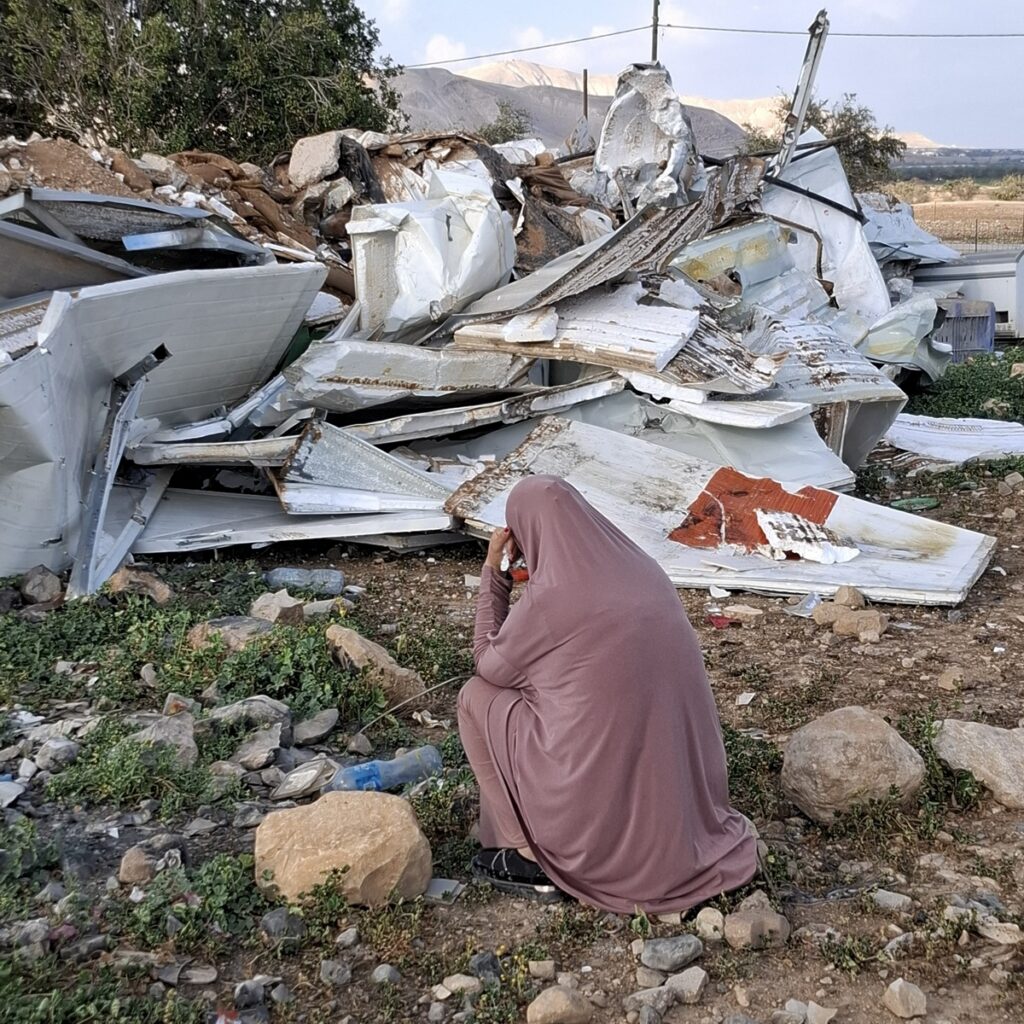
Jordan Valley - A Protective Presence in Samarra
When driving into the territories along Route 505, which is the continuation of Route 5 from Israel, it’s impossible not to notice the new appropriation going on in front of your eyes. Apparently, it’s been decided to widen the road on both sides, and in order to do so, to cut down rows of olive trees the entire length of the road. The Palestinians we met there said that the army had told the villagers to take the felled trees and use them as firewood or something else, and not to take whole trees and replant them somewhere else.
En Al Hilwa, Khalet Makhul, and Samra: We brought goods to the families, mainly food packages, courtesy of Nava (who gets them from a family that collects food for the Palestinians). Finally, we stopped at Samra as a protective presence. We’ve already become part of the villagers’ family. They wait for us on Thursdays, like people waiting for the welcome first rains. The children are already in the “community center” and the flocks are at the ready. And the adults are asking themselves where we’ll go first. We’ve set a routine so that each time we alternate between the two families, once with one family in the morning and the other in the afternoon, and the following week, it’s the other way round. We have to show fairness. But reality gets in the way of plans and sometimes it gets messed up, causing a commotion. That’s what happened today. It all worked out in the end. The question was, where would we eat maklouba – no doubt a serious matter.
The shepherds went out to pasture. Two youngsters asked us to take them to Bardala to buy gas for cooking and provisions from the supermarket that would last for a while. And then the “community center” opened. We learned the Hebrew letters enthusiastically. We learned to speak quietly. And we finished with a spelling game and English words. Once again, I swore I’d never be a teacher in this life or the next. But it was wonderful.
From time to time, we hear the sound of an ATV and everyone gets up and looks to see where the noise is coming from. They follow the route to see where it’s going and imagine who’ll be harassed this time.
Most of our day is spent on the connection we’ve made with the families, joint activity, conversations about the difficulties and the happy moments, laughter, and games. We all agree that it could be possible for everything to be different, if only the intentions could move away from guns towards letting everyone live. Together or separately.
At the end of the day, we were at Khalet Makhul to check everything was in order.
Location Description
Bardala
See all reports for this place-
A relatively large township in Area B in the northern part of the Valley, home to about 300 families of farmers and other families. The villages of Bardala and Kardala, located nearby, sit on a very large reservoir of groundwater. In 1968, an "agreement" was signed between the occupier (represented by the Mekorot water company) and three villages (including Ein al-Bida), stipulating that in exchange for their agreement to stop pumping water their wells, Mekorot would establish its own pumping stations on their land and allocate them a "generous" quota of waterinfo-iconfor at the cost of pumping only (a few cents per cubic meter). Over the years, Mekorot violated the agreement, decreased the quotas drastically (from 240 cubic meters per hour to 100 and sometimes 40 cubic meters), and quadrupled the price. The residents refused to pay, and the PA paid for them. In late 2024, the army began paving a new road around Karbala and Bardala. According to the plan, the road will surround and Karbala from the south and Bardala from north and west, and finally turn east to Highway 90. The road will completely surround Bardala on all sides, cutting off the village from all its lands and imprisoning the village within its boundaries. The residents will no longer be able to come and work their lands freely. Our friends were unable to see the roadworks because the army had set up a checkpoint on the road to the new route.
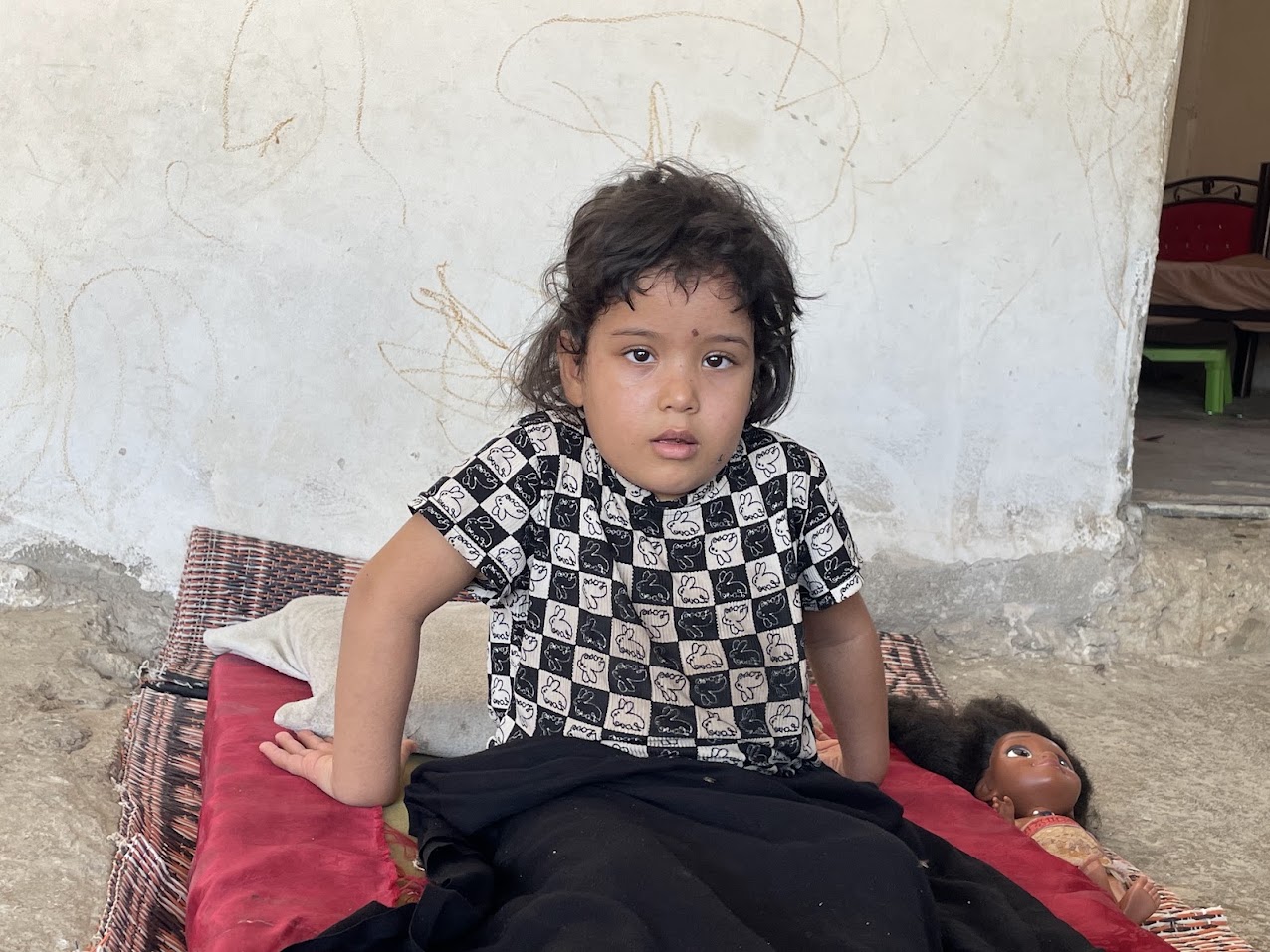 Rachel AfekAug-13-2026Jiftlik: A. was born with spina bifida
-
Khalet Makhul
See all reports for this place-
Khalet Makhul
A small settlement of a shepherd community located on the way to the settlement of Hemdat. Two nearby outposts make life miserable for the Palestinians, who make a living from grazing, and the army backs the settlers. As a result, the possible grazing areas are getting smaller.
The local children attend school in the settlement of Ein Al-Beida. Long lines of 3 hours sometimes stretch out at the Hamra and Tayasir checkpoints leading to the town of Tubas, making it difficult to get water, supplies, and sell the cheese, milk, and meat that the residents produce for their living.
Following a deadly attack at the Tayasir checkpoint in February 2025, the checkpoint was closed completely for the time being.
(Updated March 2025)
-