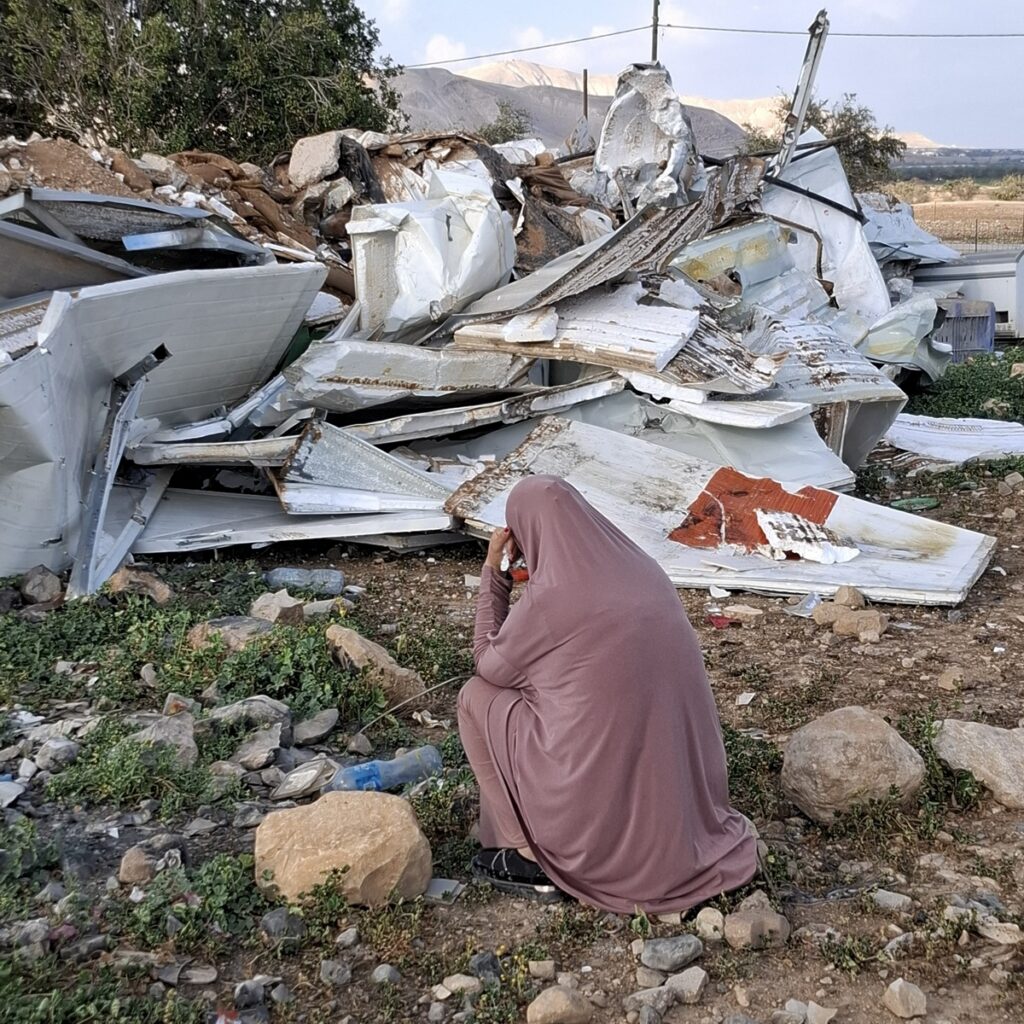
Mufaqara - Demolition orders were served on the entire village
The small village of Mufaqara is situated between A-Tuwani and the Avigail West outpost. Today, it is surrounded on all sides by “farms”—outposts inhabited by Hilltop Youth. The village is home to 12 families, comprising approximately 200 people.
Mufaqara is part of Masafer Yatta, a cluster of villages whose residents have lived under the threat of demolition and expulsion for many years. It is an extremely poor village that has long suffered from demolitions and demolition orders, as well as harassment by the settlers who surround it on all sides.
The village children travel by organized transport to the school in A-Tuwani. Medical services are available in Yatta, which is not particularly close. Once a week, a very basic clinic operates in A-Tuwani, run by Physicians for Human Rights, Médecins Sans Frontières, and the Palestinian Authority.
We came to the village following the delivery of demolition orders to all its residents, including Fadel, who lives with his extended family in three small rooms built above a well-maintained cave.
Fadel is a shepherd. Until 2023, he owned a flock of 200 sheep. Today, following the closure imposed on the West Bank and continued settler harassment, much of the flock has been sold or slaughtered to provide food for the family. He now has only about 70–80 sheep remaining. Since the settlers prevent him from grazing his flock on land outside the village, he is forced to buy fodder—with money that, as he says, he simply does not have.
In addition to raising sheep, Fadel used to cultivate olive trees and vegetable plots. All of these were destroyed during settler incursions. The residents surrounded the village with barbed-wire fences in an attempt to protect themselves. Nevertheless, considerable damage is caused almost daily: water pipes and electricity cables are disconnected, the road leading to the village is blocked, and stones are thrown at the residents. They are also subjected to curses and verbal abuse, both day and night.
Fadel told us that the settlers from Avigail are aged 17 and older, while the new “farms” send even younger boys.
As for the demolition orders, the family was given one month to file an appeal. The organization Haqel is providing them with legal assistance, among other forms of support. However, to submit the appeal, the family must deposit NIS 8,000 as a court guarantee. In a village where everyone has been unemployed since October 7, 2023, it is unclear how they will manage to raise the money.
This is only one story among very many—far too many—throughout the West Bank.
In addition to some clothing, we brought a generous donation of vegetables, which was gratefully received. It should be noted that Muhammad sets out very early, before the shift begins, to collect these donations—in addition to the hours he devotes to the shift itself.
Location Description
A-Sawiya
See all reports for this place-
A-Sawiya
Located about 18 km south of Nablus.
The population of the village was 2,904 in 2016. In 1983, about 400 dunams, on a hill about a kilometer south of the village, were declared "state lands" and the settlement of Ali was established on them. Over the years, the settlement has expanded to additional lands privately owned by the villagers, and nearby villages in an area of about 1,000 dunams. Only in 2013 was an outline plan prepared for Ali, in which hundreds of illegal structures were approved in its territory. In 2017, a synagogue was built in the Ali settlement, in violation of the law without permits, outside the legal territory of the settlement and on private Palestinian land of a-Sawiya residents.
Over the years, the settlement has expanded to additional lands privately owned by the villagers, and nearby villages in an area of about 1,000 dunams. Only in 2013 was an outline plan prepared for Ali, in which hundreds of illegal structures were approved in its territory. , Outside the legal territory of the settlement and on private Palestinian land of the residents of a-Sawiyah.
Checkpoint Watch companies have been in contact with the village since 2007. They document the checkpoints, the settlers' violence, the sewage problems flowing from the nearby settlements and outposts, and even held knitting and English lessons with women in the village. Even during the Corona we were in telephone contact to help the plight of the residents.
-
Mesafer Yatta
See all reports for this place-
This is happening in Fire Area 918 in the South Hebron Hills
On the eve of Remembrance Day (the day before Israel Independence Day), 4th May, 2022, the Israeli High Court decided on the transfer and expulsion of residents from 8 Palestinian communities in the area of Masafar Yata in the South Hebron Hills. Residents of the villages have been living under the threat of demolition, evacuation and expropriation since the IDF issued evacuation orders in 1999 based on the 1980s proclamation of their area of residence as a firing zone for IDF drills. None of the nearby settlements were included in this zone. The Masafer Yata Palestinian villages retain a special lifestyle and ancient agricultural culture. They also posess a clear historical documentation that testifies to a Palestinian settlement in this area, generations before the establishment of Israel, long ago in the caves and at later times outside them.
Evacuating residents from the area means destroying these historic villages and leaving entire families (about 2,000 people, children, adults, and the elderly) homeless. This is contrary to international law.
In June 2022, a firing drill started, and life became harder.
-
South Hebron Hills
See all reports for this place-
South Hebron Hills
South Hebron Hills is a large area in the West Bank's southern part.
Yatta is a major city in this area: right in the border zone between the fertile region of Hebron and its surroundings and the desert of the Hebron Hills. Yatta has about 64,000 inhabitants.
The surrounding villages are called Masafer Yatta (Yatta's daughter villages). Their inhabitants subsist on livestock and agriculture. Agriculture is possible only in small plots, especially near streams. Most of the area consists of rocky terraces.Since the beginning of the 1980s, many settlements have been established on the agricultural land cultivated by the Palestinians in the South Hebron Hills region: Carmel, Maon, Susia, Masadot Yehuda, Othniel, and more. Since the settlements were established and Palestinians cultivation areas have been reduced; the residents of the South Hebron Hills have been suffering from harassment by the settlers. Attempts to evict and demolish houses have continued, along with withholding water and electricity. The military and police usually refrain from intervening in violent incidents between settlers and Palestinians do not enforce the law when it comes to the investigation of extensive violent Jewish settlers. The harassment in the South Hebron Hills includes attacking and attempting to burn residential tents, harassing dogs, harming herds, and preventing access to pastures.
There are several checkpoints in the South Hebron Hills, on Routes 317 and 60. In most of them, no military presence is apparent, but rather an array of pillboxes monitor the villages. Roadblocks are frequently set up according to the settlers and the army's needs. These are located at the Zif Junction, the Dura-al Fawwar crossing, and the Sheep Junction at the southern entrance to Hebron.
Updated April 2022
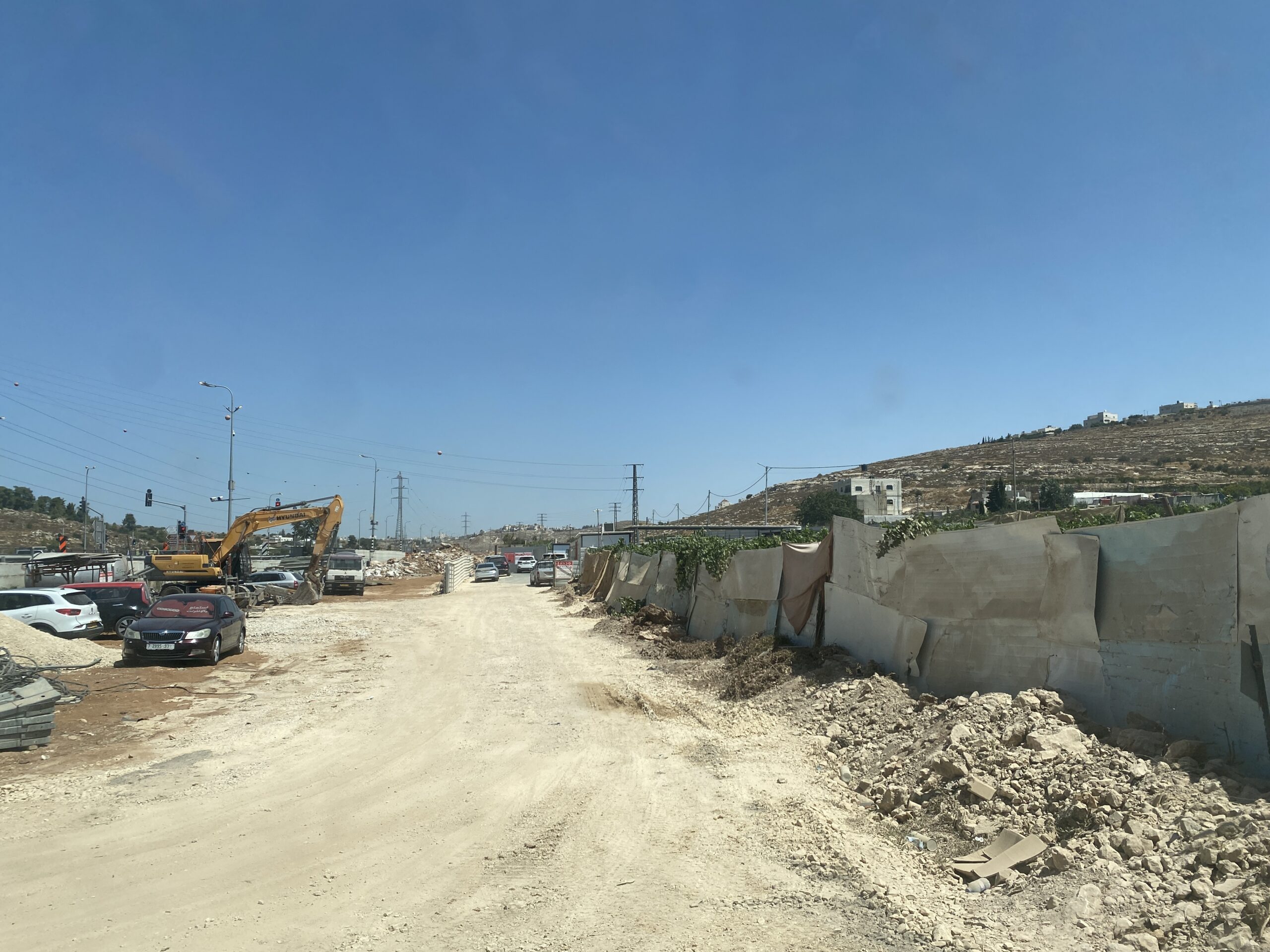 Yael ZoranAug-20-2026Ata's vineyard on the right, cut down to make way for the expansion of Highway 60
-