
Bethlehem, Etzion DCL, Jab’ah Checkpoint . Tue 23.12.08, Afternoon
Etzion DCL: there were about twenty men and six women in the waiting hall. The men were waiting for magnetic cards and the women mainly for travel permits for Christmas. Four of the people waiting didn’t have numbers and after we made some telephone calls all of them were quickly allowed in. The women all received permits valid for a month.
Jaba (Lil) Checkpoint: we received a request from a laborer who lives in the village of Tsurif (on road No 354) and works in Beit Shemesh. His travel permit requires him to go through Tarqumia, but this route very much lengthens his journey and he wastes a lot of travel time each morning and evening on his way to and from his work. He told us that everyone who receives a permit from the Etzion DCL can pass through the Jab’ah checkpoint, and only those whose permit has been issued in the Hebron DCL are discriminated against. Our efforts to help him came up against a brick wall, and we learned that the checkpoint is for Israelis only. This information did not fit-in with what we had heard from the laborer and we decided visit the place. The checkpoint is situated on the Green Line, on road No 367 a bit before the intersection with road No 357. Only a few Palestinians are given a special permit to pass through it. Usually the permit is issued to employers who can pick-up all their workers at the same meeting point. In the past there used to be access by car to the road from the village of Tsurif, but today there is a checkpoint on the outskirts of the village and the road is lined with concrete barriers on each side. The few who have permits climb on foot to the top of a small hill and wait for their employer on the road. The soldiers at the checkpoint, who were not well informed, were pleasant to us and ready to answer our questions. We heard that in the morning there is quite a lot of traffic through the checkpoint, but later in the day very little. “Do you check them all ?” we asked, “yes, because maybe infiltrators will try to enter Israel, and then what will people like you who object to the checkpoints say ? Don’t you understand how dangerous it is ? Do you want to be killed ?”. “Not exactly”, I answered, “actually I prefer to die in my bed and not in an explosion”. My answer greatly amused the soldiers. The checkpoint is run jointly by a checkpoint contractor and the army. After we had visited the place, we phoned the Palestinian who had requested our help and told him what we had learned. Then it became evident that he works in Israel but he is the only Palestinian who works for his employer, and all the others are Israelis. He told us that he had requested our help because he had heard that “ you have people who know how to open all the checkpoints for us to pass through”. We were pleased to hear that we had such a good reputation but were sorry that it wasn’t entirely justified !
Checkpoint 300 – Bethlehem: a large red sign , put there by the Tourism Ministry welcomes everyone “ May you have a happy festival and a good new year”. We wondered – what could be good in this situation and what could make everyone happy. Many laborers were returning from work. They had already prepared their permits for inspection, immediately placed their hand on the inspection machine, and hurried out of the checkpoint. An employee of the security company stood under a no-smoking sign and smoked at his ease. From time to time he went to the checkpoint entry to make sure that everyone was standing in a straight line and were not pushing, and he did this in a in a rough and aggressive manner. We tried to call him to order about his smoking, and you can guess his answer “I am forbidden to leave my post, so how do you want me to be able to smoke ?. “Maybe you shouldn’t smoke – if a Palestinian smoked he would immediately be punished, correct ?” “what business of yours is it ? everything is always bad ? you are all mean women “. What could I say ?. We left in a sad mood.
Bethlehem (300)
See all reports for this place-
Located adjacent to the Separation Wall ("Jerusalem Wrap") at the north entrance to Bethlehem, this checkpoint cuts off Bethlehem and the entire West Bank from East Jerusalem, with all the serious implications for health services, trade, education, work and the fabric of life. The checkpoint is manned by the Border police and private security companies. It is an extensive infrastructure barrier and is designated as a border terminal, open 24 hours a day for foreign tourists. Israeli passport holders are not allowed to pass to Bethlehem, and Palestinian residents are not allowed to enter Jerusalem, except those with entry permits to Israel and East Jerusalem residents. Israeli buses are allowed to travel to Bethlehem only through this checkpoint.The checkpoint, which demonstrated harsh conditions of crowding and extreme passage delays for years, started employing advanced electronic identification posts and has upgraded its gates' system as of the middle of 2019 - and conditions improved.Adjacent to the checkpoint, in an enclosure between high walls and another passage, is the historic Rachel's Tomb, which is now embedded within a concrete fortified building. It contains prayer and study complexes for Jews only, as well as a residential complex. updated November 2019 .
-
Etzion area / Gush Etzion
See all reports for this place-
Etzion Area / Gush Etzion is a group of Jewish settlements south of Jerusalem, between Bethlehem and Hebron. Attempts at Jewish settlement in the area began in 1927. 4 kibbutzim were established between 1943–1947 but were destroyed during the Battle of Gush Etzion during the War of Independence in 1948.
After the 1967 Six Day War, Jewish settlement in Gush Etzion was renewed, and since then another 14 settlements and 10 outposts have been established. According to the info-icon of the Civil Administration, Gush Etzion is now 7 times larger than its historic area, and the Jewish lands purchased before the evacuation in 1948 constitute less than 15% of the large settlement bloc of the Gush Etzion Council today, which Israel demands to annex in the permanent agreement with the Palestinians.

The Palestinian localities in the area are concentrated in enclaves, the largest of which is in the east - the Bethlehem area, which includes Beit Jala, al-Khader, Beit Sahur and more. To the west are settlements such as Husan, Nahalin, Al Jaba'a and Batir and small and ancient agricultural villages such as Shushahala, Khalat Sakaria and more. These are scattered on the last agricultural land left by the Palestinians in the area. In the 2000s, many illegal outposts sprang up, taking over private Palestinian land under the auspices of the administration and the army, trying in an extremely violent way to evict farmers from their land and homes and thus expand the settlements. Watch the video about the harsh reality in the Shushalah and Makam Nabi Daniel area.
During the 1990s, the new Road 60, most of which is forbidden to Palestinian traffic, was paved, and a separation wall was built next to it. Access to many of the Palestinian villages and agricultural lands in the area was blocked, and a buffer was created between the villages themselves as well as between them and the lands they owned. The layout of the settlements and the network of roads and checkpoints in the entire Etzion area indicate the intention to create a territorial and transportation continuum between Gush Etzion and Jerusalem.
Machsom Watch members have been active in the for many years. We talk to the Palestinians at intersections, DCOs, villages and Makamim (ancient Palestinian heritage sites) and try to publicize the looting, apartheid and violence they are experiencing. You can read about their activities in the attached reports.
in 2021, after many years of negotiations, the Civil Administration issued a new plan for the central village of Khirbet Bet Zakariya, including construction permits. The adjacent settlers protestated and asked the minister of defence to cancel the permits. Our members are in contact with the village and are trying to involve other organiztions and use public opinion and to stop this cancelation.
-
-
Etzion DCO
See all reports for this place-
serves residents of Bethlehem and surrounding villages who need magnetic cards, work permits for Israel, permits for one-time entry for religious or health reasons, various police permits, etc.
-
Jab'ah CP / The LamedHey crossing
See all reports for this place-
Jab'ah CP / The LamedHey crossing
The checkpoint is on the green line, on road 367 leading from Gush Etzion to Emek HaElah - shortly before its intersection with road 357. It is manned by the army and the crossings authority. Active 24 hours. According to our inspection, the checkpoint is for Israelis only in one lane for private cars and one for public vehicles. But according to our investigation, individual Palestinians receive a special permit that allows them to pass by car in this place. Generally, the permit is given to employers who employ more than one individual employee and who can all be collected from the same meeting point. In the past there was access by car to this road from the village of Surif. Today there is a checkpoint at the edge of the village and in the tundas on the sides of the road, up a small hill. The few who have the permits climb on foot up the small hill and wait on the road for employers.
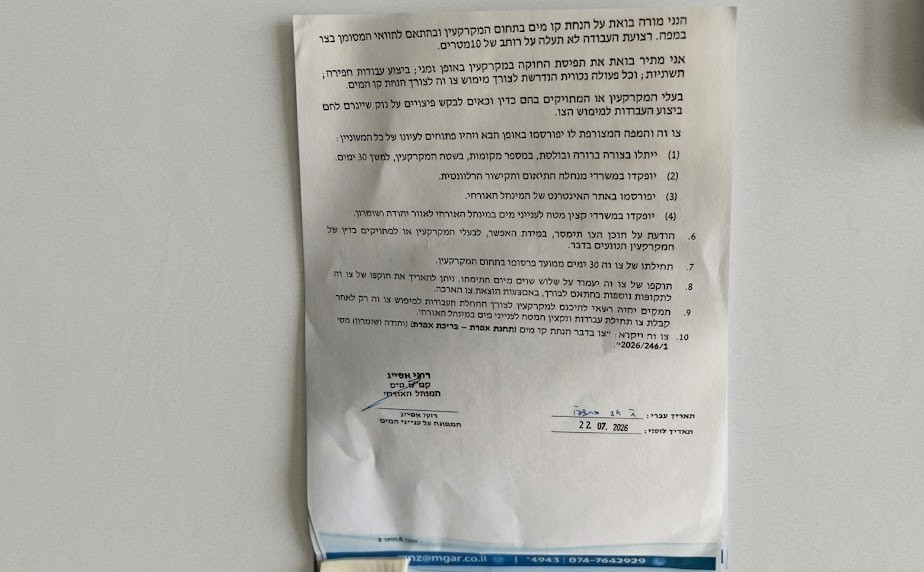 Natanya GinsburgAug-10-2026Gush Etzion. Water Line Laying Order
-
