
‘Anabta, Eyal, Irtah, Tue 5.5.09, Afternoon

15:00
When we arrive at the Anabta
checkpoint, we see four open lanes. The cars drive through without delay.
Quite euphoric we get out of the car looking forward to a “pleasant”
shift, but then… The soldier, Chen Sodry, who doesn’t approve of
Zehava approaching a car and glancing into its trunk while, suspiciously,
he is checking some Coca-Cola bottles, says: “Either you move back
or I close the checkpoint.”
15:10
The checkpoint closes. All the
soldiers at the northern and southern checkpoints gather around us,
as an ugly argument is taking place. In the meantime two lines of cars,
one into and one out of Tulkarm, are formed. In the end we reach a
compromise with the commander. We move backwards 2 meters and the checkpoint
opens.
15:45
We leave for Sha’ar Efryim.
The line of cars goes on all the way to the junction.
The “Te’enim Gate”
Instead of going to school seven-year-old
children are standing along the road selling all kinds of goods.
16:00
Sha’ar Efrayim
A line of about 60-70 people
is moving forwards at a steady pace. We measure the time for a man in
a red shirt. After five minutes we see him walking towards the exit.
16:15
The number of people is growing.
One more checkpoint is opened.
16:25
We measure the time for a man
with a computer. It takes him five minutes to get through.
We feel uncomfortable standing
here. People keep talking to us and complaining, “Come at four in
the morning, then you will see how bad things are. There are no toilets,
no covers from the sun or the rain. We keep waiting here from one o’clock
at night. We have no life.
17:00
The Eyal checkpoint
Here the number of people waiting
in line is bigger. We measure the time for a worker wearing red clothes.:
20 minutes. It is hard to count the people, about 190. Everybody is
complaining about what goes on in the morning. They claim that a month
ago it was not like this.
A man tells us that on last Thursday
a Jewish contractor, who had been waiting for his workers for a long
time, wanted to enter the checkpoint and talk to the soldiers. He told
them that he had also been a soldier and that they should not shout
at him. When he returned to his car the soldiers followed him and beat
him.
Another man tells us that the
last few days people from B’Tselem (The Israeli Information Center
for Human Rights in the Occupied Territories) have been coming, so the
soldiers haven’t been throwing smoke grenades.
17:45
We see that the lines are moving
forward at a good pace, so we intend to leave quite soon. However, families
of prisoners with women and children begin to arrive. Each time it takes
a long time for the turnstile to open, and it is getting crowded. It
has been 15 minutes since the turnstile opened. The situation is getting
intolerable. One woman faints. I try to give her water over the fence.
I call the IDF Humanitarian Center. Maybe it will help. The turnstile
opens and the families of the prisoners are let through.
Once again the turnstile is closed.
It is terribly crowded. I also notice that the number of people being
let through is very small. That is why so many people are gathered at
the entrance. The reason is obvious – the checking is very slow.
A soldier comes out telling us
that if we want to help the Palestinians we should keep the line in
order, and if not he will call for some soldiers to really give everybody
a hard time.
I count the people waiting in
line: about 250
18:15
I call the IDF Humanitarian Center
once more and the turnstile opens. It gets less crowded at the entrance.
The checking inside is faster. I measure the time for a man in a black
sweater- 25 minutes to get through.
The soldiers check five people
in a minute.
I am told that a third checkpoint
has been opened. The line disappears quickly.
18:50
There is no line. No more people
arrive. Inside it is announced that permits will be taken from people
arriving after 19:00.
We drive home feeling as if we
have been on the slave market. Just think of it, many people envy those
lucky ones with their permits to work in Israel.
'Anabta CP
See all reports for this place-
'Anabta CP
The checkpoint is located south of the village of 'Anabta, at the intersection of Road 60 (leading to Nablus at the entrance to Area A), with Road (57, 557, 5576) facing west towards the Einav settlement and the checkpoint at the exit from the West Bank - Figs checkpoint. Until 2010 we used to watch the intersection and report the long columns created due to a slow inspection of the vehicles in both directions.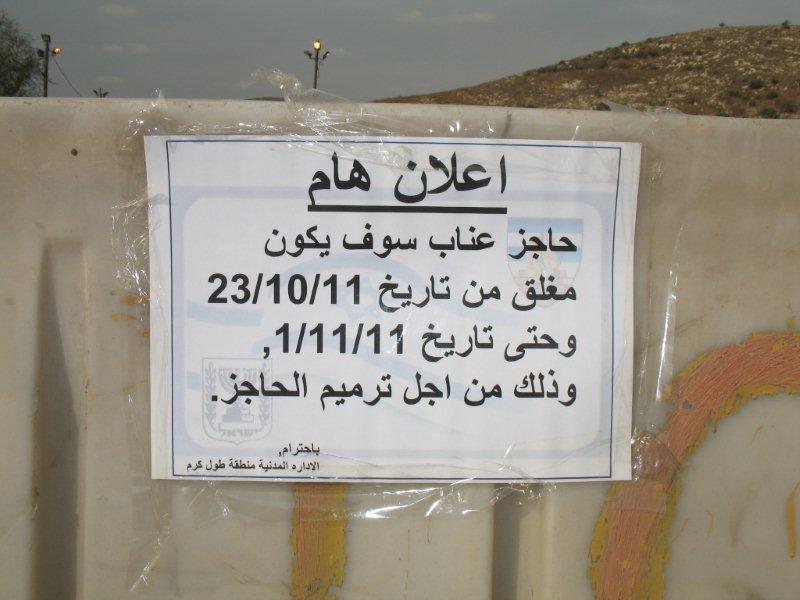 Oct-28-2011Anabta checkpoint 24.10.11
-
Eyal Checkpoint / Crossing
See all reports for this place-
Eyal Checkpoint is intended for pedestrians and Palestinians only. This is the main barrier for workers to cross from the center of the West Bank. Workers with a work permit to enter Israel can pass through it for trade, medicine, and visiting prisoners. The checkpoint was built on the Green Line north of Qalqilya in the separation barrier that surrounds the city. The checkpoint began operating in 2004 by the military. Opening hours on weekdays from 04:00 to 19:00. We started holding shifts there in 2007. We arrived at the checkpoint before it opened at 4 in the morning. We reported on the difficult conditions and the long and cramped queues of workers who must continue their journey by commuting to work throughout Israel. At the end of June 2009, the checkpoint was operated by a civil security company, The transit time has been gradually shortened, today it is faster, but the Palestinians still have to arrive very early to make it to the transportation. Usually, about 15,000 people pass through.
-
Irtah (Sha'ar Efrayim)
See all reports for this place-
The checkpoint is for Palestinians only. It is the main barrier to the passage of workers from the northern West Bank to Israel. Workers with a permit to work in Israel and also for trade (with appropriate permissions), medicine, and visiting prisoners. One can cross the checkpoint only on foot. The checkpoint is located north of Road 557 and south of Tulkarm. Operated by a civil security company, opening hours: between 4:00 and 19:00 on weekdays. As members of Machsom Watch, we began our shifts to this location in 2007. We arrived before it opened at 4 in the morning and report since, on the harsh conditions and the long and crowded queues of workers. The workers who pass by continue their journey by transportation to work throughout Israel. In the first period of its activity, about 3,000 and then 5,000 people passed through this checkpoint every day. Due to the small number of checking points and arbitrary delays for long periods of time in the "rooms", workers feared losing their transportation. Hence workers leave their homes at 2:30 at night to be among the first. Today, 15,000 pass and the transition is faster. Workers are still leaving their homes very early to get past the checkpoint at 7 p.m. In an adjacent compound, there is a terminal for the transfer of goods on a commercial scale, using the back-to-back method.
-