
Eyal Crossing, ‘Anabta, ‘Azzun ‘Atma, Beit Iba, Deir Sharaf, Jubara (Kafriat), Shave Shomron, Te’enim Crossing, Sun 12.7.09, Af
Summary
What is the reality behind the pleasant calm and stillness of the OPT minus many of the infamous checkpoints and roadblocks which made day-to-day life — through violation of the freedom of movement — so burdensome and time-consuming for Palestinians? There's a continuing grip over life in the OPT, a separation barrier which engenders not only a dividing up but a deluge of daily degradation of ordinary people seeking to go about their everyday lives and a reality from which we, as MachsomWatchers, checkpoint monitors and observers, cannot turn our eyes. The dignity and human rights of another people, our neighbors, is at stake and the pleasant quietitude, as often impressed on us by the Israeli media is, in the long run, ruinous to the future image and character of this country.
Around Qalqiliya
14:15 Ras Atiya
Habla and Ras Atiya are isolated from their "mother" city, Qalqiliya. Why? They are situated on the separation barrier whose aim is not only to encompass surrounding Israeli colonies but, as we saw today, to extend them more and more. On the way up to Alfei Menashe from Route 555, there's a brand new poster advertising new apartments: yes, in this day and age! But the advertisement on the side of the main highway into the OPT is not the only new object to see. As we climb the steep hills above the plant nurseries of Habla, we come upon a brand new, blindingly white, retaining wall and, one after the other, huge trucks bearing rocks and bringing or taking away material which is essential for construction of a new infrastructure, we must assume, for the "natural" growth of the nearest settlement/colony.
14:15 — we move on to Ras Atiya where the soldiers have no objection to us crossing the separation barrier and heading on into the village. Twenty meters from the checkpoint is a school on whose wall is written, "Let me learn peaceful" (in English) and "Stop killing children." A youngish woman is returning home from working in Jajulya (not far away as the crow flies) but light years in distance and hurdles for a Palestinian trying to eke out a living to feed six children (via Eyal as well as Ras Atiya) .
On exiting Ras Atiya, we take some wrong turns and drive on well paved beautiful roads beyond Azzun Atme (we're on the other side from where MW usually goes) and drive in the beautiful hilly countryside through sleepy villages passing curious and friendly children on holiday from school, all the while trying to find our way back to Route 555! Having driven through "forests" of olive trees, we land up in Biddya with its broad and straight main street and dwarf palm trees and finally make our way back to Funduk through Emanuel.
Back to the reality of Occupation, we're greeted by a rolling checkpoint, a jeep at the junction with Routes 555 and 5066, and two border police either harassing or joking with a teenager on the other side of the road as a truck which has obviously already been stopped, turns around in the middle of the roadway and heads back in the direction from whence it came. .
18:00 Eyal
Few workers, all men, going in, and a stream observed leaving the terminal building. We follow a few men from the time they approach the terminal for the checking procedure until they are seen outside the building: never more than two minutes.
Zufin gate
Open, little traffic, but many settler cars returning "home." No Palestinians at the gate.
18:30 Habla
The peaceful nature of the nurseries belies what goes on after dark, long after watchful observers are at home. Just a few nights ago, a large group of soldiers, wearing night vision glasses, burst through the peace and quiet of the night at Habla, seeking, so they say, youngsters who were "trying to get into Israel," and they were there until 2:00 a.m.! They trampled over everything, made a ruckus and were rude and insolent too, to the elderly father of one of the nursery owners who, in daylight hours was not allowed the special privilege to get through the line — to sit and wait — at CP 109. He must be treated "equally" (badly) and had to stand in line.
Around Nablus
15:50 Deir Sharaf
We have been told that entry to Nablus is open to Israelis today, and that we should try to go through the checkpoint with the car. We do so! The commander, a corporal, tells that it's true that usually it's only Saturdays, and that although coming out of Nablus is fine, going in is another problem…"You can come out, but you can't go in" Yet, today, "I'll let you, but I need to see your IDs." He is puzzled by the Hebrew nomenclature (Mamlacha Meuchedet) for the UK! "What on earth country is that?" he asks.
Traffic flows freely in the direction of Nablus, and it's quite heavy.
Nablus itself, we learn, is more or less left alone by the IDF, other than incursions once or twice a month (different from nightly incursions of just a short while ago). The Palestinian Police are effective, but the economy is very weak.
Deir Sharaf now boasts a Nablus bakery which has the most delectable "knafeh," the dessert for which Nablus is famous. We sample it and make out way to the defunct Beit Iba. It's hard to believe today what once went on there. The kiosks are shuttered, there are no taxis awaiting pedestrians, and an endless stream of traffic flows into and out of the city. We venture a few more kilometers to the village of Beit Iba itself, furniture showrooms and workshops on both sides of the road.
16:55 Shavei Shomron
Just to remind us of a real checkpoint, we drive up Route 60 to the checkpoint at the back end of Shavei Shomron. Soldiers tell us we can't be there, and when we ask how come Israeli Jews were there less than a week ago (on the way to bury books in Homesh) the soldier replies, "I wasn't there then" (as if laws are dependent only on an individual's say so!) An Israeli pickup truck with a sick Palestinian in it is stopped at the checkpoint, can't proceed. We don't' see the end of this as we have been told, in no uncertain terms, to leave immediately.
Deir Sharaf
17:05 — on our return to the checkpoint at Deir Sharaf, there is a long, long line of vehicles, waiting to be checked. Within ten minutes we're in front of a soldier who asks us what we're about. We tell him that his commander told us we could cross the checkpoint. He points to two imagininary stripes on his shoulder to make sure that this was the person we meant. We ask why every vehicle is being checked. "We're looking for somebody." The work on the new road to Shavei Shomron appears to have stopped completely.
Around Tulkarm
17: 20 Anabta
Back to checkpoint reality: several hundred meters before Anabta, we're greeted by one sign after another. "Approaching checkpoint…. or "Stop, checkpoint ahead," etc. But before the road divides into four or five lanes for vehicle checking there is one huge red metal poster with lettering nearly a foot high, exclaiming "A" and then continuing in Hebrew only that "this road brings you to area A, to which entrance is forbidden to Israelis… endangering your lives ….and is an illegal act." We take note of it and of the endless stream of cars with yellow license plates approaching the checkpoint (Israeli cars): what this sign has to do with them is not clear. Somehow, it's another indicator of the rampant racism we're now accustomed to. Israeli Jews are not allowed into Area A but Palestinian Israelis – that's a different matter.
The renovated Anabta checkpoint now boasts a bigger and better lookout tower as well as its older, stubbier forerunner. As we approach the checkpoint proper, a soldier comes up to us, demanding to know who we are. He has never heard of MachsomWatch, and even after our explanation asks, "So, you're journalists?" Photos, of course, are forbidden, etc., etc.
17:45 Jubara
Not a fig tree in sight at the so-named access point to the OPT, but a long line of slowly moving vehicles. When we get to the checking post proper a military policeman comes up to us, knowing who and what MachsomWatch is, but telling us we should have gone into the other lane (which could not be seen from the end of the line). We notice that a number of Israeli vehicles, yellow license plates have been turned back from entering the OPT. Why is not clear. There are police, as usual, stationed at the entry point to the OPT. We note that the traffic light is no more at the closed gate leading up to the village of Jubara.
'Anabta CP
See all reports for this place-
'Anabta CP
The checkpoint is located south of the village of 'Anabta, at the intersection of Road 60 (leading to Nablus at the entrance to Area A), with Road (57, 557, 5576) facing west towards the Einav settlement and the checkpoint at the exit from the West Bank - Figs checkpoint. Until 2010 we used to watch the intersection and report the long columns created due to a slow inspection of the vehicles in both directions.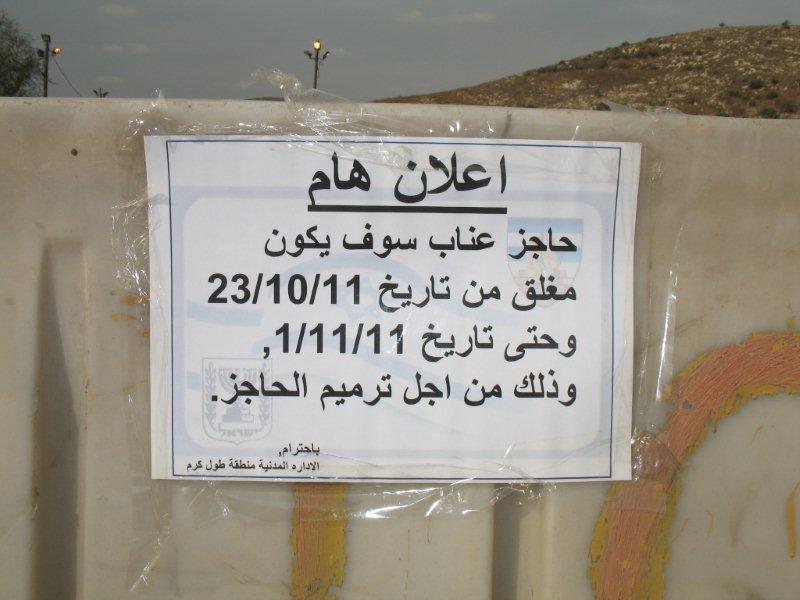 Oct-28-2011Anabta checkpoint 24.10.11
-
'Azzun 'Atma
See all reports for this place-
'Azzun 'Atma
A Palestinian village of about 1,800 residents. The settlement of Sha'arei Tikva was established on its land adjacent to it, and the settlement of Oranit was established on its agricultural lands. By 2013, the separation fence had passed through the village and a checkpoint staffed by the army allowed the residents to cross from side to side. After building a massive wall surrounding the village and some of its agricultural lands, the residents went daily for five years to their lands that remained in the Seam Zone through the Oranit agricultural checkpoint (4). Since 2018 it has only opened during the olive harvest and the farmers have to pass daily at the Beit Amin / Abu Salman checkpoint (1447), about 3 kilometers north.From a report from March 24, 2021: "The farmers from Beit Amin and Azon Atma are happy that since February 21 the Oranit checkpoint .is going to be open 3 times a day, The farmers are really developing the place."
Report from July 14, 2024: "Ornit checkpoint is closed . The Beit Amin/Abu Salman agricultural checkpoint is closed (there is no contact with the military to check if it opens rarely), the Ezbat Jaloud checkpoint was opened once a day before the war.
Updated for July 2024
 Apr-11-2019Azoun: The main entrance to village blocked now for several weeks
-
Beit Iba
See all reports for this place-
A perimeter checkpoint west of the city of Nablus. Operated from 2001 to 2009 as one of the four permanent checkpoints closing on Nablus: Beit Furik and Awarta to the east and Hawara to the south. A pedestrian-only checkpoint, where MachsomWatch volunteers were present daily for several hours in the morning and afternoon to document the thousands of Palestinians waiting for hours in long queues with no shelter in the heat or rain, to leave the district city for anywhere else in the West Bank. From March 2009, as part of the easing of the Palestinian movement in the West Bank, it was abolished, without a trace, and without any adverse change in the security situation.
 Jun-4-2014Beit-Iba checkpoint 22.04.04
-
Deir Sharaf checkpoint
See all reports for this place-
Deir Sharaf checkpoint is located west of Nablus and south of the settlement of Shavei Shomron, at the entrance to the village of Deir Sharaf on the road leading to Nablus. The checkpoint was activated in early March 2009 after the Beit Iba checkpoint was closed. Palestinians are allowed through the checkpoint , but not for Israelis. Unlike the checkpoints leading to Qalqilya and Tulkarm, crossing of Israeli Palestinians is only allowed on Saturdays.
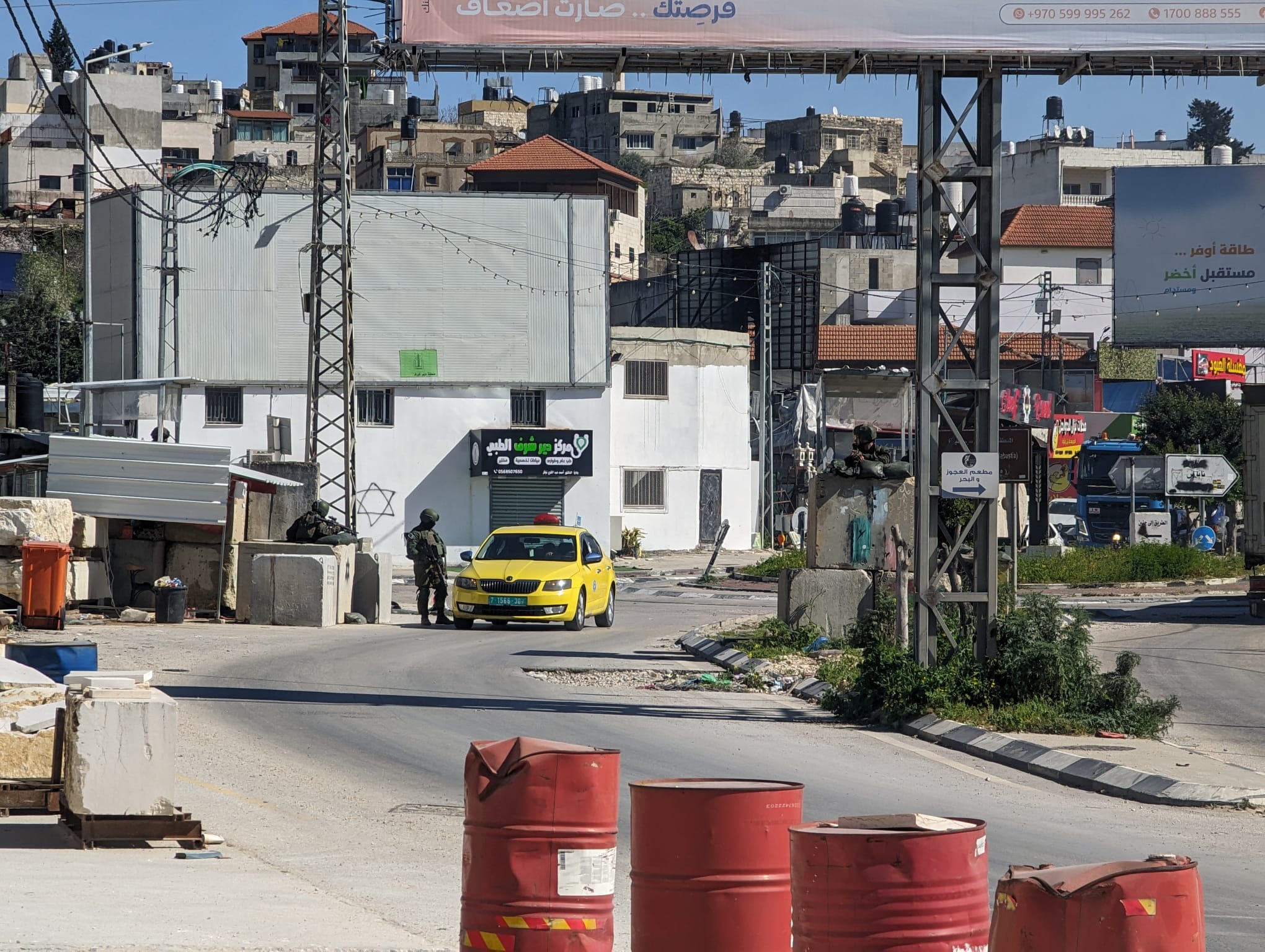 Nina SebaFeb-28-2024Deir Sharaf - the entrance to the village
-
Eyal Checkpoint / Crossing
See all reports for this place-
Eyal Checkpoint is intended for pedestrians and Palestinians only. This is the main barrier for workers to cross from the center of the West Bank. Workers with a work permit to enter Israel can pass through it for trade, medicine, and visiting prisoners. The checkpoint was built on the Green Line north of Qalqilya in the separation barrier that surrounds the city. The checkpoint began operating in 2004 by the military. Opening hours on weekdays from 04:00 to 19:00. We started holding shifts there in 2007. We arrived at the checkpoint before it opened at 4 in the morning. We reported on the difficult conditions and the long and cramped queues of workers who must continue their journey by commuting to work throughout Israel. At the end of June 2009, the checkpoint was operated by a civil security company, The transit time has been gradually shortened, today it is faster, but the Palestinians still have to arrive very early to make it to the transportation. Usually, about 15,000 people pass through.
-
Jubara (Kafriat)
See all reports for this place-
The Jabra checkpoint was on Road 557, south of Tulkarm, on the side of the Figs Pass, which is located within the Palestinian Authority (a few kilometers east of the Green Line), and serves as an entry barrier from the territories to Israel. The checkpoint to the village of Jubara, which until 2013 was in the seam area, blocked and surrounded by a fence, was intended for the passage of the family members of the house next to the checkpoint, and also for the MachsomWatch volunteers (with special permission only), on their way to checkpoint 753. on the other side of the village. The soldiers supervising the "fig crossing" also supervised the crossing at this checkpoint, in our shifts we often waited a long time until the key was found and the gate opened. The checkpoint was abolished and became part of the separation fence that was moved west following the High Court.
-
Shave Shomron Checkpoint
See all reports for this place-
The checkpoint is on Route 60 (the main road to the northern West Bank), opposite settlement. Has been blocked to Palestinians since disengagement from Gaza and northern Samaria.
-
Te'enim Crossing
See all reports for this place-
Te'enim Crossing The Figs checkpoint, located on Road 557, east of the Green Line and the Ephraim Checkpoint (Road 444), is a vehicle crossing, open 24/7 all year round. It serves the Israeli population, including those authorized to enter the Palestinian Authority. The passage of foreigners holding international passports recognized by the State of Israel is approved. In exceptional cases will the passage of a Palestinian be allowed here.
-