
Eyal Crossing, ‘Anabta, Irtah (Sha’ar Efrayim), Te’enim Crossing, Mon 15.6.09, Afternoon
Translator: Charles K.
Anabta
15:40 It seems that construction has been completed. Two pillbox towers rise by the roadside. Next to the southernmost, which is also the taller of the two, is a booth which, according to what soldiers told us a few weeks ago, will be, to the best of their knowledge, a customs point. The checkpoint is still located south of them, near the junction.
Two soldiers inspect those entering, and two others those leaving. No line at the entrance, but there’s a very long line at the exit. Traffic moves, but very slowly. We can’t see the end of the line from where we’re standing, but one of the drivers who’s come through the checkpoint reports on a huge line of vehicles. When we left at 16:00 there was still a long line.
Te’anim crossing, Jab’ara
16:10 A line in the exit lane on the right (the one for “people without permits”), not very long. It seems that documents of vehicles in all the lanes are being inspected. The soldiers ask who we are, and for IDs. We show them the Machsom Watch tags. They call out, “Women against the occupation.” They haven’t heard of us. Yona explains to them that we usually go into the village. After a minute for clarification, a polite soldier opens the gate for us. We didn’t see any delays at checkpoint 753 (the children’s gate). Two children on bicycles go from Jab’ara toward the former A-Ras checkpoint which is open to traffic.
Irtach
Dozens of laborers returning from their workday walk toward the entrance, crowding around the closed turnstile, crushed against one another. The entrance doors to the hall are wide open and we can see what’s happening. Five minutes later the turnstile opens for 5 minutes. Inside there’s only one window open for document inspection. Many laborers crowd in, much pushing and shouting. The turnstile turns and locks intermittently. Above people’s heads, in a sort of “gallery,” a security guard patrols with a gun.
16:50 An additional window opens and the pressure eases. A Palestinian comes out and tells us he waited two and a half hours, and no one came to open the turnstile. He phoned the DCO a number of times, and each time was told that someone would come and open. He said that it’s like that every day after 13:00, and it’s particularly difficult when there are people who have to get to the hospital at a certain time. We promised to find out who to contact.
A Palestinian returning from his day’s work stops next to us and thanks us. According to him, things go better when we’re there. He says that Wednesdays and Thursdays are particularly difficult, because, in addition to the workers, entire families return from visiting prisoners.
Eyal crossing
17:20 No lines at all at the entrance.
'Anabta CP
See all reports for this place-
'Anabta CP
The checkpoint is located south of the village of 'Anabta, at the intersection of Road 60 (leading to Nablus at the entrance to Area A), with Road (57, 557, 5576) facing west towards the Einav settlement and the checkpoint at the exit from the West Bank - Figs checkpoint. Until 2010 we used to watch the intersection and report the long columns created due to a slow inspection of the vehicles in both directions.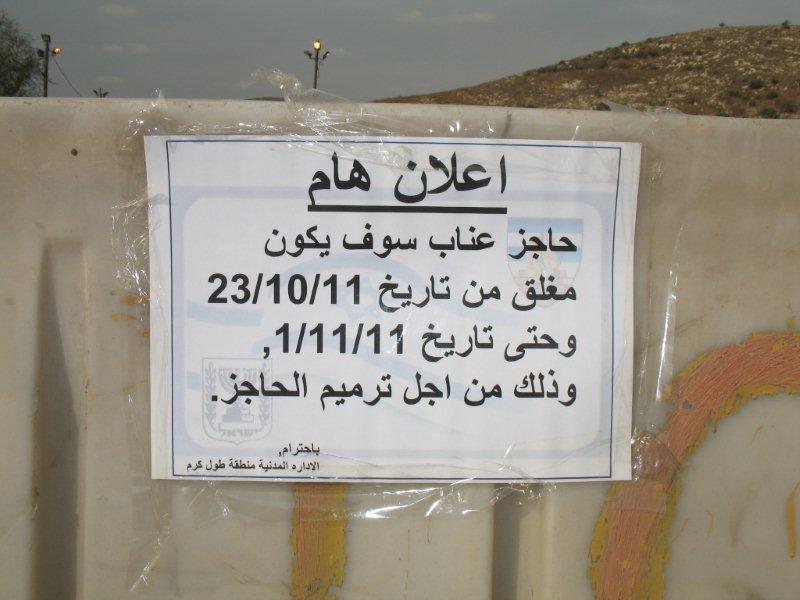 Oct-28-2011Anabta checkpoint 24.10.11
-
Eyal Checkpoint / Crossing
See all reports for this place-
Eyal Checkpoint is intended for pedestrians and Palestinians only. This is the main barrier for workers to cross from the center of the West Bank. Workers with a work permit to enter Israel can pass through it for trade, medicine, and visiting prisoners. The checkpoint was built on the Green Line north of Qalqilya in the separation barrier that surrounds the city. The checkpoint began operating in 2004 by the military. Opening hours on weekdays from 04:00 to 19:00. We started holding shifts there in 2007. We arrived at the checkpoint before it opened at 4 in the morning. We reported on the difficult conditions and the long and cramped queues of workers who must continue their journey by commuting to work throughout Israel. At the end of June 2009, the checkpoint was operated by a civil security company, The transit time has been gradually shortened, today it is faster, but the Palestinians still have to arrive very early to make it to the transportation. Usually, about 15,000 people pass through.
-
Irtah (Sha'ar Efrayim)
See all reports for this place-
The checkpoint is for Palestinians only. It is the main barrier to the passage of workers from the northern West Bank to Israel. Workers with a permit to work in Israel and also for trade (with appropriate permissions), medicine, and visiting prisoners. One can cross the checkpoint only on foot. The checkpoint is located north of Road 557 and south of Tulkarm. Operated by a civil security company, opening hours: between 4:00 and 19:00 on weekdays. As members of Machsom Watch, we began our shifts to this location in 2007. We arrived before it opened at 4 in the morning and report since, on the harsh conditions and the long and crowded queues of workers. The workers who pass by continue their journey by transportation to work throughout Israel. In the first period of its activity, about 3,000 and then 5,000 people passed through this checkpoint every day. Due to the small number of checking points and arbitrary delays for long periods of time in the "rooms", workers feared losing their transportation. Hence workers leave their homes at 2:30 at night to be among the first. Today, 15,000 pass and the transition is faster. Workers are still leaving their homes very early to get past the checkpoint at 7 p.m. In an adjacent compound, there is a terminal for the transfer of goods on a commercial scale, using the back-to-back method.
-
Te'enim Crossing
See all reports for this place-
Te'enim Crossing The Figs checkpoint, located on Road 557, east of the Green Line and the Ephraim Checkpoint (Road 444), is a vehicle crossing, open 24/7 all year round. It serves the Israeli population, including those authorized to enter the Palestinian Authority. The passage of foreigners holding international passports recognized by the State of Israel is approved. In exceptional cases will the passage of a Palestinian be allowed here.
-
