
Hamra, Tayasir, Za’tara (Tapuah), Sun 20.9.09, Afternoon
Jordan Valley, 20.9.09
Translation: Bracha B.A.
The emptiness is astounding. Today is the first day of Eid el Fitr – the Moslem holiday marking the end of the month of Ramadan on which women go to visit relatives who live elsewhere: sisters, daughters, mothers, aunts. All the checkpoints are empty. More than anything the ghostly quiet the prevails at the checkpoints tells the situation of the Palestinians – they have no strength to cope with the degradation, insecurity, and the pleasing to proud and power-hungry children. I missed the lines and the pushing crowds rather than see the desolate holiday that no one was celebrating.
12:30 Tapuach Checkpoint (Daatra Junction)
There are no lines. A single car is being checked quickly. There are no pedestrians since it is not permitted to cross this checkpoint on foot.
12:50 – Ma’aleh Ephraim
One car is being checked for a long time (about ten minutes).
13:45 – Hamra Checkpoint
Here, too, there are few people. A family – an elderly father and mother and three children, originally from Forush Beit Dejan just east of the checkpoint but today they live in Nablus. They want to visit their siblings in Forush Beit Dejan, but they are not being allowed to cross in their car. They ask that consideration be given because of the holiday and the special measures that have been promised.
I also approach the Liaison and Coordination Administration officer and try to persuade him to carry these measures out, but nothing helps. They have to go through on foot and continue without their car because it is registered in Nablus. After about a half hour of pleading they leave their car on the western side of the checkpoint. They take out pots filled with food and sweets and begin walking. After about 500 meters we see a tractor (apparently the brother) who arrived from the east and loaded everyone on.
The soldiers, as usual, are extremely hostile. The commander is, on the other hand, polite, and tried to keep us away and when we insist, he lets us. One of the soldiers declares a strike in response. He sits down on a chair in the shade of the shelter of course, and refuses to work. He says to his commander, “And if they were Arabs, would you let them stand there?” (“There” referred to the edge of the shelter that was set up for the Palestinians but where they were forbidden to stand.) “They’re worse than the Arabs,” he adds.
The few people crossing are all dressed in holiday clothes, suits and sparkling dresses and have to get out of their cars and taxis and walk about 300 meters through the dusty checkpoint.
Liaison and Coordination Administration officer arrives. We tell him that we are going on to Gochia Gate.
15:00 Gochia Gate/Checkpoint
15:20 – Tayasir Checkpoint
Here, too, there are few people, but more than there were at Hamra Checkpoint. The men get out of the cars that are going from the Jordan Valley to the West Bank and line up to have their documents checked. Those coming from the east have to get out in front of the checkpoint and pass through on foot. A mother with children comes to be checked, and the children go through in front of her through the turnstile and wait for her on the other side of the checkpoint. The soldier barks at them to get out of the checkpoint. The children are frightened but don’t want to go far from their mother and go out slowly, stealing glances behind them to wait for their mother.
An old woman passes through the magnometer with a small bag. The magnometer beeps and the soldier tells her in Hebrew to go back through the magnometer without the bag. She does not understand him and stand there confused. She then hands the bag to the soldier but he doesn’t want it, so she extends the bag to another one. The soldiers lose patience and repeat the order angrily. The woman freezes, helpless. Finally after trial and error she does what they want and goes through.
Again the checkpoint commander tries to move us away and we insist on staying. We left at 16:20.
We made a holiday visit to the Hadida and Salamin families who are next to the Ro’i and Bik’ot settlements. Abu Sakker’s son was arrested this week by the head of security at Ro’i and several other soldiers. They surrounded him with their jeeps time after time in smaller and smaller circles and he was closed in with the sheep until they ran over three sheep – one of which was killed and two goats were injured. The policemen that were called suggested that Abu Sakker conduct a sulha (a ceremony to mark an end to the quarrel) with the settlers and he refused. What good would that do? They want to evict Hadida’s people from there anyway.
We sat with the families who were very happy that we came and received us warmly, and it was a shame to have to leave (they suggested that we stay to spend the night). On the way back we saw that the Hamra Checkpoint and Ma’aleh Ephraim were empty.
Hamra (Beqaot)
See all reports for this place-
One of the Jordan Rift Valley checkpoints that prevent direct transit between the West Bank and the Jordan Valley, in addition to Tayasir Checkpoint. Located next to Hamra settlement, on Route 57 and the Allon Road.
Read about the peple of the Jordan Valley and the quiet transfer happening there.
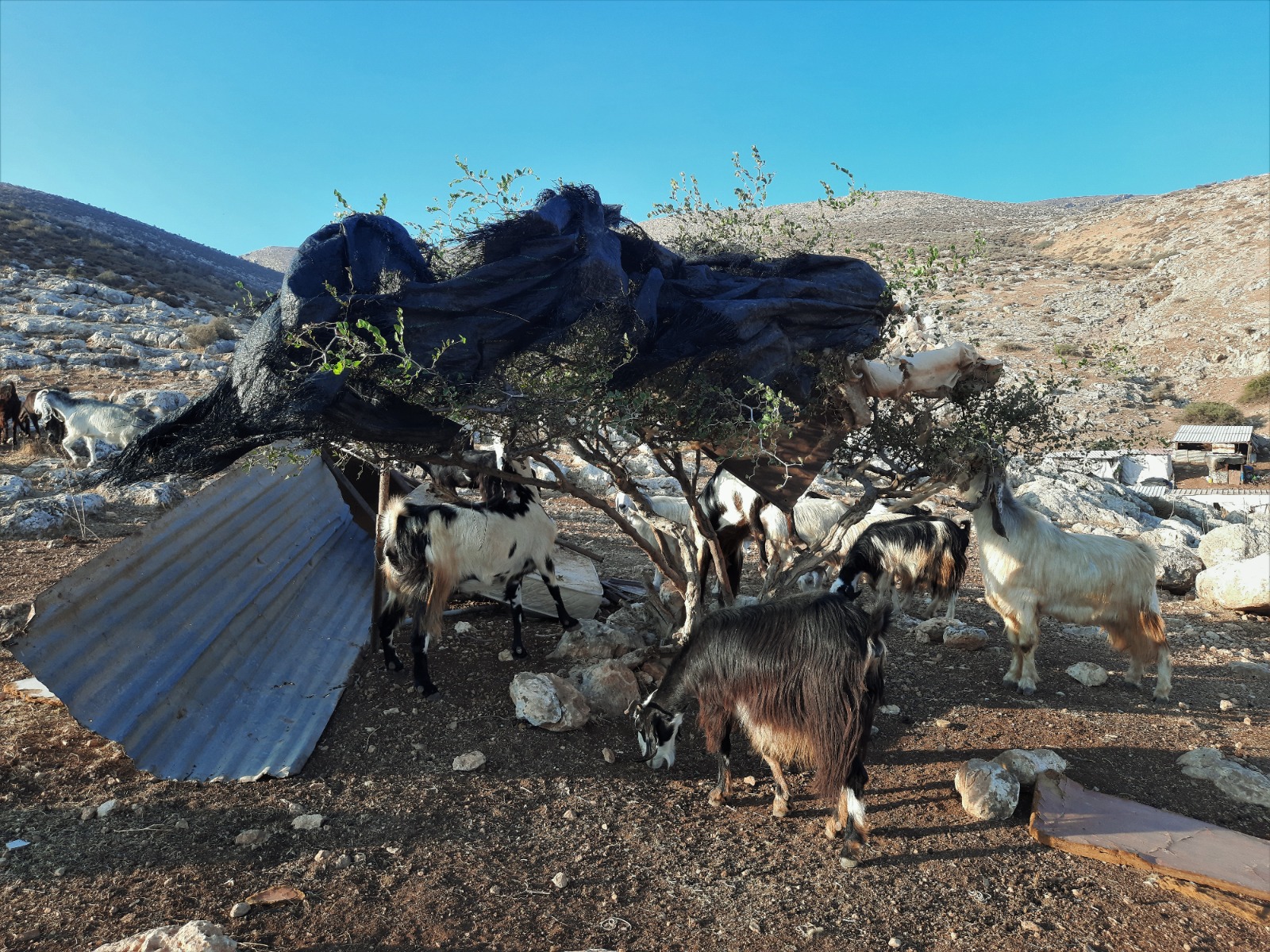 Shahar ShilohNov-3-2021Ein Shibli: grazing begins close to home
-
Tayasir CP
See all reports for this place-
Located on road 5799, It is one of the checkpoints control the passage between the northern West Bank and the Jordan Valley. For a long time, it stood empty and open, with only a sign next to it warning against entering Area A. It was adjacent to an old military camp - now everything is neglected. How much money was invested here, and how much brainwashing was done to the soldiers of Netzah Yehuda and Kfir.
Today, it is very difficult to pass there. Many delays. Often, teachers from Tubas are not allowed to pass into the Valley to villages like Ein al-Bida where the local schools are located, and there are no classes. There are additional days when the checkpoint is closed. In general, there is a wait there of about two to four hours to go towards the Valley and also to return. Many times the Palestinians are forced to use the Hamra checkpoint, which also leads into Tubas and the West Bank, but there is also a huge queue there and a long wait.
Following a deadly attack on soldiers at the nearby base in February 2025, the checkpoint was completely closed for the time being. (Updated March 2025)
-
Za'tara (Tapuah)
See all reports for this place-
Za'tara (Tapuah) Za'tara is an internal checkpoint in the heart of the West Bank, at the intersection of Road 60 and Road 505 (Trans-Samaria), east of the Tapuah settlement. This checkpoint is the "border" marked by the IDF between the north and south of the West Bank, in accordance with the policy of separation between the two parts of the West Bank that has been in place since December 2005. At the Za'tara checkpoint, there are separate routes for Israelis and Palestinians. In the route for Israelis, there are no inspections and the route for Palestinians inspects. The queue lengthens and shortens suits. The checkpoint is open 24 hours a day. The checkpoint is partially staffed and the people who pass through it are checked at random.
 Shoshi AnbarSep-27-2023Za'atra (Tapuah Intersection). Signs
-