
Hebron, Sansana, South Hebron Hills, Thu 15.4.10, Morning
Guest – Anya
Sansana-Meitar crossing
Many groups of laborers awaiting their employers on the Israeli side of the crossing. No line on the Palestinian side, no buses.
Route 60
Israeli flags, and occasionally flags of the Har Hebron Regional Council, flying from all the telephone poles all along the road to Hebron – another symbolic way to attach this area to Israel.
Dura-al Fawwar junction – soldiers stand on the Dura side, watching cars but not stopping them.
Hebron
Pharmacy checkpoint – From time to time, soldiers stop youths and men and inspect their bags after they’ve gone through the magnemometer. Suddenly, three soldiers with weapons drawn run into a blocked alley on the H2 side of the checkpoint, from which children are emerging on the way to school. A CPT volunteer standing next to the checkpoint explains that some children live in houses in the alley, and when the soldiers see them coming out they’re afraid they bypassed the checkpoint from area H1. A minute after their dramatic entry to the alley, the soldiers came out.
Later in our tour we noticed (new?) blue and white signs erected near the settlement centers and other locations, explaining in Hebrew and English how important the locations are from a Jewish perspective. The city is unusually quiet – soldiers are sitting at the Beit Hadassah luncheonette, no music from Beit Gutnick.
Michal T. had asked us to stop at the worshipper’s route in order to hear from A., whom they met on the Tuesday shift, the entrance to whose home was blocked by the army before Passover (cf. report from 13 April). When we arrived we saw two soldiers stationed at the entrance to the worshippers’ route, and others standing on the roof of one of the tall buildings in the area. We found A., who explained the problem: three days before Passover, a military crane and truck arrived and blocked the entry to the alley leading from his home to the worshippers’ route with cement cubes, to a height of some 3 meters. The most serious problem is that his 90-year-old mother, confined to a wheelchair, now can’t easily and quickly reach the road or obtain medical treatment. The soldiers said that they’ll reopen the alley after Passover, but they haven’t yet done so. There’s a back way from his house, but it involves climbing stairs and walking along an uneven route over the roofs of other buildings – which is impassible to a wheelchair. We sat with him briefly at his house and met his wife, son and mother. We wrote down information about him and his wife, and promised to transmit it to Yesh Din, which will try to do something. A. said that two other locations along the worshippers’ route had also been blocked with concrete that same day, and at our request took us to see them as well (photos attached). A. thinks that the intent is to block off the route completely; the army adds more and more obstructions every year.
To the left of the exit from Kiryat Arba, on Route 60, is E.’s house. He also hasn’t any luck – his land and family homes are located in a bad location – at the foot of Kiryat Arba’s new Nofei Mamre neighborhood. The group of Palestinians living in this area is completely cut off from Hebron by Kiryat Arba, and to reach the city and its services they must drive to Halhul. This little area is a sort of no-man’s-land, not under the control of the Palestinian Authority, so it doesn’t provide them with any services, and not under the jurisdiction of Israeli authorities. The Civil Administration is trying to annex more and more of the family’s land; no one is willing to provide water to them, and they have to buy it and pay a high price.
At the exit from Kiryat Arba we noticed that next to the Kiryat Arba army base there was a new, small base with a number of mobile homes – above which floated a balloon (like a small zeppelin), in the sky above Hebron, apparently photographing the area.
Hebron
See all reports for this place-
According to Wye Plantation Accords (1997), Hebron is divided in two: H1 is under Palestinian Authority control, H2 is under Israeli control. In Hebron there are 170,000 Palestinian citizens, 60,000 of them in H2. Between the two areas are permanent checkpoints, manned at all hours, preventing Palestinian movement between them and controlling passage of permit holders such as teachers and schoolchildren. Some 800 Jews live in Avraham Avinu Quarter and Tel Rumeida, on Givat HaAvot and in the wholesale market.
Checkpoints observed in H2:
- Bet Hameriva CP- manned with a pillbox
- Kapisha quarter CP (the northern side of Zion axis) - manned with a pillbox
- The 160 turn CP (the southern side of Zion axis) - manned with a pillbox
- Avraham Avinu quarter - watch station
- The pharmacy CP - checking inside a caravan with a magnometer
- Tarpat (1929) CP - checking inside a caravan with a magnometer
- Tel Rumeida CP - guarding station
- Beit Hadassah CP - guarding station
Three checkpoints around the Tomb of the Patriarchs
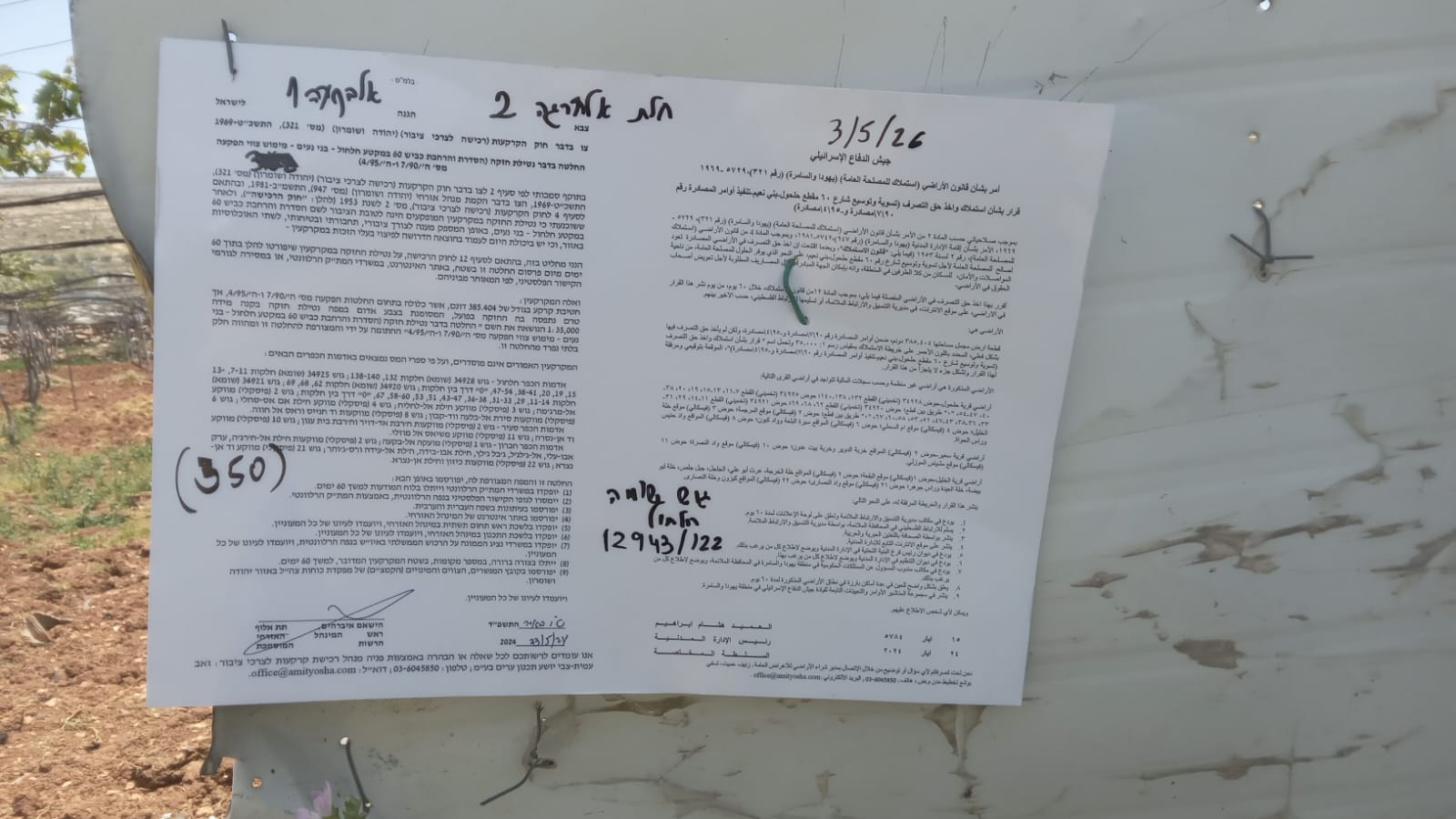 Muhammad D.May-13-2026Hebron - Request for compensation for land expropriation
-
Meitar checkpoint / Sansana
See all reports for this place-
Meitar Checkpoint / Sansana The checkpoint is located on the Green Line and serves as a border crossing between Israel and the West Bank. It is managed by the Border Crossing Authority of the Defense Ministry. It is comprised of sections for the transfer of goods as well as a vehicle checkpoint (intended for holders of blue identity cards, foreign nationals or diplomats and international organizations). Passing of Palestinians is prohibited, except for those with entry permits to Israel. Palestinians are permitted to cross on foot only. The crossing has a DCO / DCL / DCL / DCL (District Coordination Office), a customs unit, supervision, and a police unit. In the last year, a breach has been opened in the fence, not far from the crossing. This breach is known to all, including the army. There does not appear to be any interest in blocking it, probably as it permits needed Palestinian workers without the bureaucratic permits to get to work in Israel. Food stalls and a parking area economy have been created, but incidents of violent abuse by border police have also been recorded. Updated April 2022
-
South Hebron Hills
See all reports for this place-
South Hebron Hills
South Hebron Hills is a large area in the West Bank's southern part.
Yatta is a major city in this area: right in the border zone between the fertile region of Hebron and its surroundings and the desert of the Hebron Hills. Yatta has about 64,000 inhabitants.
The surrounding villages are called Masafer Yatta (Yatta's daughter villages). Their inhabitants subsist on livestock and agriculture. Agriculture is possible only in small plots, especially near streams. Most of the area consists of rocky terraces.Since the beginning of the 1980s, many settlements have been established on the agricultural land cultivated by the Palestinians in the South Hebron Hills region: Carmel, Maon, Susia, Masadot Yehuda, Othniel, and more. Since the settlements were established and Palestinians cultivation areas have been reduced; the residents of the South Hebron Hills have been suffering from harassment by the settlers. Attempts to evict and demolish houses have continued, along with withholding water and electricity. The military and police usually refrain from intervening in violent incidents between settlers and Palestinians do not enforce the law when it comes to the investigation of extensive violent Jewish settlers. The harassment in the South Hebron Hills includes attacking and attempting to burn residential tents, harassing dogs, harming herds, and preventing access to pastures.
There are several checkpoints in the South Hebron Hills, on Routes 317 and 60. In most of them, no military presence is apparent, but rather an array of pillboxes monitor the villages. Roadblocks are frequently set up according to the settlers and the army's needs. These are located at the Zif Junction, the Dura-al Fawwar crossing, and the Sheep Junction at the southern entrance to Hebron.
Updated April 2022
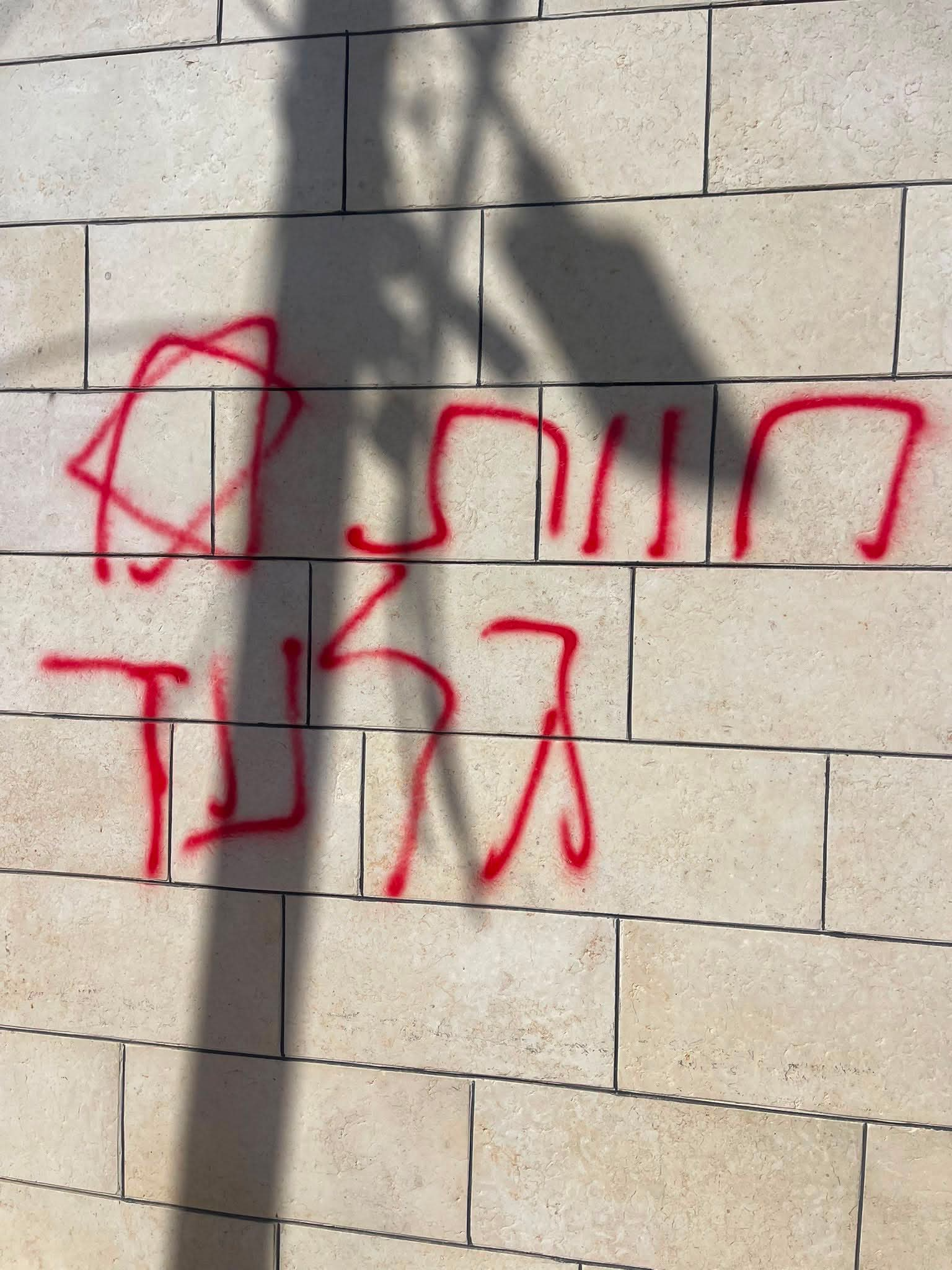 A Palestinian residentJul-19-2026Graffiti sprayed in A-Tuwani
-