
‘Anabta, Habla, Irtah (Sha’ar Efrayim), Jubara (Kafriat), Ras ‘Atiya, Sun 28.3.10, Afternoon
Summary: Recently, something Barack Obama told The Atlantic's Jeffrey Goldberg during his campaign for the presidency came out: "Being a friend to Israel is partly to hold up a mirror and tell the truth." It's holding up the mirror that we MachsomWatchers do, and have done, through our monitoring over the past nine years. It is we who show, in our daily reports, that the hold on the settlement enterprise is total, that the authorities-that-be have no intention of quitting the Occupied Palestinian Territories, or of allowing Palestinians to exercise their rights. We shall have to see, in the upcoming weeks, if the American demands including withdrawing roadblocks, removing soldiers from parts of the West Bank and demanding a freeze on new Jewish settlements on Palestinian territory becomes part of the reality we monitor, or whether the harassment and humiliation, of which the Americans seem to know nothing, continue so cruelly and mindlessly without end in sight.
12:00 Gate 1392 – HablaThe three soldiers have nothing to do, are willing to talk – but only a little. In spite of a change to the summer clock, the three opening times of the gate(s) have not changed. The one fluent English speaker is told that he must not talk to us! No vehicular or animal traffic at all, although there are numerous cars, Israeli as well as Palestinian, at the nursery and at the greengrocer. As the gates on the far side are closed, exactly at 12:15, a tractor appears, but the young man driving it makes no attempt to persuade the soldiers to let him through. He turns the heavy equipment around and leaves, giving up. Near Alfe Menashe on the way to Ras AtiyaThere's a new gate, or gates, on the new roadway before the Separation Wall is reached. The big yellow gate is open, the hill gradient beyond still as steep, now well tarred.
13:30 Ras Atiya.As we approach the Seam Zone checkpoint, we meet one of the teachers, cheerfully walking towards the crossing. He tells us that, yes, he and his fellow teachers now cross by going through the concrete building (something they had refused to do when this new ruling was introduced a couple of weeks ago). Indeed, we see that the door only opens sometimes, people having to wait, either by the turnstiles or by the locked closed door until beckoned for checking. Numerous schoolchildren around as well as a busload of boys and girls cheerfully calling out, in English, to ask our names.
Jit and Deir Sharaf
Unmanned
16:00 Shavei ShomronA drive up to the usual closed checkpoint, on Route 60, shows that there's a new earth mound in the middle of the roadway, near where the so-called security road and wall were built around the settlement. On the other, Deir Sharaf, side of the settlement, the new roadway is well finished and completely unused. A jeep with two soldiers standing on the roadway is placed at the entrance to the now blocked old roadway.
16:20 Anabta It seems we're back on Route 5, where we were held up today by a bad accident. Long before Anabta, traffic grinds to a halt on this narrow road. When we near the checkpoint, there are still no soldiers in sight, so it seems there was, as usual no one there, but the red traffic light is, as always, on red, as traffic creeps and crawls through the checkpoint, but without stopping. From the Tulkarm direction, very little traffic. No explanation as to the reason for the jam.
16:30 Jubara A long line of vehicles is waiting to pass the checkpoint, and we enter the settlers' lane and are told, rudely, by a military policewoman to hand her IDs and passports, and it seems she's never examined a passport before. Four people's passports are examined, every page, she makes one of the visitors delete a photo of the checkpoint and insists on having the trunk of the car opened. A "Happy Passover" is greeted with a glare and a stony silence.
16:50 Irtah In contrast to Jubara, a very polite security official, earpiece in place, followed by a baseball capped security guard with gun, responds cheerfully that although there's no problem, the guests are asked to please not take photos.
It's the last hours before "closure" marks the end of work in Israel for those Palestinian workers luckily enough to be allowed to do so – when there are no holidays or religious festivals being celebrated. Hordes of men, only a few women, make their way back to the OPT, many bearing bags of goodies, and most men carrying huge, long bags — like huge camel bags — over their shoulders, filled to the brim with oranges. Many say how easy it was to pass this morning, nobody seems to lament the closure, "What can one do?" is the tenor of acceptance we hear, over and over. A dozen or so oranges escape from a bag and roll, swiftly, like balls in a bowling alley, towards the pins that we know already cannot, in this Occupation, be knocked down.
'Anabta CP
See all reports for this place-
'Anabta CP
The checkpoint is located south of the village of 'Anabta, at the intersection of Road 60 (leading to Nablus at the entrance to Area A), with Road (57, 557, 5576) facing west towards the Einav settlement and the checkpoint at the exit from the West Bank - Figs checkpoint. Until 2010 we used to watch the intersection and report the long columns created due to a slow inspection of the vehicles in both directions.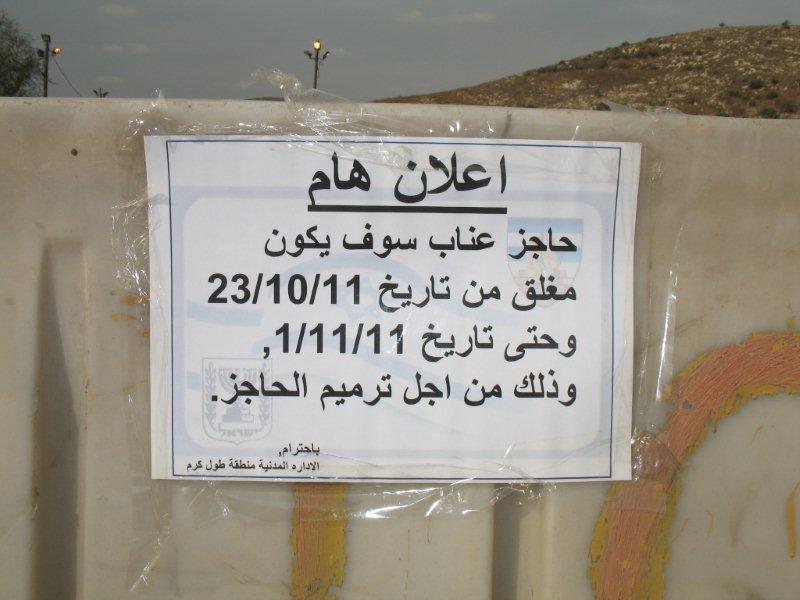 Oct-28-2011Anabta checkpoint 24.10.11
-
Habla
See all reports for this place-
Habla CP (1393)
The Habla checkpoint (1393) was established on the lands of the residents of Qalqilya, on the short road that
connected it for centuries to the nearby town of Habla. The separation barrier intersects this road twice and cut off the residents of Qalqilya from their lands in the seam zone.(between the fence and the green line).
There is a passage under Road 55 that connects Qalqilya to the sabotage This agricultural barrier is used by the farmers and nursery owners established along Road 55 from the Green Line and on both sides of the kurkar road leading to the checkpoint.
This agricultural checkpoint serves the residents of Arab a-Ramadin al-Janoubi (detached from the West Bank), who pass through it to the West Bank and back to their homes. The opening hours (3 times a day) of this agricultural checkpoint are longer than usual, about an hour (recently shortened to 45 minutes), and are coordinated with the transportation hours of a-Ramadin children studying in the occupied in the West Bank.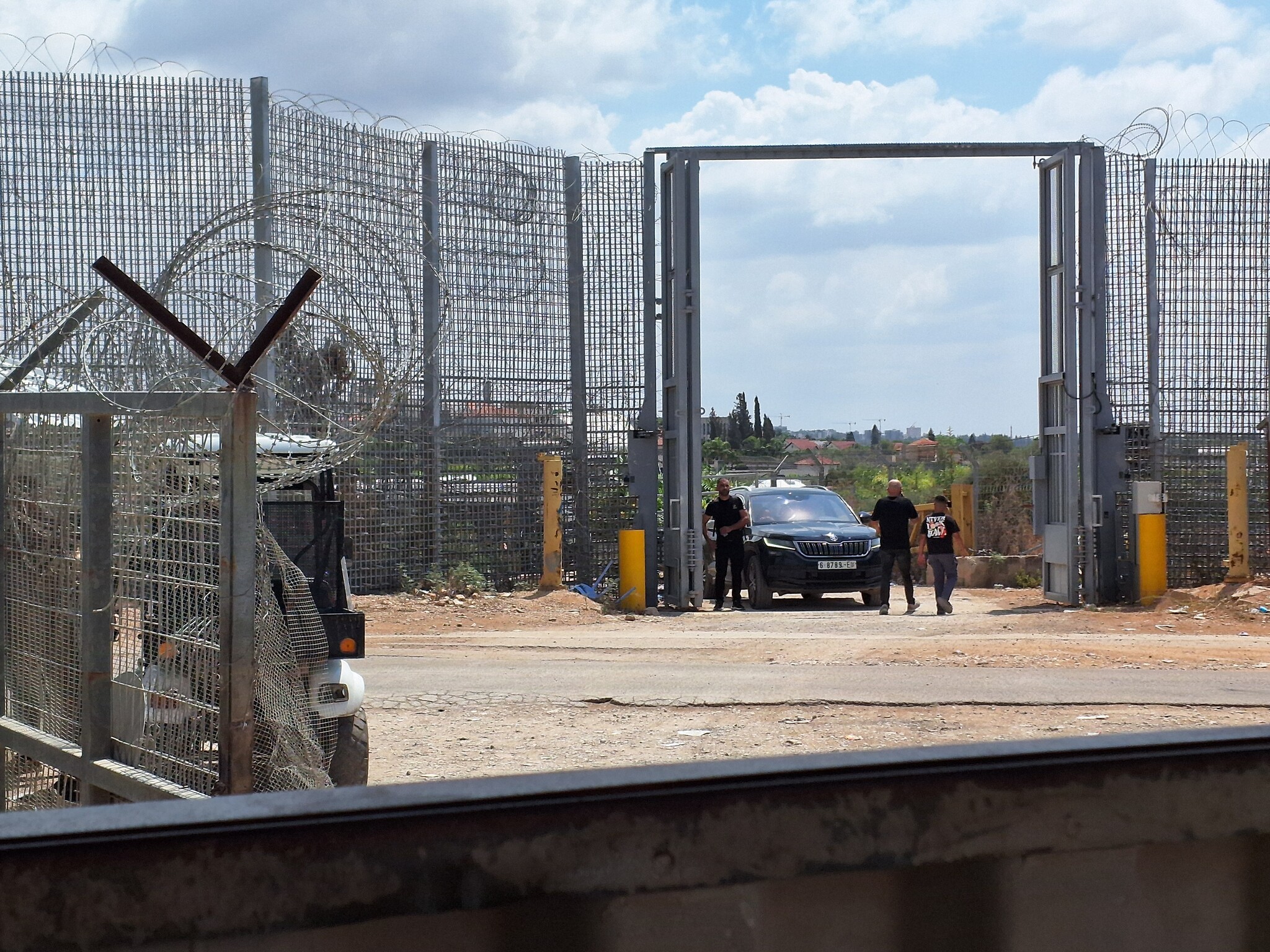 Ronit Dahan-RamatiAug-31-2026Habla. The gate is open
-
Irtah (Sha'ar Efrayim)
See all reports for this place-
The checkpoint is for Palestinians only. It is the main barrier to the passage of workers from the northern West Bank to Israel. Workers with a permit to work in Israel and also for trade (with appropriate permissions), medicine, and visiting prisoners. One can cross the checkpoint only on foot. The checkpoint is located north of Road 557 and south of Tulkarm. Operated by a civil security company, opening hours: between 4:00 and 19:00 on weekdays. As members of Machsom Watch, we began our shifts to this location in 2007. We arrived before it opened at 4 in the morning and report since, on the harsh conditions and the long and crowded queues of workers. The workers who pass by continue their journey by transportation to work throughout Israel. In the first period of its activity, about 3,000 and then 5,000 people passed through this checkpoint every day. Due to the small number of checking points and arbitrary delays for long periods of time in the "rooms", workers feared losing their transportation. Hence workers leave their homes at 2:30 at night to be among the first. Today, 15,000 pass and the transition is faster. Workers are still leaving their homes very early to get past the checkpoint at 7 p.m. In an adjacent compound, there is a terminal for the transfer of goods on a commercial scale, using the back-to-back method.
-
Jubara (Kafriat)
See all reports for this place-
The Jabra checkpoint was on Road 557, south of Tulkarm, on the side of the Figs Pass, which is located within the Palestinian Authority (a few kilometers east of the Green Line), and serves as an entry barrier from the territories to Israel. The checkpoint to the village of Jubara, which until 2013 was in the seam area, blocked and surrounded by a fence, was intended for the passage of the family members of the house next to the checkpoint, and also for the MachsomWatch volunteers (with special permission only), on their way to checkpoint 753. on the other side of the village. The soldiers supervising the "fig crossing" also supervised the crossing at this checkpoint, in our shifts we often waited a long time until the key was found and the gate opened. The checkpoint was abolished and became part of the separation fence that was moved west following the High Court.
-
Ras 'Atiya
See all reports for this place-
The checkpoint is presently on the Separation Barrier roadway, manned and open 12 hours a day, from 6:30 to 18:30. West of it is the large Seam Line village whose school is attended by children from the nearby villages east of the Barrier and many of whose inhabitants have permits to work in Israel. How long this checkpoint will remain in place is unknown, since construction of the Separation Wall, just by the settlement of Alfe Menashe, east of the present Separation Barrier, is endless, as is the creation of a new road and, obviously, a new checkpoint.
-
