
Qalandiya, Sun 27.6.10, Afternoon
Qalandyia – The afternoon shift from 3:30 – 7:00 p.m.
Particular incidents: we were imprisoned by degrees, first of all because they thought we took photographs and then because we did actually take photographs. Each time for over 20 minutes.
OK, it wasn't easy to return to the Kalandia shift, my original shift, it was worse than all the descriptions.
Apparently an 'easy' day, not packed with noteworthy incidents, a relatively 'quiet' day, jarringly routine, menacing one's freedom of movement. As an architect from Beit Chanina who works in Ramallah told us, as we stood by the turnstile: "Today is a heavenly day". Heavenly? Thus: at 3:30 p.m., before I had even managed to take in everything in all its details, I heard Tamar order, while driving: "Get out, quickly, quickly – there's an ambulance!" In the car park stood an ambulance which had arrived from 'El – Mukased' hospital in East Jerusalem, furnished with all the relevant permits, waiting for an ambulance which should arrive from Ramallah to pass over a patient by the 'back to back' method, however, when the ambulance arrived at the roadblock the soldiers informed them that all the permits had been cancelled and they would have to start everything, everything, all over again! It took an hour and ten minutes of unnecessary waiting! Meanwhile an additional ambulance arrived from Jerusalem to meet an ambulance from Nablus, also with all the necessary paperwork, which was also miraculously cancelled and also necessitated a wait for new permits. A kind of work arrangement: permits, cancellations and then permits.
Finally the ambulance from Ramallah arrived with the new permits. The door opens: from ambulance 'A' a boy of 8 alights, accompanied by his worried mother, the boy has been in a fuzzy state for 3 days, sleepy, wrapped up in a small bed, this time he is moved quickly by the 'back to back' method to a stretcher in ambulance 'B'. The door closes and they go off to 'El Mukased'.
Within 10 minutes the ambulance from Nablus arrives, carrying a young man with an injured knee, in great pain, accompanied by both his mother and father. According to him he was hit by soldiers two months ago and since then his knee has not recovered. The medical team moves him very gently from bed to bed. His face is twisted with pain, every movement is considered so that it may possibly hurt less than the previous one.
In both cases I was shocked by the shameful spectacle, revolting, of a Military Policeman from the Erez unit, big built, backed up by a security guard, employed by the 'Civilian Centre' security company, both of them with weapons at the ready, standing over a woman, giving orders, instructing her to open her bag to see that, heaven forbid, nothing suspicious is hidden in her bags. A difficult sight, humiliating in the eyes of any human being, but both the mothers behaved practically, compliantly, as if it soldiers and security guards are naturally part of everyday life, of your daily routine. This was a very powerful demonstration of a great determination not to give in! To think the mother had to devote all her attention to the soldier and the security guard while her son was being moved from ambulance to ambulance. What strength, what power, what vigour is necessary to move on, to survive with honour!
Another ambulance arrives from Ramallah, waiting for a doctor from Jerusalem and, at the same time, an ambulance from Jerusalem with a patient after treatment for his liver in 'El Mukased' hospital.
That's it, there are no more ambulances, we can now deal with 'trivialities' and find out, finally, who is against whom. What do I remember about QalandiYa roadblock? Roni explains to me: "There was a hill here, do you remember? It was all flattened to build the roadblock called a terminal". I remember.
Qalandiya roadblock has changed – it was always a tough place but now even more so! It looks like a huge cage, like a ghetto with guard dogs on every side. A sorry spectacle, an unforgettable one. The squalor, the filth, the brutal architecture, the array of cables and the control, the arbitrariness, the dividing chains, the fences, a wall and another wall, a lower one meant only for the days of Ramadan, pillboxes: that's the scenery you regard as you stand there, 'Crusader' scenery, tough scenery.
To think about the people who get up each morning faced with this brutal scenery! Their determined stance, almost aristocratic, in the hardship, in the filth, in the humiliation which beggars belief!
We go through the turnstiles to the Palestinian side. In the waiting shed 4 people sit on a bench. One of them, an older man, tells us that he left home in Nablus at 5:00 a.m., just to visit and keep his son, who runs a tea and coffee stall near the shed, company. So he sits opposite him, on the bench, all day, watches him and enjoys the time he spends with him. I asked him if he came just to spend time with his son, he gave me a big smile and was pleased that I understood and was even impressed with how much he loves his son.
The strong smell of tear gas reaches us. In the distance, on the west side, we saw black and white smoke billowing. We tried to find out what it was. No one knew and no one was interested! In the roadblock no one was moved, life continued routinely. The 'baklava' seller smiles and shrugs his shoulders: don't know! Tamar leaves in a hurry because of the smell of gas.
On her way out the soldiers will detain her in the checkpoint for about half an hour because they thought she photographed them. She didn't! Her complaints and denials did not help her; they demanded that she enter the inspection room, and other goodies, such fun at the roadblock!
We were also detained at the checkpoint, they simply closed the turnstiles. With us were two Palestinians on their way out who were punished against their will. The queue outside grew longer and more than 50 people were crowded there, a moment after the architect said to me "Today is heavenly"… The soldiers, one male and three female, in the room on the other side of the window amused themselves and giggled, turned their backs to us and made all kinds of gestures, just like a kindergarten. It was embarrassing. They simply locked us in for over 20 minutes and announced loudly that we are not permitted to take photographs. We are permitted to take photographs but anyway an officer came and demanded that I delete the photos, I of course did so, firstly because they weren't any good or particularly important and also because I was uncomfortable with the growing queue outside. How can soldiers be punished for the collective punishment they meted out? In any case, there are still a few pictures in the camera. I will send them on later.
On the south side, at the car crossing, there are two traffic policemen from the motorcycle unit in charge of the traffic entering Qalandiya and whose job it is to inspect the vehicles entering. They are a few metres in front of the soldiers' post and simply stop almost every second vehicle and detain most of them after the thorough inspection of almost every part of the vehicle. Most of them get a statement informing them that the vehicle must not be driven and they are sent to re-test the vehicle – an expenditure of NIS 1500.
At about 5:00 p.m., a Border Police jeep arrives and a man aged about 30 from Bethlehem alights. He is employed, with a permit, at the chicken slaughterhouse in Atarot. He was on his way at noon when he was caught working at Ramot. This means: "You were caught at Ramot – so you have lost your permit!" This is what the DCO officer told him today at 1:30 p.m., after he had been harassed and sent backwards and forwards from Bethlehem to Qalandiya, since Sunday, each day with the promise that he would be given a permit. They promised Tamar too and me as well that they would deal with it personally, "And tell him to speak only to me". Smiles and lots of promises and today too he is sent away empty handed, he will try tomorrow, inshallah!!! This means: "Tomorrow there will be another avocado…"
Qalandiya Checkpoint / Atarot Pass (Jerusalem)
See all reports for this place-
Click here to watch a video from Qalandiya checkpoint up to mid 2019 Three kilometers south of Ramallah, in the heart of Palestinian population. Integrates into "Jerusalem Envelope" as part of Wall that separates between northern suburbs that were annexed to Jerusalem in 1967: Kafr Aqab, Semiramis and Qalandiya, and the villages of Ar-Ram and Bir Nabala, also north of Jerusalem, and the city itself. Some residents of Kafr Aqab, Semiramis and Qalandiya have Jerusalem ID cards. A terminal operated by Israel Police has functioned since early 2006. As of August 2006, northbound pedestrians are not checked. Southbound Palestinians must carry Jerusalem IDs; holders of Palestinian Authority IDs cannot pass without special permits. Vehicular traffic from Ramallah to other West Bank areas runs to the north of Qalandiya. In February 2019, the new facility of the checkpoint was inaugurated aiming to make it like a "border crossing". The bars and barbed wire fences were replaced with walls of perforated metal panels. The check is now performed at multiple stations for face recognition and the transfer of an e-card. The rate of passage has improved and its density has generally decreased, but lack of manpower and malfunctions cause periods of stress. The development and paving of the roads has not yet been completed, the traffic of cars and pedestrians is dangerous, and t the entire vicinity of the checkpoint is filthy. In 2020 a huge pedestrian bridge was built over the vehicle crossing with severe mobility restrictions (steep stairs, long and winding route). The pedestrian access from public transport to the checkpoint from the north (Ramallah direction) is unclear, and there have been cases of people, especially people with disabilities, who accidentally reached the vehicle crossing and were shot by the soldiers at the checkpoint. In the summer of 2021, work began on a new, sunken entrance road from Qalandiya that will lead directly to Road 443 towards Jerusalem and Tel Aviv. At the same time, the runways of the old Atarot airport were demolished and infrastructure was prepared for a large bus terminal. (updated October 2021)
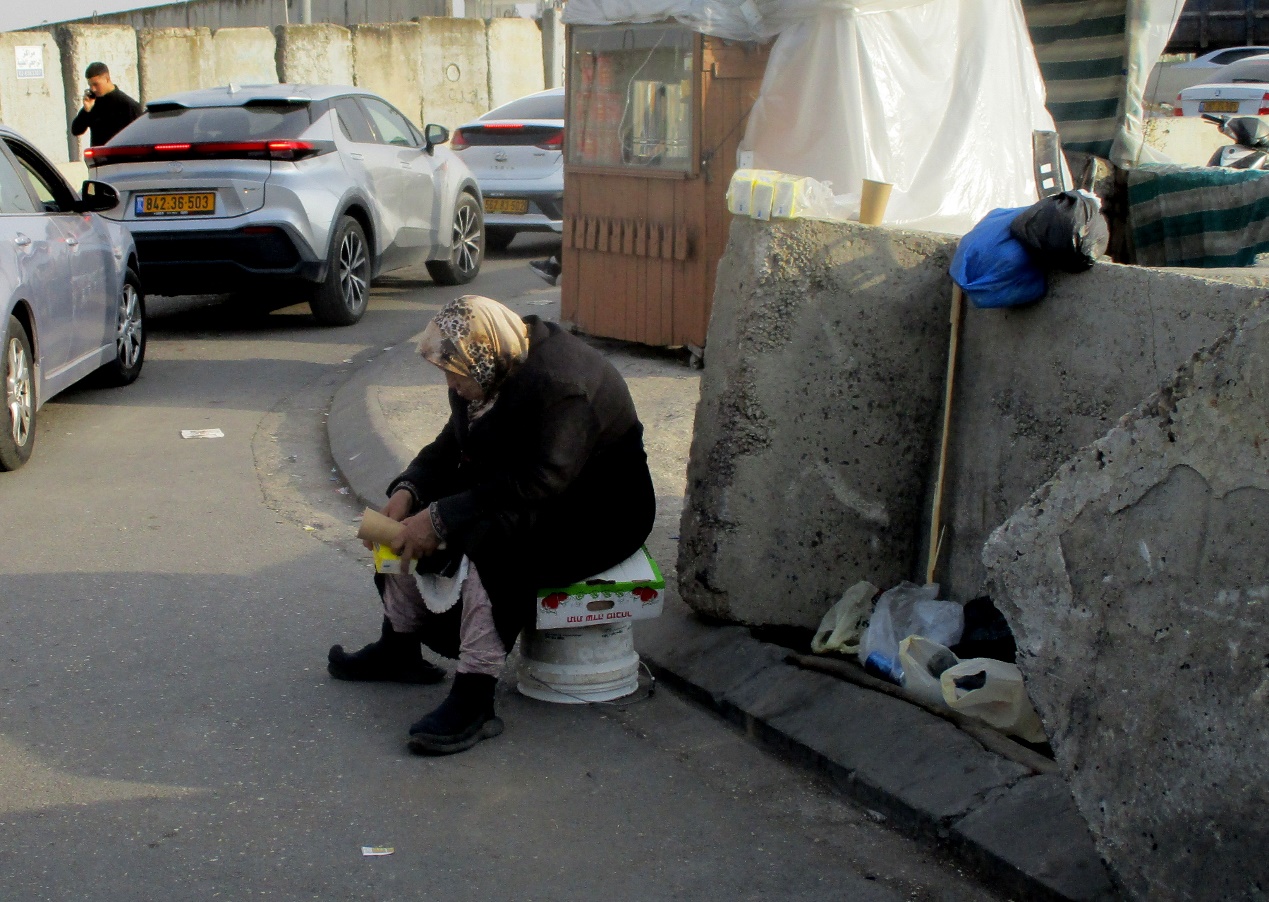 Tamar FleishmanOct-11-2026Qalandiya. Female Beggar
-
