South Hebron Hills, Wed 20.10.10, Morning
Translator: Charles K.
Route 317
All the “illegal” outposts (as if the other ones were legal) observe us from the hilltops. All have paved access roads, water and electric lines, and a number of Hummers protecting them. We didn’t stop at the checkpoint near Beir Yattir. Maybe someone should check to see whether the problems with the Abu-Kabita children have been resolved.
Umm el-Hir
We picked up Eid, from Umm el-Hir. She tells us about problems with settlers from Carmel who live next to the fence, near the village’s traditional bread oven. The oven (which might be older than Carmel) operates in the traditional way – it’s heated by fire. Don’t forget, Umm el-Hir has almost no access to electricity, except solar energy from the Village Group project. The oven emits smoke that sometimes, depending on the wind direction, annoys the residents of the Carmel settlement. The latter sometimes come in the middle of the night and pour water over the oven so it’s unusable in the morning (it takes a few hours to warm it up). A few days ago it happened again. They called the police. There was a lot of talk about compromise (blah blah blah), and that was it. With a little imagination it would be possible to “cook up” a solution – for example, install an electric oven and get electricity from Carmel.
Hashem el-Daraj: the kindergarten
We drove on to Hashem el-Daraj. We had made an appointment (with Eid’s help) with Huda, the kindergarten teacher, to visit the kindergarten. There were about 35 children aged 3-4. When we arrived the children sat at small tables, drawing. Since there aren’t enough tables some of the children sat in a second row and, of course, just watched the others drawing. Noa and Noga sat with the children and drew with them. I drew with the children seated in the second row, on the floor. We had brought Frisbees that had been donated along with many other toys, and Noga and Noa played with the children.
The interior of the kindergarten looks a little better after Aliya, the kindergarten teacher, and her husband had visited – a few decorations, a poster with numbers, etc. We gave Huda her October salary, from donations we’d received: from a British foundation and from members of our MachsomWatch group.We talked about needs that could easily be met: balls, paddles, in short – outdoor games that don’t have to be assembled from parts that must be stored together when not in use.
Huda, of course, served us tea (the gas balloon is located in the room. It’s really dangerous – but otherwise it would be stolen). The plan is to begin building soon. Noa is working with the architect who volunteered to prepare a renovation plan for the kindergarten! It’s also necessary to find a professional kindergarten teacher, preferably a Bedouin woman, to keep an eye on the project – to make weekly visits, for example. So if anyone has any ideas – let us know.
At the end of the day (which will be the beginning…) the kindergarten will be splendid.
South Hebron Hills
See all reports for this place-
South Hebron Hills
South Hebron Hills is a large area in the West Bank's southern part.
Yatta is a major city in this area: right in the border zone between the fertile region of Hebron and its surroundings and the desert of the Hebron Hills. Yatta has about 64,000 inhabitants.
The surrounding villages are called Masafer Yatta (Yatta's daughter villages). Their inhabitants subsist on livestock and agriculture. Agriculture is possible only in small plots, especially near streams. Most of the area consists of rocky terraces.Since the beginning of the 1980s, many settlements have been established on the agricultural land cultivated by the Palestinians in the South Hebron Hills region: Carmel, Maon, Susia, Masadot Yehuda, Othniel, and more. Since the settlements were established and Palestinians cultivation areas have been reduced; the residents of the South Hebron Hills have been suffering from harassment by the settlers. Attempts to evict and demolish houses have continued, along with withholding water and electricity. The military and police usually refrain from intervening in violent incidents between settlers and Palestinians do not enforce the law when it comes to the investigation of extensive violent Jewish settlers. The harassment in the South Hebron Hills includes attacking and attempting to burn residential tents, harassing dogs, harming herds, and preventing access to pastures.
There are several checkpoints in the South Hebron Hills, on Routes 317 and 60. In most of them, no military presence is apparent, but rather an array of pillboxes monitor the villages. Roadblocks are frequently set up according to the settlers and the army's needs. These are located at the Zif Junction, the Dura-al Fawwar crossing, and the Sheep Junction at the southern entrance to Hebron.
Updated April 2022
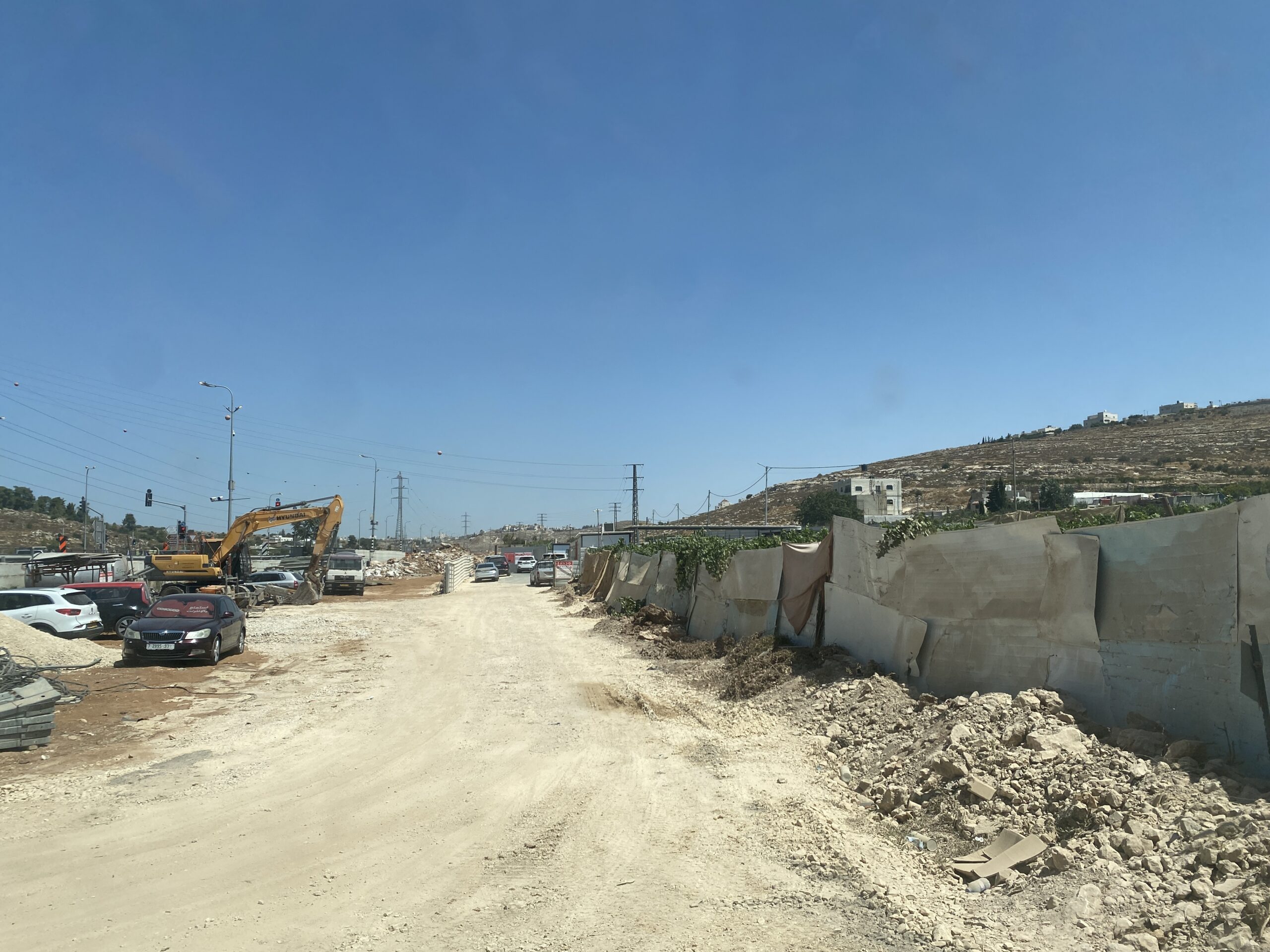 Yael ZoranAug-20-2026Ata's vineyard on the right, cut down to make way for the expansion of Highway 60
-