
Eyal Crossing, Habla, Irtah (Sha’ar Efrayim), Wed 13.10.10, Morning
Translation: Suzanne O.
Summary: At Artach many people are detained for long periods and the number of those coming to us with complaints is greater than ever.
Artach
We were told that the facility opened at 4:00 a.m.
4:30 a.m.
The sound of a loud tumult rises the nearer one gets to the entrance. They admit people for 3 minutes – 20 people a minute – and then there is an interval of 5 minutes, during which no one is admitted.
Each opening of the turnstile and the admittance of a few people (the estimate of the queue is 3,000 we are told later) causes chaos, pushing and shouting, someone described it as being like a war.
4:50 a.m.
About 50 people are admitted, and again chaos erupts while the queue is reorganised.
At the exit from the facility tens of people approach us and their main complaint is the long wait in the rooms.
Some of them waited for three quarters of an hour in the rooms, and someone said he had waited even longer.
The door was closed in the face of one of the labourers, he was hurt, he cried out in pain and shock, perhaps also from anger and insult, and for this he was punished by shouts and a wait of three quarters of an hour.
We were also told that there are very few guards/inspectors inside, that they are dealt with at a snail's pace and that the female inspectors are half asleep and their behaviour is insulting and humiliating.
Quote: "You are going too far, there can be no peace this way".
We were told that two days ago, in the queue at the entrance, because of the pressure and the pushing a concrete pillar was overturned and several people were hurt.
Again there were complaints about late opening (at 5:00 a.m.) on Fridays.
A labourer who sometimes crosses the Ayal roadblock says that the wait in the rooms here is much longer which is confirmed later by people at Ayal.
Another labourer said that no officers, or anyone in authority who can be approached in case of problems, are available at the facility.
We left feeling strongly that the treatment of the labourers is deteriorating and that we have nowhere to take this disgrace.
Ayal crossing
5:30 a.m.
The labourers say that it is OK today. Good. No one came to us with complaints.
We saw that the turnstile got stuck twice and went to ask for it to be opened up again.
We moved to where we can see the entrance to the facility from the eastern side. There is a huge awning to provide shelter from rain and sun for those in the queue. The labourers march in line along the fence, patiently; there is no pushing or pressure, perhaps because there are people responsible for organising the queue.
How can we make this happen at Artach?
The maximum waiting time in the rooms: 15 minutes.
Can this be raised with the administration: there is a difference of 4 times the waiting time between the facilities!
6:15 a.m.
We took another look at the entrance to the facility, without any hindrance from the guards, and we saw very few people. They walk in a leisurely fashion to the entrance. There is no pressure. There is no chaos, a totally different picture from the one at Artach.
Sha'ar Chabala
6:40 a.m.
We were told that it opened at 6:30 a.m. Five people at a time cross. The inspection time in the hut is approximately 2 minutes.
A school bus (from Ramadin) coming from the Israeli side is stopped in front of the crossing. The driver alights, waits for the soldiers to signal him to come over to them. The soldiers inspect ID cards, keep them, and the driver returns to his vehicle, takes it across the gate, and then stops. A soldier with a weapon at the ready gets on the bus for an inspection. He alights with 3 pupils and a teacher (females) – each one with a head covering, they are taken to be inspected in the hut. Did their head coverings make him suspicious? They are released after a few minutes, the driver gets the ID cards back and the vehicle can cross.
A reserve officer gets us to move away, claiming that it is a closed military area! They are polite to the Palestinians (a small blessing).
The labourers tell us that some of them work on Alfei Menasheh. A young man tells us that he works picking his olives in his grove near Alfei Menasheh, he says that the yield is excellent this year! He told us that sometimes a labourer goes to water the field – it takes a short time, but afterwards he is stuck at the roadblock and has to wait hours in order to get back, the second opening time is some 7 hours later.
Eyal Checkpoint / Crossing
See all reports for this place-
Eyal Checkpoint is intended for pedestrians and Palestinians only. This is the main barrier for workers to cross from the center of the West Bank. Workers with a work permit to enter Israel can pass through it for trade, medicine, and visiting prisoners. The checkpoint was built on the Green Line north of Qalqilya in the separation barrier that surrounds the city. The checkpoint began operating in 2004 by the military. Opening hours on weekdays from 04:00 to 19:00. We started holding shifts there in 2007. We arrived at the checkpoint before it opened at 4 in the morning. We reported on the difficult conditions and the long and cramped queues of workers who must continue their journey by commuting to work throughout Israel. At the end of June 2009, the checkpoint was operated by a civil security company, The transit time has been gradually shortened, today it is faster, but the Palestinians still have to arrive very early to make it to the transportation. Usually, about 15,000 people pass through.
-
Habla
See all reports for this place-
Habla CP (1393)
The Habla checkpoint (1393) was established on the lands of the residents of Qalqilya, on the short road that
connected it for centuries to the nearby town of Habla. The separation barrier intersects this road twice and cut off the residents of Qalqilya from their lands in the seam zone.(between the fence and the green line).
There is a passage under Road 55 that connects Qalqilya to the sabotage This agricultural barrier is used by the farmers and nursery owners established along Road 55 from the Green Line and on both sides of the kurkar road leading to the checkpoint.
This agricultural checkpoint serves the residents of Arab a-Ramadin al-Janoubi (detached from the West Bank), who pass through it to the West Bank and back to their homes. The opening hours (3 times a day) of this agricultural checkpoint are longer than usual, about an hour (recently shortened to 45 minutes), and are coordinated with the transportation hours of a-Ramadin children studying in the occupied in the West Bank.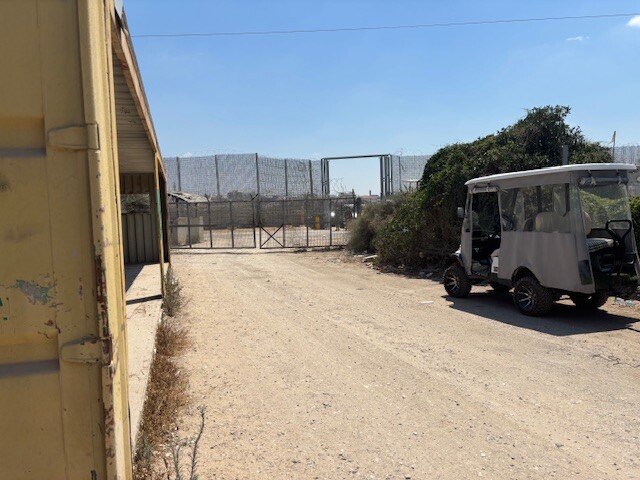 Nina SebaAug-18-2025Habla: The gate is in the process of closing
-
Irtah (Sha'ar Efrayim)
See all reports for this place-
The checkpoint is for Palestinians only. It is the main barrier to the passage of workers from the northern West Bank to Israel. Workers with a permit to work in Israel and also for trade (with appropriate permissions), medicine, and visiting prisoners. One can cross the checkpoint only on foot. The checkpoint is located north of Road 557 and south of Tulkarm. Operated by a civil security company, opening hours: between 4:00 and 19:00 on weekdays. As members of Machsom Watch, we began our shifts to this location in 2007. We arrived before it opened at 4 in the morning and report since, on the harsh conditions and the long and crowded queues of workers. The workers who pass by continue their journey by transportation to work throughout Israel. In the first period of its activity, about 3,000 and then 5,000 people passed through this checkpoint every day. Due to the small number of checking points and arbitrary delays for long periods of time in the "rooms", workers feared losing their transportation. Hence workers leave their homes at 2:30 at night to be among the first. Today, 15,000 pass and the transition is faster. Workers are still leaving their homes very early to get past the checkpoint at 7 p.m. In an adjacent compound, there is a terminal for the transfer of goods on a commercial scale, using the back-to-back method.
-