
Hebron, South Hebron Hills, Tue 21.12.10, Morning
Translator: Charles K.
Meitar crossing
06:45 – The laborers have already crossed to the Israeli side and are walking to their employers’ vehicles. Two busloads of prisoners’ relatives are waiting under the canopy..
Route 60
Full of life. Many vehicles and many children walking to school along the side of the road. An army jeep again parked at the turn to Samu’a, again vehicles are inspected but not detained.
Below Beit Haggai, on the blocked road to Hebron’s southern entrance, an army jeep waits, despite the roadblock and the concertina wire.
At Kvasim junction – a sheep market. The soldiers continue to observe people’s everyday life..
At the entrance to Kiryat Arba: Work continues on “Derekh HaBanim” to the Cave of the Patriarchs. It also seems that construction of the Nofei Mamreh neighborhood is nearing completion. The smiling guard at the gate greets us: “Congratulations – you’re ten years old, right?!" "How did you know?" “Galei Zahal” [the army radio station]. “Are you pleased?" “When people are happy, I’m happy!” he replies. Is the Messiah coming? Peace talks with the settlers are possible.
Hebron
Soldiers everywhere in the area of the worshippers route and Curve 160.
CPT observers at the Pharmacy junction report that the children’s backpacks haven’t been inspected recently. We also see that it’s all routine there. On the other hand, they say there are many nighttime searches, during which children are picked up and handcuffed. It looks as if the settlers are renovating the deserted market opposite Gross Square with the intention of reopening it. We should keep track of what’s going on.
The remaining checkpoints in the Shouhada Street and Tel Rumeida – the usual despair, but no particular problems.
Cave of the Patriarchs – Border Police soldiers have detained four people. We wait to see what happens. Two are released immediately, and the two others wait a long time. I ask the commander why the long delay. He (surprisingly) is polite and replies patiently: “Routine check. This is a security zone, you know.” We keep waiting. Meanwhile Abed, from the souvenir shop, offers us tea. TIPH observers and CPT members have also gathered there. Like us, they all want to know what will happen to the detainees. Everyone’s drinking tea and talking. A long time passes, and I hear the two detainees explaining to the Border Police soldier something about thousands of dinars. I approach again to ask what’s going on, and why they have to wait so long – it’s already been half an hour. The commander, a Druze, remains genial and polite (he respects an older woman). He explains that the two came from Bethlehem to collect a large debt from someone in Hebron, and since they’re not from Hebron, when they were entered into the computer “someone” required a more thorough check, and now it’s out of his hands. He says he’s familiar with most of those crossing and usually uses his authority and doesn’t detain people for no reason. He’s surprisingly sensitive to the situation and wants to know how we feel, do we succeed in solving anything, how our acquaintances feel about what we’re doing. I lay out our entire “I believe.” His patience, interest, attention and question go beyond anything we’ve experienced here in the past with Border Police soldiers. Meanwhile, a man passes by whom the soldier identifies as the debtor’s brother. He tells him that those two are looking for his brother. The man seems embarrassed, and asks the soldier not to allow them to cross and reach his brother. He hurries away. One of the detainees saw what was occurring and asks the soldier whether the man would send his brother here so they could meet him. “Yes, yes – sure!” says the soldier. “He said he’d send his brother to you…”
It turns out that the Border Police soldiers also serve as mediators in the context of the structure of “normal” relationships in this abnormal city, in which every daily action of non-Jews is subject to inspection, oversight and reporting. And the settlers? They speed dangerously everywhere in their cars and stare at us threateningly.
Hebron
See all reports for this place-
According to Wye Plantation Accords (1997), Hebron is divided in two: H1 is under Palestinian Authority control, H2 is under Israeli control. In Hebron there are 170,000 Palestinian citizens, 60,000 of them in H2. Between the two areas are permanent checkpoints, manned at all hours, preventing Palestinian movement between them and controlling passage of permit holders such as teachers and schoolchildren. Some 800 Jews live in Avraham Avinu Quarter and Tel Rumeida, on Givat HaAvot and in the wholesale market.
Checkpoints observed in H2:
- Bet Hameriva CP- manned with a pillbox
- Kapisha quarter CP (the northern side of Zion axis) - manned with a pillbox
- The 160 turn CP (the southern side of Zion axis) - manned with a pillbox
- Avraham Avinu quarter - watch station
- The pharmacy CP - checking inside a caravan with a magnometer
- Tarpat (1929) CP - checking inside a caravan with a magnometer
- Tel Rumeida CP - guarding station
- Beit Hadassah CP - guarding station
Three checkpoints around the Tomb of the Patriarchs
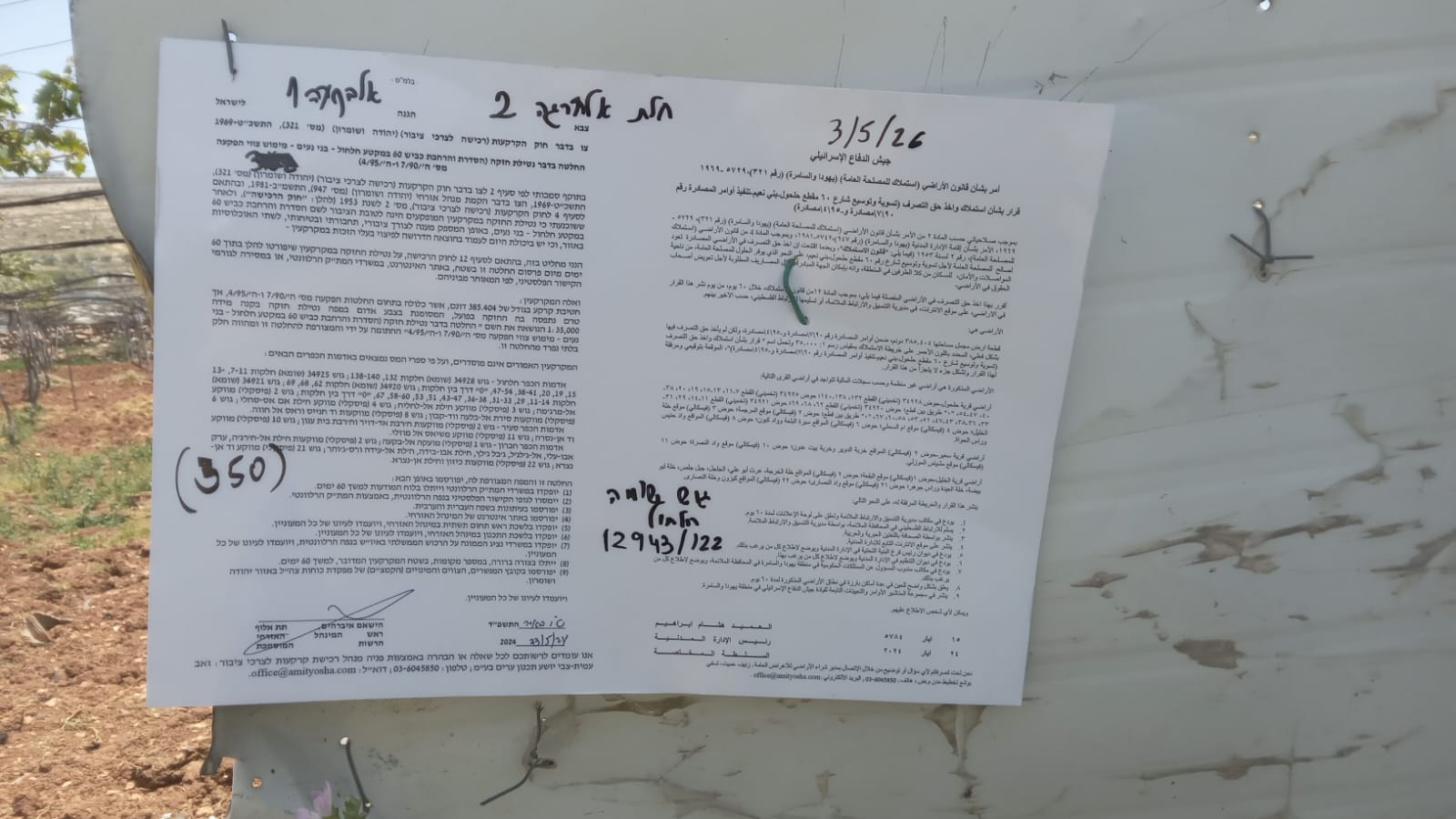 Muhammad D.May-13-2026Hebron - Request for compensation for land expropriation
-
South Hebron Hills
See all reports for this place-
South Hebron Hills
South Hebron Hills is a large area in the West Bank's southern part.
Yatta is a major city in this area: right in the border zone between the fertile region of Hebron and its surroundings and the desert of the Hebron Hills. Yatta has about 64,000 inhabitants.
The surrounding villages are called Masafer Yatta (Yatta's daughter villages). Their inhabitants subsist on livestock and agriculture. Agriculture is possible only in small plots, especially near streams. Most of the area consists of rocky terraces.Since the beginning of the 1980s, many settlements have been established on the agricultural land cultivated by the Palestinians in the South Hebron Hills region: Carmel, Maon, Susia, Masadot Yehuda, Othniel, and more. Since the settlements were established and Palestinians cultivation areas have been reduced; the residents of the South Hebron Hills have been suffering from harassment by the settlers. Attempts to evict and demolish houses have continued, along with withholding water and electricity. The military and police usually refrain from intervening in violent incidents between settlers and Palestinians do not enforce the law when it comes to the investigation of extensive violent Jewish settlers. The harassment in the South Hebron Hills includes attacking and attempting to burn residential tents, harassing dogs, harming herds, and preventing access to pastures.
There are several checkpoints in the South Hebron Hills, on Routes 317 and 60. In most of them, no military presence is apparent, but rather an array of pillboxes monitor the villages. Roadblocks are frequently set up according to the settlers and the army's needs. These are located at the Zif Junction, the Dura-al Fawwar crossing, and the Sheep Junction at the southern entrance to Hebron.
Updated April 2022
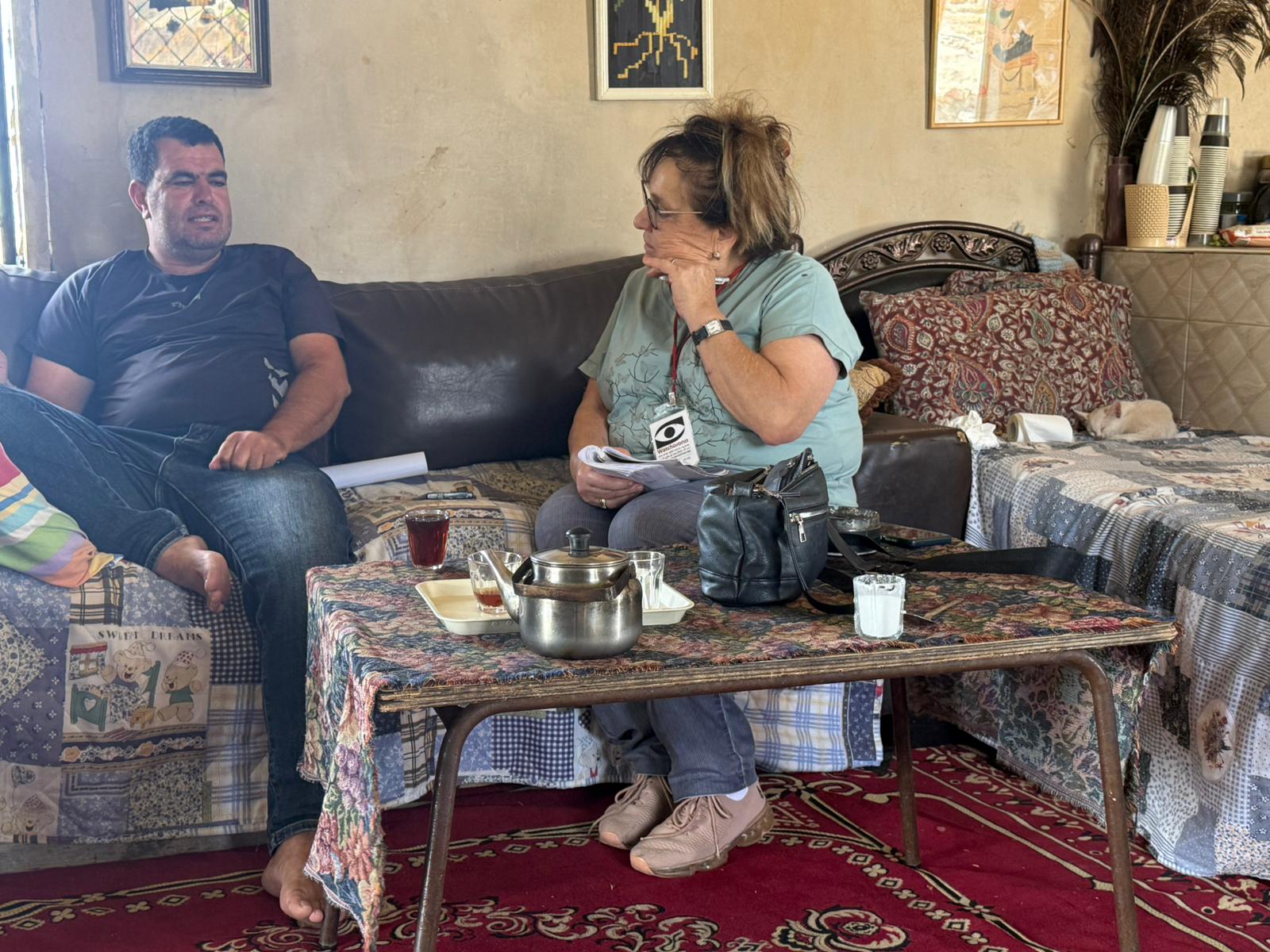 Muhammad D.Aug-31-2026Michal with B'Tselem researcher Nasser Nawaja'a in Susiya
-
