
Ar-Ram, Qalandiya, Mon 3.1.11, Afternoon
The extent of the mess at Qalandiya became apparent to us only slowly. It seems that nothing was working properly. The new western facility for people arriving by bus had been opening and closing intermittently all day long, driving people crazy. As a result, the pressure of crowds in the old pedestrian passageways rose considerably but nothing was done to relieve it – on the contrary, the soldiers on duty continued to open and close passageways with no consideration for the numbers of people and the time spent waiting on line. At the end of our shift, as more and more people were returning from work and studies in Ramallah, there were only two passageways open, one of which was only for those who were not carrying bags and parcels. This constitutes clear discrimination against women who are always carrying something in their hands.
The CP was like an island in a sea of traffic jammed up in every conceivable direction. As a result, the buses from Ramallah have stopped trying to drive through the CP, they don't even come close (because then they would be caught in the jam), but discharge their passengers back up the line where they can still make a u-turn and beat a retreat. Consider what this means for the handicapped and for mothers with small children.
Later on we learned that there were changes in the traffic situation all over the area. On the road from Qalandiya to the city of A-Ram vehicles were stalled bumper to bumper because of roadwork. The 2-lane road connecting to "Highway" 60 has become one-way and one-lane, going west to east one-half the distance and east to west the other half. This must be somewhat confusing for anyone trying to get from "Highway" 60 to Ramallah – we still haven't figured out how it's done. Back in the northern square of Qalandiya, one of the vehicle lanes exiting northward has been blocked by concrete blocks. This forces cars going to Ramallah to travel east (out of their way) for about a kilometer where they reach a roundabout and join the traffic jam going north. In short, "balagan" hardly begins to describe the situation and no one seems to know when it will be solved.
16:15, Qalandiya: When we reached Qalandiya, there were two active passageways, when one was closed another was opened. The poor folks standing at the head of the line in the passageway that was closed were, of course, the last to reach the line that formed in the passageway that had opened and were forced to wait twice as long. Suddenly a new line was opened, but this, unfortunately, was exclusively for those who were not carrying bags or parcels, i.e. for a limited number of men only.
The situation at Qalandiya is difficult. Even our friend the coffee vendor has given up in despair and taken his stand to another CP. I hope he's making a better living there.
We went outside into the northern square to see what was happening in the new "bus" passageway. We found that the passageway was closed. The gatekeeper told us that for the last two days this passageway has been opened and closed intermittently, four or five times a day. Buses have stopped driving to the CP because of the long wait in the traffic jam. He told us that on Sunday morning (2.1.2011) the children arriving by bus had not been allowed through to get to school. They had been delayed at the CP for two hours. When they realized that they had missed their school day, they all returned home. Contrary to past practice, the children were not allowed to use the "Humanitarian Gateway" in the old part of the CP.
Traffic was jammed up in every direction. A taxi driver sitting in the jam swore by his children that he was waiting for 1.5 hours already. It was easy to believe him. Others told us that they had waited yesterday for 2 and even 3 hours in the traffic jams around Qalandiya.
17:00: There are two active passageways in the old CP. One of them is crowded with men women and children (about 50 in all) while the other is almost empty (this is the line for people without bags).
17:15: We left Qalandiya and were immediately swallowed by the traffic jam. When we reached A-Ram we found that the road had become a one-lane one-way track going east.
Mid-way to Adam Junction, this road became a one-lane one-way track going west. All those travelling to Jerusalem were diverted to a detour through the city of A-Ram that eventually rejoined the old road at Lil/Jabba CP.
A-Ram
See all reports for this place-
two kilometers south of Qalandiya and 300 metres north of Neve Yaacov Junction, in Dahiyat el-Barid Quarter. Checkpoint has operated since 1991, in a Palestinian area annexed to Jerusalem in 1967. The checkpoint has been inactive since the middle of 2009.
The wall was built on the road that led to Jerusalem. Since then the situation in the town has deteriorated. Houses are abandoned and half finished, most of the businesses have closed. Severe neglect around the fence and on the streets. Those who could left. Updated January 2024
-
Qalandiya Checkpoint / Atarot Pass (Jerusalem)
See all reports for this place-
Click here to watch a video from Qalandiya checkpoint up to mid 2019 Three kilometers south of Ramallah, in the heart of Palestinian population. Integrates into "Jerusalem Envelope" as part of Wall that separates between northern suburbs that were annexed to Jerusalem in 1967: Kafr Aqab, Semiramis and Qalandiya, and the villages of Ar-Ram and Bir Nabala, also north of Jerusalem, and the city itself. Some residents of Kafr Aqab, Semiramis and Qalandiya have Jerusalem ID cards. A terminal operated by Israel Police has functioned since early 2006. As of August 2006, northbound pedestrians are not checked. Southbound Palestinians must carry Jerusalem IDs; holders of Palestinian Authority IDs cannot pass without special permits. Vehicular traffic from Ramallah to other West Bank areas runs to the north of Qalandiya. In February 2019, the new facility of the checkpoint was inaugurated aiming to make it like a "border crossing". The bars and barbed wire fences were replaced with walls of perforated metal panels. The check is now performed at multiple stations for face recognition and the transfer of an e-card. The rate of passage has improved and its density has generally decreased, but lack of manpower and malfunctions cause periods of stress. The development and paving of the roads has not yet been completed, the traffic of cars and pedestrians is dangerous, and t the entire vicinity of the checkpoint is filthy. In 2020 a huge pedestrian bridge was built over the vehicle crossing with severe mobility restrictions (steep stairs, long and winding route). The pedestrian access from public transport to the checkpoint from the north (Ramallah direction) is unclear, and there have been cases of people, especially people with disabilities, who accidentally reached the vehicle crossing and were shot by the soldiers at the checkpoint. In the summer of 2021, work began on a new, sunken entrance road from Qalandiya that will lead directly to Road 443 towards Jerusalem and Tel Aviv. At the same time, the runways of the old Atarot airport were demolished and infrastructure was prepared for a large bus terminal. (updated October 2021)
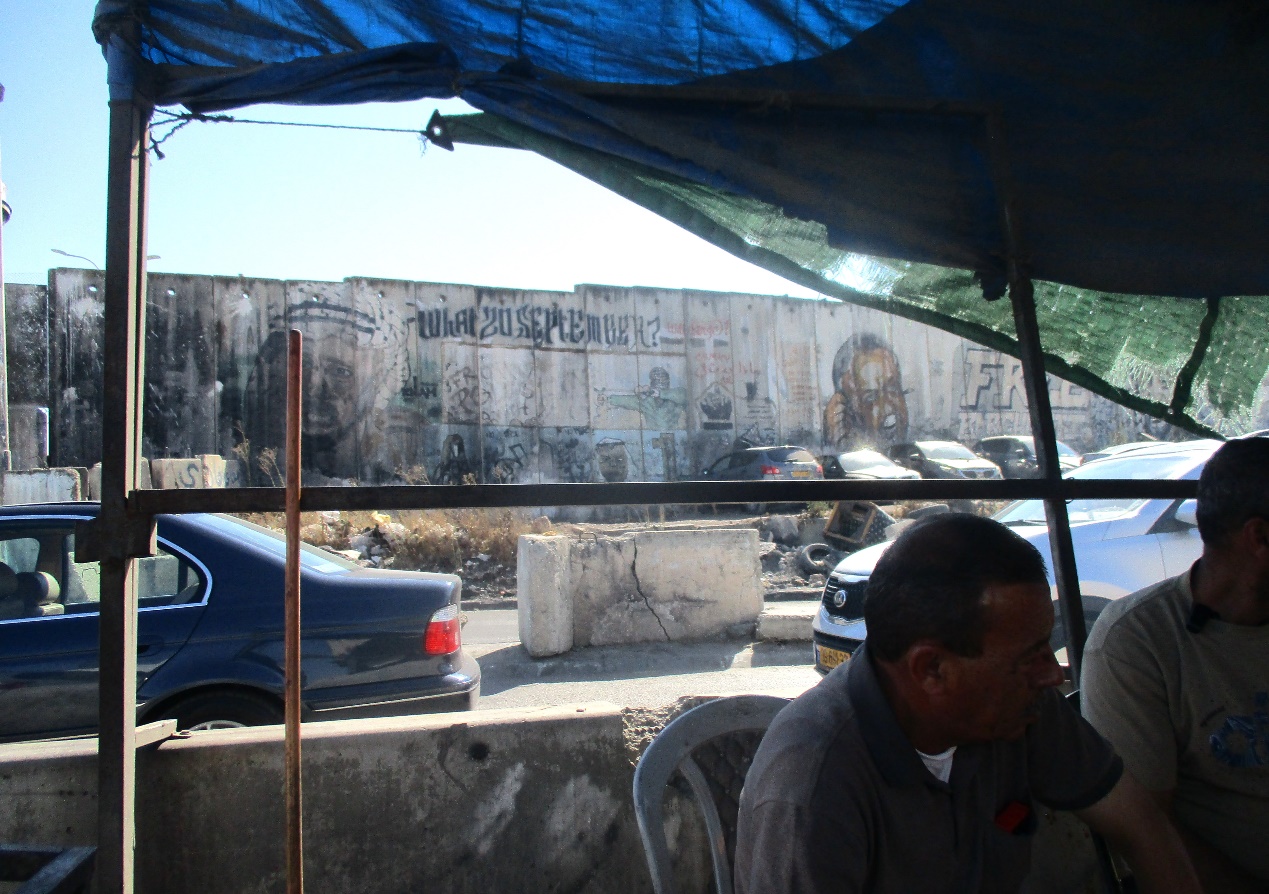 Tamar FleishmanJul-21-2026Qalandiya. Conversation in the shadow of the wall
-
