
Habla and Falamya agricultural gates, through villages to Funduq, Jit Junction and Anabta, 14.2.11, morning
Habla and Falamya agricultural gates, through villages to Funduq, Jit Junction and Anabta,
07:00 Habla
The gate opened on time. The revolving gate at the entrance is out of order and people enter through the exit from the facility. Inspections go quickly and the first five come through in three minutes.
It seems to us there are many laborers going through today and many arguments about places on line. There’s disorder near the gate, and even though the soldiers let the bus through without inspection, they are delaying it until the laborers get away from the gate. The elderly guard from the plant nurseries also crosses today without being inspected.
A laborer who came through and is waiting nearby for his brother who hasn’t yet crossed says that he expects the soldiers to keep order on the line, and that he’ll be late for work because of the disorder…
07:30 We left, even though many laborers hadn’t yet crossed.
The road from Jayyus to Tulkarm, which is being repaved, is open, and we don’t have to drive through the village, but because of the roadworks farther on we failed to turn to the Jayyus agricultural gate and drove to the Falamya gate.
08:05 Falamya
A tractor and passengers are quickly inspected, as are a horse and rider. No one is waiting.
08:20 We leave.
We stop at Kfar Jamal, next to the grocery, and people immediately ask whether we need help. A discussion starts; people gather and recount problems.
- An elderly couple, whose lands are beyond the fence, have crossing permits but its hard for them. Their son works in Jericho but comes home for two days every week. He can’t get a crossing permit so he can’t help his parents.
- A Palestinian with two plots of land: one near Falamya gate and the second near Sla’it gate, which is far away and hard to reach. He can get a crossing permit for only one of them.
- The third received a permit to reach his land beyond the fence, but his wife isn’t allowed to cross
S., a farmer with 25 dunams of olive trees and 21 dunams of za’atar that he exports to Jordan, speaks excellent Hebrew and helps translate. He’s a roofer by profession, had a permit for many years to work in Israel and made a good living. But one day he got fed up with the harassment at the checkpoints and decided to stop working in Israel. He resumed farming. Every day he goes to his fields which are also beyond the fence. Sometimes the soldiers tell him he’s forbidden to cross; when he insists they check with the DCO, make believe they’re correcting the error and allow him through.
There’s a well on the land with an output of 900/hrs/month, but he has only 770 hours when he can work. He wants a permit to remain at night in order to use all the available water. He went to the area with T., the crossings officer, to explain the problem. The officer took all the documents and promised to help, but when S. went to the DCO to meet Sh., the officer in charge of Qalqilya, he said that he was turned down rudely and abusively, despite his explanations.
He concludes our conversation by saying that everything is arbitrary and illogical. But he understands very well and greatly respects our efforts to make people in Israel and the world aware of the occupation’s injustices. He also knows about Sylvia and her work, and greatly respects her efforts.
After having tea we part and continue via the village of Zibat to the village of Hajja. The road is beautiful, the day clear and all is blooming.
We notice a lot of new construction along the road of large, attractive homes and wonder whether it’s Area B. We stop next to a man walking on the roadside who confirms it’s Area B and construction is permitted but the fear is that if Qedumim, which is nearby, is expanded, more land will be taken from them and they won’t be permitted to build on their lands. Part of Hajja is in Area B, and the other side of the road is Area C.
He tells us that when he was a boy he’d travel freely to Israel and find all kinds of temporary jobs, so he knows Hebrew. Later, in the ‘80s, he studied economics in Jordan but couldn’t find a job so came back to his village to work his land. Fortunately, all the village lands are on this side of the fence, so they don’t have any problems of that kind.
Thank God, there’s work, and all his children are with him. He invited us to his home, of course, but we thanked him and drove on.
We drive via Funduq, reach Jit junction and return to reality.
10:00 A flying checkpoint at Tapuach junction. Two Hummers and a police car pull cars over to the roadside, inspect documents and release them a few minutes later. We watched, from above, what was going on, saw that the inspections were quick and no line formed, so we drove on.
The checkpoint clearly reminded us that the occupation is alive and well, despite the easing of restrictions!
We drove freely through the'Anabta checkpoint, though there were soldiers in the pillbox, and then homeward through Te’anim gate.
'Anabta CP
See all reports for this place-
'Anabta CP
The checkpoint is located south of the village of 'Anabta, at the intersection of Road 60 (leading to Nablus at the entrance to Area A), with Road (57, 557, 5576) facing west towards the Einav settlement and the checkpoint at the exit from the West Bank - Figs checkpoint. Until 2010 we used to watch the intersection and report the long columns created due to a slow inspection of the vehicles in both directions.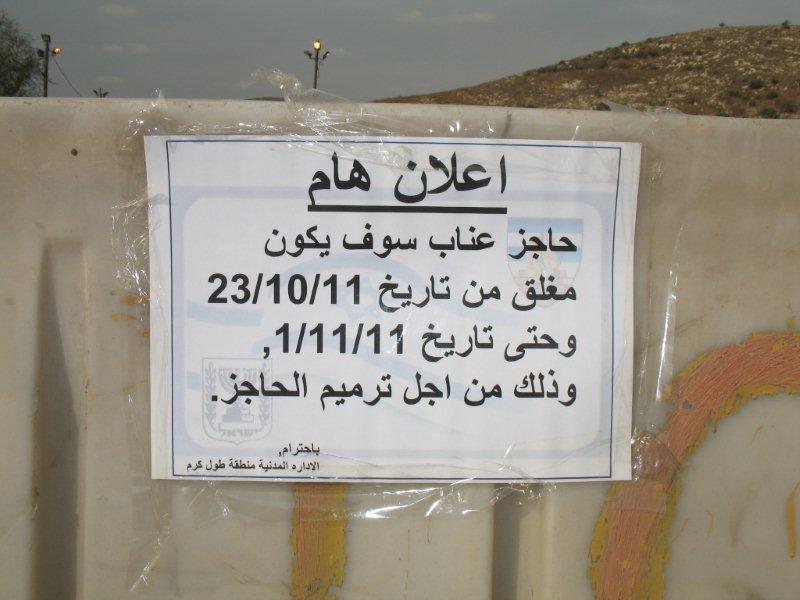 Oct-28-2011Anabta checkpoint 24.10.11
-
Habla
See all reports for this place-
Habla CP (1393)
The Habla checkpoint (1393) was established on the lands of the residents of Qalqilya, on the short road that
connected it for centuries to the nearby town of Habla. The separation barrier intersects this road twice and cut off the residents of Qalqilya from their lands in the seam zone.(between the fence and the green line).
There is a passage under Road 55 that connects Qalqilya to the sabotage This agricultural barrier is used by the farmers and nursery owners established along Road 55 from the Green Line and on both sides of the kurkar road leading to the checkpoint.
This agricultural checkpoint serves the residents of Arab a-Ramadin al-Janoubi (detached from the West Bank), who pass through it to the West Bank and back to their homes. The opening hours (3 times a day) of this agricultural checkpoint are longer than usual, about an hour (recently shortened to 45 minutes), and are coordinated with the transportation hours of a-Ramadin children studying in the occupied in the West Bank.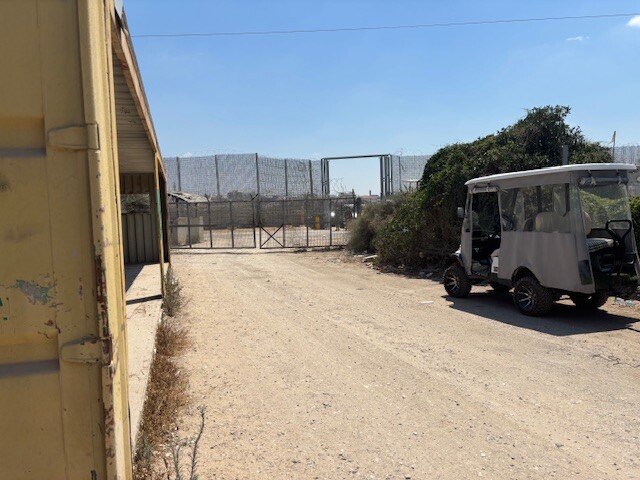 Nina SebaAug-18-2025Habla: The gate is in the process of closing
-
Jit Junction
See all reports for this place-
The checkpoint is located on Route 60 near at the junction with Route 55, near the village of Jit. There was a checkpoint for vehicles passing between the north and south of the West Bank, which was abolished towards 2010. Since then, surprise checkpoints have been set up there from time to time with a police or Border Police vehicle, and vehicles and their passengers are inspected.
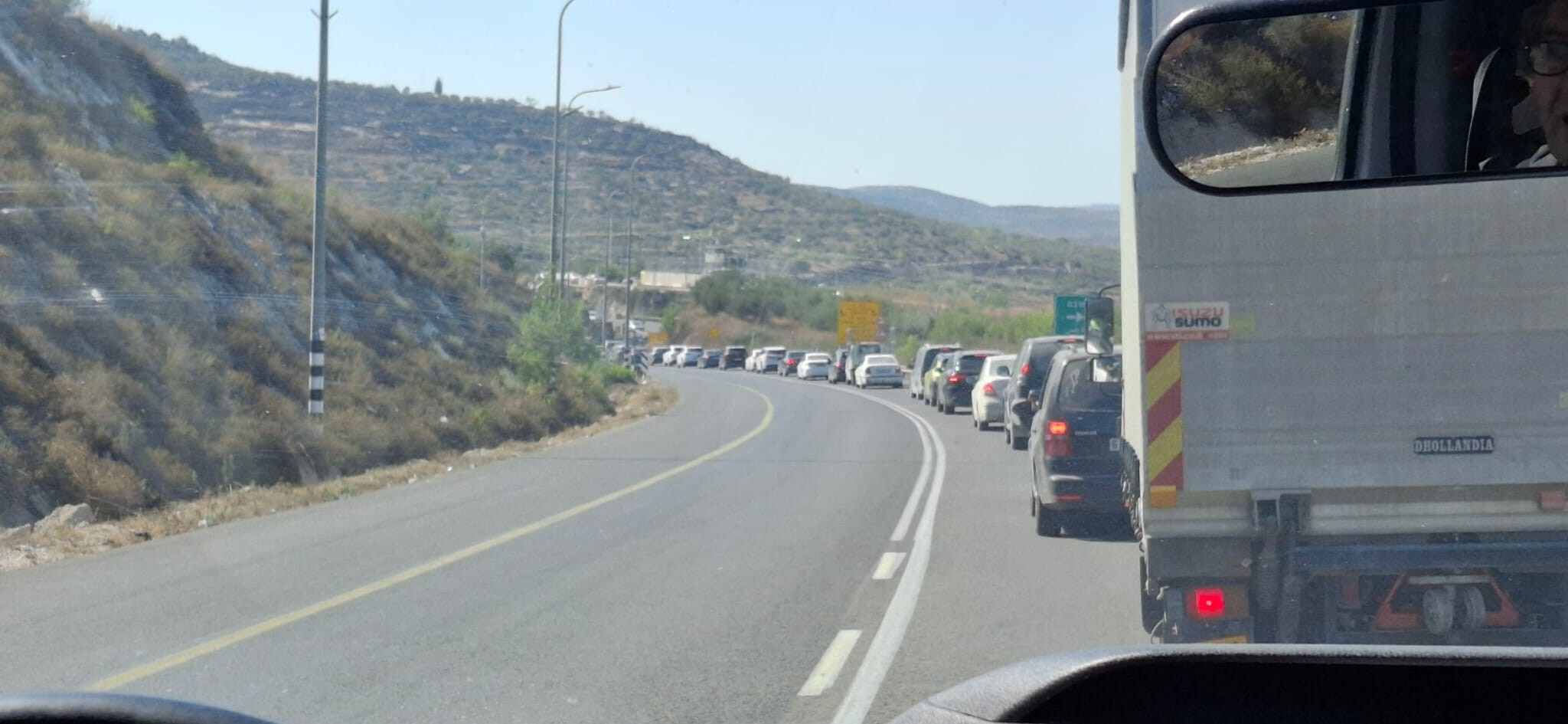 Anat PolakJul-17-2025Yitzhar Road, Jit Junction: traffic jam
-