
‘Anabta, Beit Iba, Deir Sharaf, Habla, Irtah (Sha’ar Efrayim), Jubara (Kafriat), Sun 22.5.11, Afternoon
Summary
It’s of course presumptuous to say that the women of MachsomWatch are helping to harness change in the Middle East, but it’s true that we are, have been and will continue to be a democratic movement, and that we have called for an end to what looks like permanent occupation, and for a peace deal based on endorsing the reality of Israel’s boundaries before the 1967 Six Day War. Our main objectives are based on the protection of Palestinian human rights of which earning a livelihood and enjoying freedom of movement are but two rights on which we report violations. Moreover, we who pass into the OPT and monitor the ever creeping Separation Barrier, and what it involves, see in it a demographic reality that does increasing damage to the fabric of Palestinian life with the non stop harassment and humiliation that defines occupation.
13:15 Green Line
We cross the Green Line, over Route 6, Israel’s only toll road, and wonder, as we do, each week, how our fellow citizens are left in total ignorance as to where that line should, in fact, be. There are no markings, no signs of what once existed or exists today on precious few maps. The Green Line between what is internationally recognized (the 1949 Armistice) as Israel and what is occupied Palestinian territory tends to be ignored both in theory and practice. And to the women of MachsomWatch it’s pretty clear that the Israeli government would like to move final borders as far east as they possibly can. It is therefore obvious why Netanyahu, now in Washington, downplays the significance of the Green Line. But the reality we view, several kilometers ahead and east of us, is the ever creeping Separation Barrier, snaking its way through lands that have, for generations, been Palestinian owned.
13:20 Habla Gate 1392
The gates have been open for a while; the almost brand new pedestrian gate is now padlocked, no longer used – after how few weeks? A soldier, one of a group of reservists, tells us that they are new here; that he has no idea about a school bus of Bedouin children, but a bus has already passed; he adds, quite cheerfully, that he’d prefer to be at the Dead Sea or in Eilat, but then the conversation ceases when a fellow soldier informs us that we cannot stand where we have been, but need to step back to the gate itself.
Another soldier trains a pair of binoculars on the village of Habla, and on being asked why, says he’s looking at “the view” including flowers of which there are none at this time of year.
A beautiful horse appears, together with a frisky and skittish young foal not far behind, but otherwise few people, just one tractor and one horse drawn cartful of fruit.
Route 55, Deir Sharaf, Anabta, Route 57
Nothing untoward to report, merely that Occupation seems to go on forever. Happily, the beautiful carpentry work of the Huwwash Brothers near the former Beit Iba checkpoint seems to display a more welcoming permanence.
Near Jubara, on Route 57, one Hummer has stopped an Israeli car (yellow license plates), on the side of the road, and at Jubara the two seated soldiers don’t even bother to get up as we pass.
16:10 – cows crossing the road make a change from the customary goats and sheep, and these, not the usual black and white, but light brown, waddle their way to yellowing fields, which seem to provide little sustenance for the likes of cows, near the back-to- back crossing at Irtah.
16:15 Irtah (Sha’ar Efraim)
A large crowd of returning workers in a never ending flow, but no women at this relatively late hour. We learn that entry into Israel for the laborers this morning, the first day of the new week, was “as expected” but, lo and behold, the entryway, through the turnstile, into the checking hall, is completely closed and, instead, a metal gate, leading directly to a turnstile, leading down to the other turnstiles by the parking lot on the Palestinian side of the “terminal” is now open.
We express our pleasant surprise to the Palestinians who greet us in their usual manner, but as they walk this untrodden path homewards, they display no emotion, either of astonishment or joy, at this so-called new found freedom. After all, the checking hall and its ugly monitoring of body and foodstuffs could be back tomorrow! Years of occupation have taught Palestinians that nothing can be trusted, that the only consistency about occupation lies in its inconsistency.
As is usual here, we have been spotted by the private contracting company overseeing this “terminal,” and a staff member appears from inside the checking hall, telling us, that today is the first day of a new policy: no checking of Palestinians on their return to the Territories. He has no idea who made such a decision, merely that for the first time in his five years at the “terminal,” there is no checking of returning Palestinians — at least for today.
'Anabta CP
See all reports for this place-
'Anabta CP
The checkpoint is located south of the village of 'Anabta, at the intersection of Road 60 (leading to Nablus at the entrance to Area A), with Road (57, 557, 5576) facing west towards the Einav settlement and the checkpoint at the exit from the West Bank - Figs checkpoint. Until 2010 we used to watch the intersection and report the long columns created due to a slow inspection of the vehicles in both directions.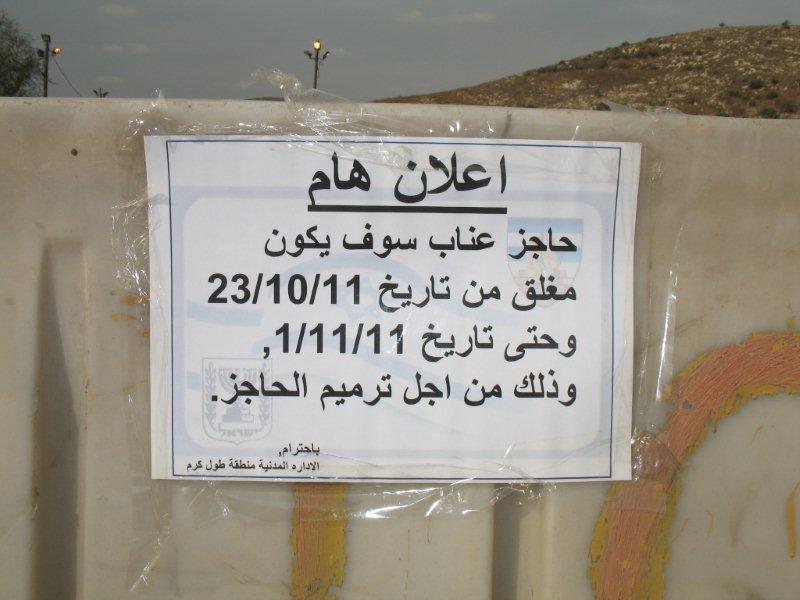 Oct-28-2011Anabta checkpoint 24.10.11
-
Beit Iba
See all reports for this place-
A perimeter checkpoint west of the city of Nablus. Operated from 2001 to 2009 as one of the four permanent checkpoints closing on Nablus: Beit Furik and Awarta to the east and Hawara to the south. A pedestrian-only checkpoint, where MachsomWatch volunteers were present daily for several hours in the morning and afternoon to document the thousands of Palestinians waiting for hours in long queues with no shelter in the heat or rain, to leave the district city for anywhere else in the West Bank. From March 2009, as part of the easing of the Palestinian movement in the West Bank, it was abolished, without a trace, and without any adverse change in the security situation.
 Jun-4-2014Beit-Iba checkpoint 22.04.04
-
Deir Sharaf checkpoint
See all reports for this place-
Deir Sharaf checkpoint is located west of Nablus and south of the settlement of Shavei Shomron, at the entrance to the village of Deir Sharaf on the road leading to Nablus. The checkpoint was activated in early March 2009 after the Beit Iba checkpoint was closed. Palestinians are allowed through the checkpoint , but not for Israelis. Unlike the checkpoints leading to Qalqilya and Tulkarm, crossing of Israeli Palestinians is only allowed on Saturdays.
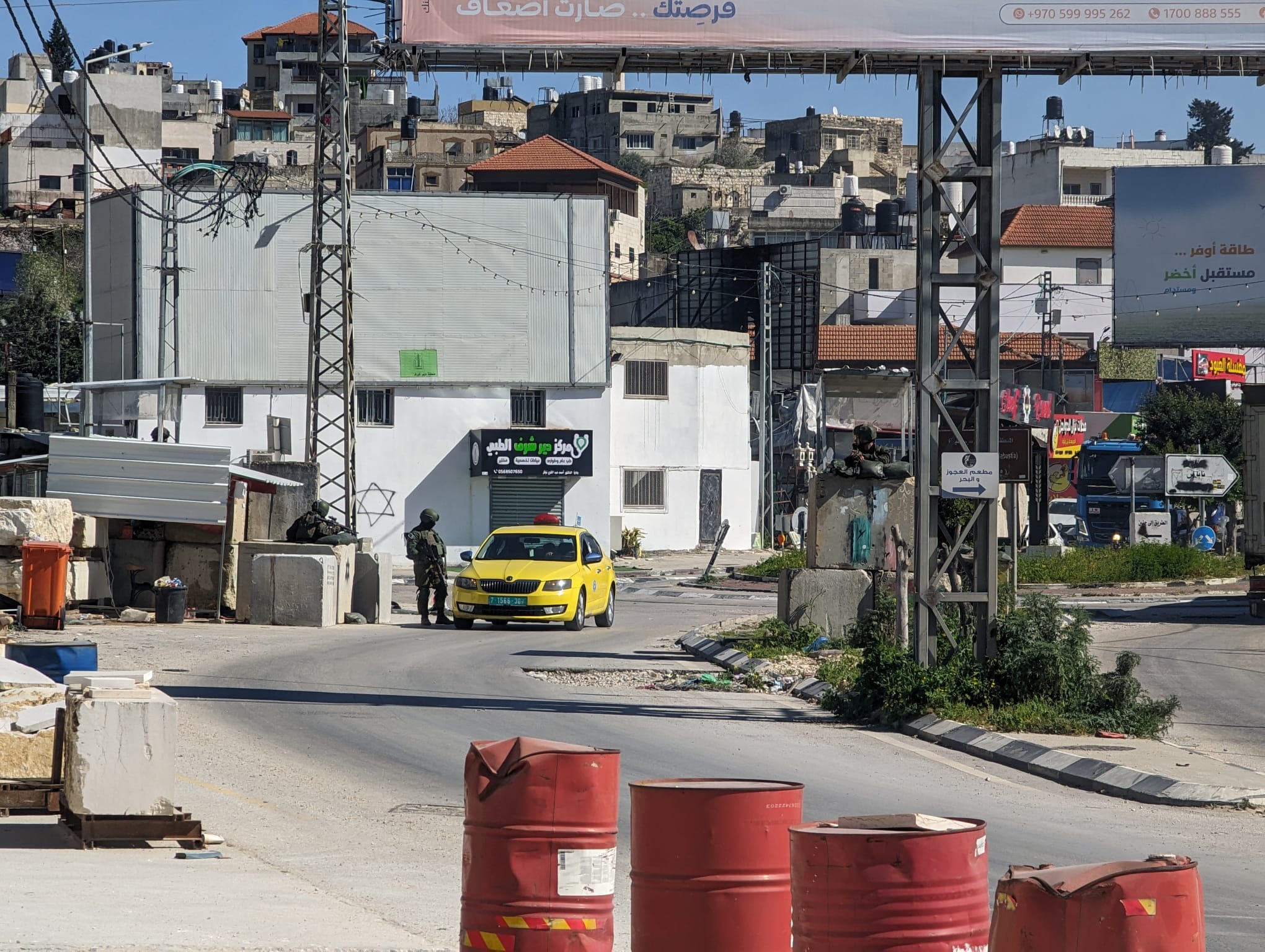 Nina SebaFeb-28-2024Deir Sharaf - the entrance to the village
-
Habla
See all reports for this place-
Habla CP (1393)
The Habla checkpoint (1393) was established on the lands of the residents of Qalqilya, on the short road that
connected it for centuries to the nearby town of Habla. The separation barrier intersects this road twice and cut off the residents of Qalqilya from their lands in the seam zone.(between the fence and the green line).
There is a passage under Road 55 that connects Qalqilya to the sabotage This agricultural barrier is used by the farmers and nursery owners established along Road 55 from the Green Line and on both sides of the kurkar road leading to the checkpoint.
This agricultural checkpoint serves the residents of Arab a-Ramadin al-Janoubi (detached from the West Bank), who pass through it to the West Bank and back to their homes. The opening hours (3 times a day) of this agricultural checkpoint are longer than usual, about an hour (recently shortened to 45 minutes), and are coordinated with the transportation hours of a-Ramadin children studying in the occupied in the West Bank.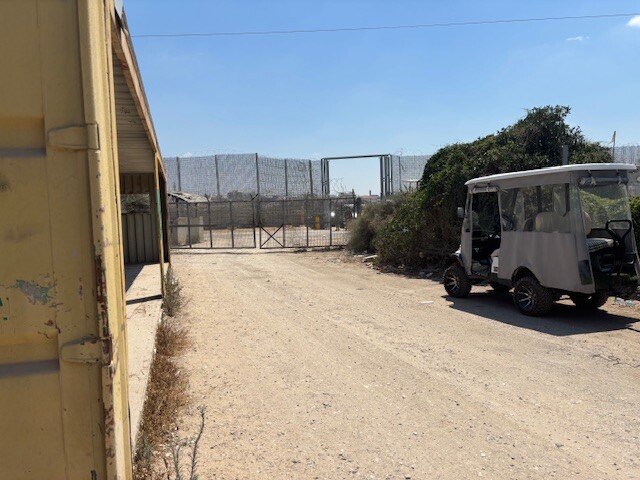 Nina SebaAug-18-2025Habla: The gate is in the process of closing
-
Irtah (Sha'ar Efrayim)
See all reports for this place-
The checkpoint is for Palestinians only. It is the main barrier to the passage of workers from the northern West Bank to Israel. Workers with a permit to work in Israel and also for trade (with appropriate permissions), medicine, and visiting prisoners. One can cross the checkpoint only on foot. The checkpoint is located north of Road 557 and south of Tulkarm. Operated by a civil security company, opening hours: between 4:00 and 19:00 on weekdays. As members of Machsom Watch, we began our shifts to this location in 2007. We arrived before it opened at 4 in the morning and report since, on the harsh conditions and the long and crowded queues of workers. The workers who pass by continue their journey by transportation to work throughout Israel. In the first period of its activity, about 3,000 and then 5,000 people passed through this checkpoint every day. Due to the small number of checking points and arbitrary delays for long periods of time in the "rooms", workers feared losing their transportation. Hence workers leave their homes at 2:30 at night to be among the first. Today, 15,000 pass and the transition is faster. Workers are still leaving their homes very early to get past the checkpoint at 7 p.m. In an adjacent compound, there is a terminal for the transfer of goods on a commercial scale, using the back-to-back method.
-
Jubara (Kafriat)
See all reports for this place-
The Jabra checkpoint was on Road 557, south of Tulkarm, on the side of the Figs Pass, which is located within the Palestinian Authority (a few kilometers east of the Green Line), and serves as an entry barrier from the territories to Israel. The checkpoint to the village of Jubara, which until 2013 was in the seam area, blocked and surrounded by a fence, was intended for the passage of the family members of the house next to the checkpoint, and also for the MachsomWatch volunteers (with special permission only), on their way to checkpoint 753. on the other side of the village. The soldiers supervising the "fig crossing" also supervised the crossing at this checkpoint, in our shifts we often waited a long time until the key was found and the gate opened. The checkpoint was abolished and became part of the separation fence that was moved west following the High Court.
-