Back to reports search page

Abu Dis, Ras Abu Sbitan (Olive Terminal), Sheikh Saed, Silwan, Wed 25.5.11, Morning

Observers: Idit Schlesinger, Anant Tueg (reporting)
May-25-2011
| Morning


6:50 Sheikh Saed
 
In conversation with the driver of the vespa-ambulance parked at the feet of the checkpoint in Jabel Mukhaber we learn that recently the road with the checkpoint stayed open several times for the passage of ambulances, and that is a welcome change.   All the owners of a variety of permits cross the checkpoint without unnecessary delays.  Those without permits apparently no longer come this way.  To our question whether there had been any special events on the day of Naqba the answer was negative.
 
7:30 Silwan
 
A lot of stones scattered across the roads of the Bustan neighbourhood testify to all the confrontations, past and future.  As for work on infrastructure — the construction of sidewalks going down from the City of David has begun on the eastern side of Ein Hilweh St.  We have yet to see how far this improvement will go.  Meantime traffic in one direction towards the temple mount proceeds slowly.
 
8:00 Zeitim Crossing
 
An excited meeting outside the checkpoint with a group of women from Jericho on their way for a day-trip to Haifa and Acco.  For the majority of these women, this is a first visit to Israel and they are very excited, surprised by our presence and our very existence, the older women introducing us to the younger who have not met many Israelis, and who ask many questions about our activities.  With resepct to crossing, they are supplied with all the necessary permits, but one had forgotten her permit and had to return to Jericho to fetch it. At the crossing itself we met women from the group waiting in a line which moved very slowly.  Two lanes are open, and everything advances slowly, with removal of shoes, etc., and even when that stage is over, almost all have to make a special request to open the turnstile leading out of the checkpoint.  Again and again the soldiers forget to open, and those who have been checked must wait and then request to be released.
 
Idit finds a pair of glasses forgotten by one of the women in her rush to leave the checkpoint, and leaves them with the driver to deliver to the owner.  We call the commander of the crossing who replies courteously and says he'll check and try to speed things up.  We witness a heart-rending scene of a mother and her 4-5 year old: the magnometer beeps again and again, the mother takes off the child's pants impatiently and he has to cross, weeping, in his underwear.  It is a prolonged procedure for the child.  Meanwhile a line of people forms in the lane intended for crossing to the DCO, and it's already 8:45.  We call the DCO, which is in fact open, but the crossing to it is for some reason closed.  A. promises to check, and indeed, within a couple of minutes, people are able to cross.
 
9:15 Wadi Nar
 
Curious to see what has changed in the diversion of traffic, we drive from Kedar to the checkpoint and find that the road is already marked as one-way from the checkpoint, and a sign has been posted directing Palestinian traffic towards the descent to the wadi where  the new road to Al-Ezariah is under construction.  Now it's clear: traffic from the south of the West Bank will be diverted to Al-Ezariah by way of the old descent (the Jihalin way we used once upon a time), and one-way traffic from the north and from Al-Ezariah will travel up the dangerous slope to the Wadi Nar checkpoint, and from there to the south of the West Bank.  A. from the Civil Administration is unable to say just when all this will happen.   To us it is not clear whether a manned checkpoiont will be set up next to the concrete blocks goint into the new Kedar road.  On this matter too, A. is unable to tell.


  • Abu Dis / Lazarus gate (formerly The Wicket)

    See all reports for this place
    •  

      Abu Dis / Lazarus Checkpoint/Gate (east of the former “wicket”)

      Construction of the wall in the Abu Dis area blocked all the gaps that allowed people to cross from al-Ezariya to the neighbourhoods of Abu Dis and Ras al 'Amud that are located within Jerusalem’s municipal boundary. The Lazarus checkpoint is a gate in the wall adjacent to the Lazarus Monastery. Until 2011 it had a door for pilgrims to al-Ezariya and for the monastery’s kindergarten pupils from al-Ezariya. The crossing is currently closed, but the site has infrastructure for conducting inspections.

  • Ras Abu Sbitan (Olive Terminal)

    See all reports for this place
    • A large checkpoint/crossing to the area of a-Tur, Abu Dis and the Old City; only for pedestrians. Located on Jerusalem’s municipal boundary.

      One of the major crossings in Jerusalem’s central sector. It is located on the separation fence between the northern portion of the al-Ezariya neighborhood and the neighborhood of a-Tur and the rest of East Jerusalem. It is manned by Border Police soldiers and private security companies and operates 24 hours a day. Palestinians are forbidden to go through, other than permanent residents of East Jerusalem (holders of blue ID cards) and holders of work and commercial permits who are allowed through only on foot.

  • Sheikh Sa'ed

    See all reports for this place
    • A checkpoint limited to pedestrians, located on Jerusalem’s municipal boundary.

      The checkpoint sits on the separation fence at the entrance to Sheikh Sa’ad, dividing it from its neighbourhood of Jabel Mukkabar. It’s manned by Border Police soldiers and private security companies and operates 24 hours a day. Palestinians are forbidden to go through, other than residents of Jabel Mukkabar or Sheikh Sa'ad who have permits. Both groups are permitted through only on foot. Residents of East Jerusalem who don’t live in Jabel Mukkabar are also allowed to cross to Sheikh Sa’ad, but not in the opposite direction; they must return through the Sawahira ash Sharqiya checkpoint.
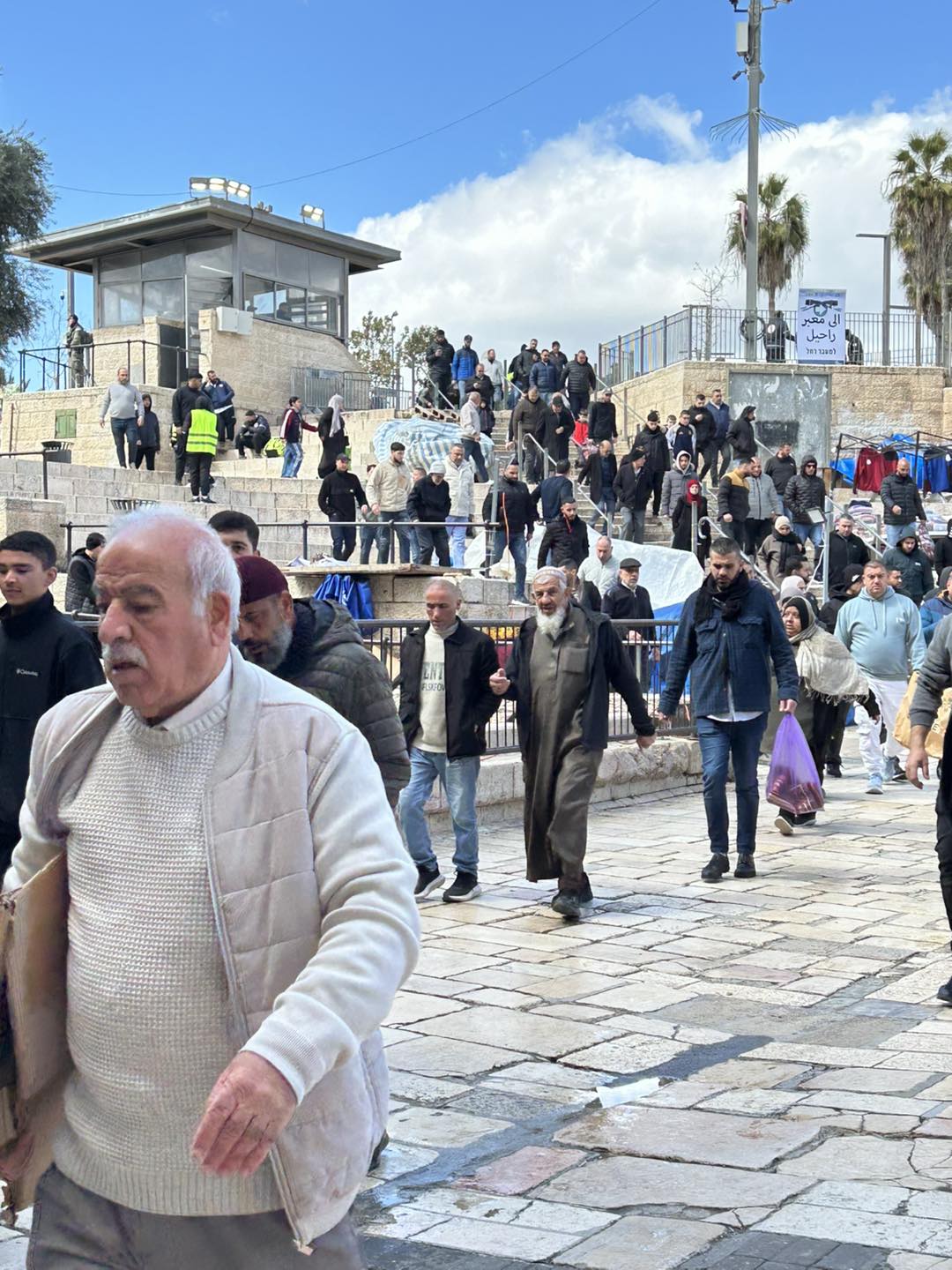
      ירושלים, שער שכם: קהל ממהר לתפילה
      Avital C
      Feb-27-2026
      Jerusalem, Damascus Gate: Crowd rushing to prayer
  • Silwan

    See all reports for this place
    • Silwan is south of the Old City of Jerusalem and has become one of the main confrontation areas with settlers.


Donate