
Agricultural crossings, Habla, Jubara (Kafriat), Tue 17.5.11, Morning
We hadn’t been in the field for about five months, and after reading the regular reports decided to visit the agricultural crossings and the villages.
We entered the territories through the Eliyau gate. No one paid us any attention, and traffic flowed freely.
We reached the Habla gate at 07:30. It had opened at 07:00, when, according to the soldiers, the children went through. Workers in the plant nurseries were crossing when we arrived.
A few dozen workers stand by the gate; they enter five at a time to have their ID’s checked. The inspection is quick, the soldiers easygoing (reservists). They say they don’t have answers to our questions “and the less we know, the better,” with all that implies.
A tractor also went out to work while we were there.
The gate is open three times a day, at 07:00, 13:00 and 18:00.
From there we continued on Route 55, passing Khirbet a-Nabi Elias, Izbet Tabib, Azzun and the picturesque village of Sir on the way to Jayyous.
08:00 The Jayyous agricultural crossing is closed.
We got on the road connecting Azzun with Tulkarm. Most of the roads are unpaved, but they’re working on all the roads, apparently with funds from donors and the Palestinian Authority. There’s no sign of the occupation except, of course, the fence surrounding the entire region.
The area doesn’t look the same as it used to.
We went through the village of Falmia and visited one of Nadim’s relatives who told us that things are ok with them; he has a permit to work in Israel, and the village is quiet.
We continued to the Jubara gate, which was closed to those coming from Tulkarm. The village can be entered only from one direction. We bypassed Tulkarm and reached Anabta, where there’s an unmanned checkpoint.
We reentered Israel through the Te’anim gate, which was manned; cars entering Israel are inspected.
Habla
See all reports for this place-
Habla CP (1393)
The Habla checkpoint (1393) was established on the lands of the residents of Qalqilya, on the short road that
connected it for centuries to the nearby town of Habla. The separation barrier intersects this road twice and cut off the residents of Qalqilya from their lands in the seam zone.(between the fence and the green line).
There is a passage under Road 55 that connects Qalqilya to the sabotage This agricultural barrier is used by the farmers and nursery owners established along Road 55 from the Green Line and on both sides of the kurkar road leading to the checkpoint.
This agricultural checkpoint serves the residents of Arab a-Ramadin al-Janoubi (detached from the West Bank), who pass through it to the West Bank and back to their homes. The opening hours (3 times a day) of this agricultural checkpoint are longer than usual, about an hour (recently shortened to 45 minutes), and are coordinated with the transportation hours of a-Ramadin children studying in the occupied in the West Bank.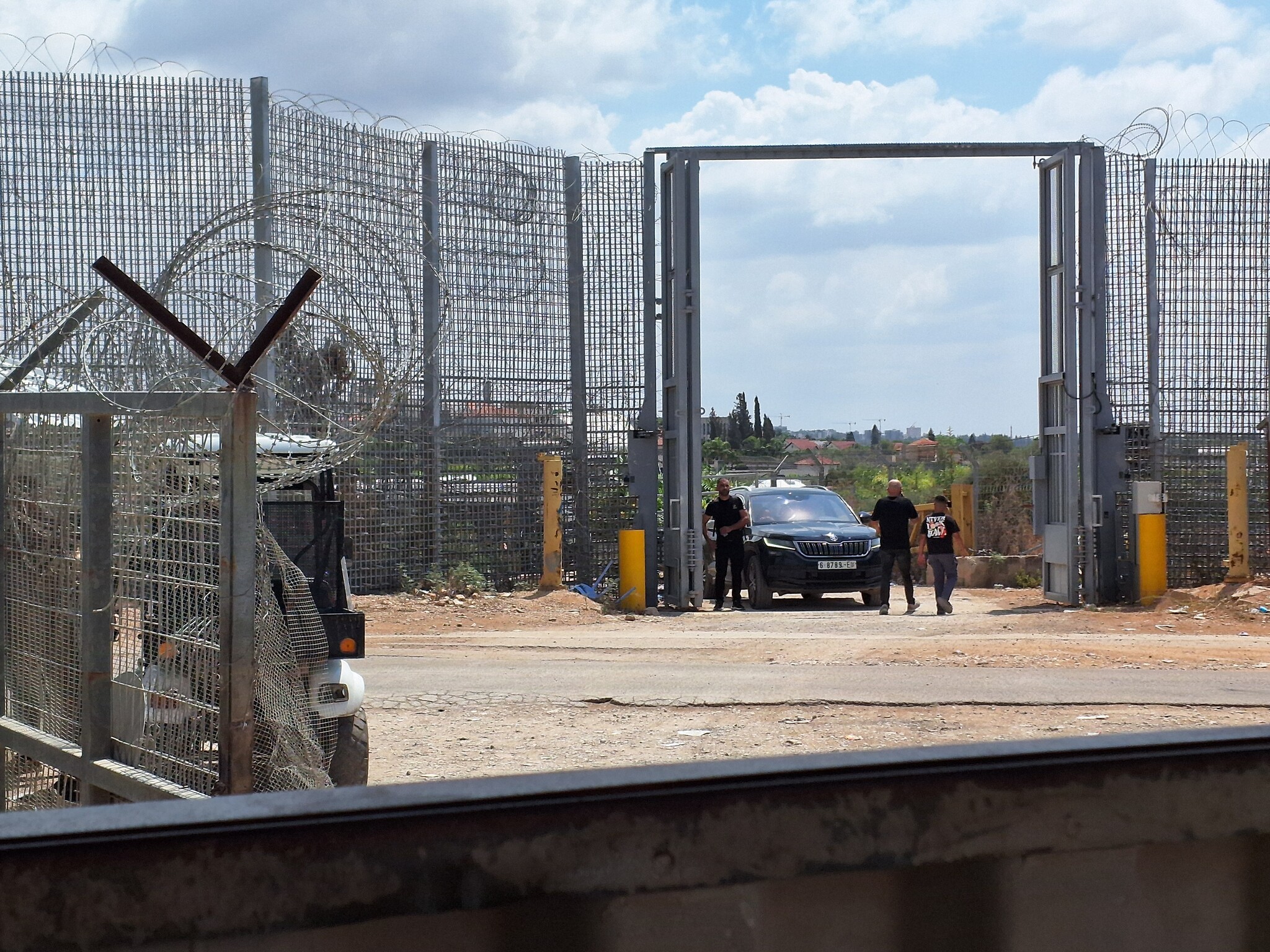 Ronit Dahan-RamatiAug-31-2026Habla. The gate is open
-
Jubara (Kafriat)
See all reports for this place-
The Jabra checkpoint was on Road 557, south of Tulkarm, on the side of the Figs Pass, which is located within the Palestinian Authority (a few kilometers east of the Green Line), and serves as an entry barrier from the territories to Israel. The checkpoint to the village of Jubara, which until 2013 was in the seam area, blocked and surrounded by a fence, was intended for the passage of the family members of the house next to the checkpoint, and also for the MachsomWatch volunteers (with special permission only), on their way to checkpoint 753. on the other side of the village. The soldiers supervising the "fig crossing" also supervised the crossing at this checkpoint, in our shifts we often waited a long time until the key was found and the gate opened. The checkpoint was abolished and became part of the separation fence that was moved west following the High Court.
-
