
‘Anin, Reihan, Shaked, Thu 23.6.11, Morning
Translator: Charles K.
06:00 A’anin checkpoint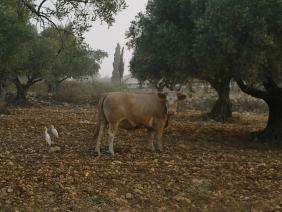
On our way to the checkpoint we caught red-handed the cows from Ein Sahala grazing on the olive trees in a grove belonging to a resident of A’anin. He often complains about the damage they do and says he knows who the cowherds are but isn’t able to do anything about them because of the fence.
The checkpoint is wrapped in fog that hides the sunrise.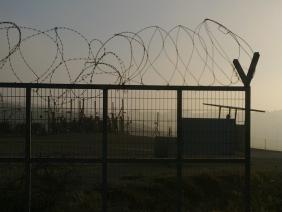
About 30 people and a donkey, and also some tractors, wait in the center of the checkpoint, which has three gates: One to the grove on the village side (which we can’t see from where we’re standing), one in the center of the checkpoint and one at the entrance to the checkpoint from the seam zone. Closed off hermetically.
There are children at the checkpoint because of school vacation, but not all go through. Even if it’s only to visit grandparents in Umm Reihan (the adjoining village in the seam zone, beyond the fence) or simply to help their father in the fields. Each child must come with the parent in whose ID card he’s listed, and with a birth certificate. Not all go through. The adults aren’t able to tell us why, the soldiers don’t want to tell us why (“Shut up, and please leave the checkpoint,” said a soldier to Netta). One of the children who was refused keeps insisting, isn’t willing to accept the edict and makes a fuss. The soldiers tell him, “Yallah, rukh” (beat it), the father, who’s already gone through the checkpoint, tells him, “Yallah, tra’wayyikh” (go home), and the boy is having a fit. He wants to cross, he wants to. The father, embarrassed, apologizes: “He’s not well mentally.” The boy keeps the soldiers busy until the checkpoint closes, he in Arabic, they in Hebrew. One of the Palestinians inside the checkpoint tries to push him back but the boy eludes him and returns to the soldiers. Before they close the checkpoint (after a delay, because of the “incident,” at 7 instead of 6:30), two soldiers push him forcefully through the middle gate and then to the lower one. The boy keeps yelling that he wants to cross. His father left a long time ago.
All the adults going through the checkpoint – women, elderly people, men – welcome us, stop for a friendly conversation, to complain, to joke (“I sat home 80 days waiting for a permit. What did I do? I was on the internet all day. Girls, of course. Why not? No good?). Under their influence, the younger generation also smiles at us on their own initiative. Sometimes.
07:05 Tura-Shaked checkpoint
Unlike the friendly atmosphere at A’anin, at Tura no one is in a hurry to talk to us in any language. Especially the women and youths. But one of the men who crossed from the West Bank to the seam zone is, in fact, willing to talk, in Hebrew. He told us that Abbas, the DCO, was replaced by Wael. The locals are willing to give him a chance. “We’ll see how it goes.” Opinions of Abbas are mixed. They’re not impressed by the state-in-waiting (Palestine) – what difference does it make? There’s no work in any case, and the money goes to the pockets of those on top.
There aren’t any pupils at the checkpoint, who usually liven things up. Crossing goes smoothly, with no problems. And why should there be problems? The only ones who come to the checkpoint are people with valid crossing permits. Many more would like to cross but have to remain home because they didn’t get permits.
07:35 Reihan checkpoint
The crossing goes like clockwork here, too, and there’s nothing to report, other than to note that here, too, there are very many people who want and must go through to Barta’a or to Jenin, were they able to obtain permits. We shouldn’t forget this, and must understand that the peace and quiet at the checkpoint is the result of the occupation’s purposely deceptive policies. A lie and a fraud, to say the least.
People exit quickly from the vehicles in which they arrived and are quickly swallowed up in the terminal. The workday begins here. Fancy new cars fill the parking lot, 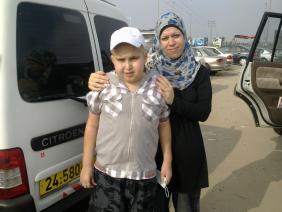 some flying small Palestinian flags.
We pick up Ali and his mother. Netta will bring them to the hospital. Ali speaks Hebrew that he learned at Rambam Hospital. A nice boy, full of medications. Fighting for his life. We hope the transplant will succeed and he’ll keep living.
'Anin checkpoint (214)
See all reports for this place-
'Anin checkpoint (214)
'Anin checkpoint is located on the Separation Fence east of the Israeli community Mei Ami and close to the village of Anin in the West Bank. It is opened twice a week, morning and afternoon, on days with shorter light time, for Anin farmers whose olive groves have been separated from the village by the fence it became difficult to cultivate their land. Transit permits are only issued to those who can produce ownership documents for their caged-in land, and sometimes only to the head of the family or his widow, eldest son, and children. Sometimes the inheritors lose their right to tend to the family’s land. The permits are eked out and are re-issued only with difficulty. 55-year-old persons may cross the checkpoint (into Israel) without special permits. During the olive harvest season (about one month around October) the checkpoint is open daily and more transit permits are issued. Names of persons eligible to cross are held in the soldiers’ computers. In July 2007, a sweeping instruction was issued, stating that whoever does not return to the village through this checkpoint in the afternoon will be stripped of his transit permit when he shows up there next time. Since 2019, the checkpoint has not been allways locked with the seam-line zone gate (1 of 3 gates), and the fence around it has been broken in several sites.
-
Barta’a-Reihan Checkpoint
See all reports for this place-
This checkpoint is located on the Separation Fence route, east of the Palestinian town of East Barta’a. The latter is the largest Palestinian community inside the seam-line zone (Barta’a Enclave) in the northern West Bank. Western Barta’a, inside Israel, is adjacent to it. The Checkpoint is open all week from 5 a.m. to 9 p.m. Since mid-May 2007, the checkpoint has been managed by a civilian security company subordinate to the Ministry of Defense. People permitted to cross through this checkpoint into and from the West Bank are residents of Palestinian communities inside the Barta’a Enclave as well as West Bank Palestinian residents holding transit permit. Jewish settlers from Hermesh and Mevo Dotan cross here without inspection. A large, modern terminal is active here with 8 windows for document inspection and biometric tests (eyes and fingerprints). Usually only one or two of the 8 windows are in operation. Goods, up to medium commercial size, may pass here from the West Bank into the Barta’a Enclave. A permanent registered group of drives who have been approved by the may pass with farm produce. When the administration of the checkpoint was turned over to a civilian security firm, the Ya’abad-Mevo Dotan Junction became a permanent checkpoint. . It is manned by soldiers who sit in the watchtower and come down at random to inspect vehicles and passengers (February 2020).
-
Tura-Shaked
See all reports for this place-
Tura-Shaked
This is a fabric of life* checkpoint through which pedestrians, cabs and private cars (since 2008) pass to and from the West Bank and the Seam-line Zone to and from the industrical zone near the settler-colony Shaked, schools and kindergartens, and Jenin university campuses. The checkpoint is located between Tura village inside the West Bank and the village of Dahar Al Malah inside the enclave of the Seam-line Zone. It is opened twice a day, between 7 a.m. and 10 a.m., and from 12 noon to 7 p.m. People crossing it (at times even kindergarten children) are inspected in a bungalow with a magnometer. Names of those allowed to cross it appear in a list held by the soldiers. Usually traffic here is scant.
- fabric of life roads and checkpoints, as defined by the Terminals Authority in the Ministry of Defense (fabric of life is a laundered name that does not actually describe any kind of humanitarian purpose) are intended for Palestinians only. These roads and checkpoints have been built on lands appropriated from their Palestinian owners, including tunnels, bypass roads, and tracks passing under bridges. Thus traffic can flow between the West Bank and its separated parts that are not in any kind of territorial contiguity with it. Mostly there are no permanent checkpoint on these roads but rather ‘flying’ checkpoints, check-posts or surprise barriers. At Toura, a small (less than one dunam) and sleepy checkpoint has been established, which has filled up with the years with nearly .every means of supervision and surveillance that the Israeli military occupation has produced. (February 2020)
 Mar-21-2022Anin Checkpoint: A magnificent breach in the center of the checkpoint
-