Qalandiya, Tue 29.11.11, Morning
Translator: Charles K.
Mornings at Qalandiya are always difficult and horrid.
Everyone crossing here feels sullied, humiliated and powerless.
There are days when everything that can go wrong, does.
Today’s such a day, November 29, early in the morning.
At 06:00 the cries of rage and anger can be heard all the way to the parking lot. Many people began climbing on the revolving gates again and there is terrible chaos everywhere. There are no orderly lines, only a huge mass of angry people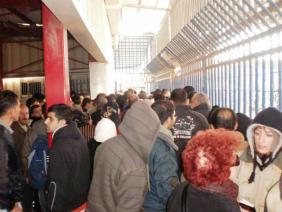 .
.
A varied crowd congregates at the “humanitarian” gate. Laborers also try their luck there; if they don’t get through they’re stuck and have no way to extricate themselves from the congestion. It’s impossible for old people who have difficulty standing, for the ill and for infants to handle this line.
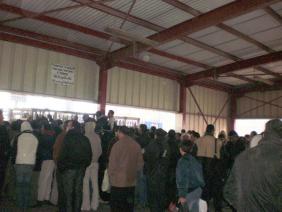
Today we saw tall men on the “humanitarian” line holding babies aloft so they won’t be crushed in the crowd.
We managed to bring through an old woman who could barely stand, but even the officer in charge was unable to get an old man to the gate. He stood pressed against the fence while the gate opened and closed a number of times, unable to move forward.
Young men who had given up trying to get through told of broken ribs, of their bosses who won’t wait if they’re late. The ecumenicals are changing shifts; three new volunteers who’ve just arrived are learning what things are really like.
Officers are in charge this morning, and they also appear pretty desparate. S. responds to every one of our appeals for help, the gate opens relatively early, but the lines in the fenced corridors take hours. They’re either short of soldiers, or they’re working slowly. Throughout this confusion and our attempts to help those waiting, the reasons for the disorder remain the same.
Timing: A laborer who arrived at the revolving gate at 06:50 came through at 07:30 – forty minutes. He exited on the Israeli side at 09:05. He’d waited another hour and thirty-five minutes in the fenced corridor. A total of two-hours-and-a-quarter.
The ecumenicals went through the empty humanitarian lane at 08:00. They came out at 09:40. At eight AM you have to wait one hour and forty minutes for inspection!
The ecumenicals told us that now they also have to go through the checkpoint, and can no longer ride the bus through the vehicle checkpoint. They don’t know whether this order applies only to the humanitarian organizations, or to all tourists.
This terrible reality slams us anew each week. How we’ve imprisoned an entire people in a cellar, behind fences and checkpoints and barriers, invisible to us as we lead our pleasant, protected lives. And does anyone think there’s any connection between security and this daily, horrible harassment.
Qalandiya Checkpoint / Atarot Pass (Jerusalem)
See all reports for this place-
Click here to watch a video from Qalandiya checkpoint up to mid 2019 Three kilometers south of Ramallah, in the heart of Palestinian population. Integrates into "Jerusalem Envelope" as part of Wall that separates between northern suburbs that were annexed to Jerusalem in 1967: Kafr Aqab, Semiramis and Qalandiya, and the villages of Ar-Ram and Bir Nabala, also north of Jerusalem, and the city itself. Some residents of Kafr Aqab, Semiramis and Qalandiya have Jerusalem ID cards. A terminal operated by Israel Police has functioned since early 2006. As of August 2006, northbound pedestrians are not checked. Southbound Palestinians must carry Jerusalem IDs; holders of Palestinian Authority IDs cannot pass without special permits. Vehicular traffic from Ramallah to other West Bank areas runs to the north of Qalandiya. In February 2019, the new facility of the checkpoint was inaugurated aiming to make it like a "border crossing". The bars and barbed wire fences were replaced with walls of perforated metal panels. The check is now performed at multiple stations for face recognition and the transfer of an e-card. The rate of passage has improved and its density has generally decreased, but lack of manpower and malfunctions cause periods of stress. The development and paving of the roads has not yet been completed, the traffic of cars and pedestrians is dangerous, and t the entire vicinity of the checkpoint is filthy. In 2020 a huge pedestrian bridge was built over the vehicle crossing with severe mobility restrictions (steep stairs, long and winding route). The pedestrian access from public transport to the checkpoint from the north (Ramallah direction) is unclear, and there have been cases of people, especially people with disabilities, who accidentally reached the vehicle crossing and were shot by the soldiers at the checkpoint. In the summer of 2021, work began on a new, sunken entrance road from Qalandiya that will lead directly to Road 443 towards Jerusalem and Tel Aviv. At the same time, the runways of the old Atarot airport were demolished and infrastructure was prepared for a large bus terminal. (updated October 2021)
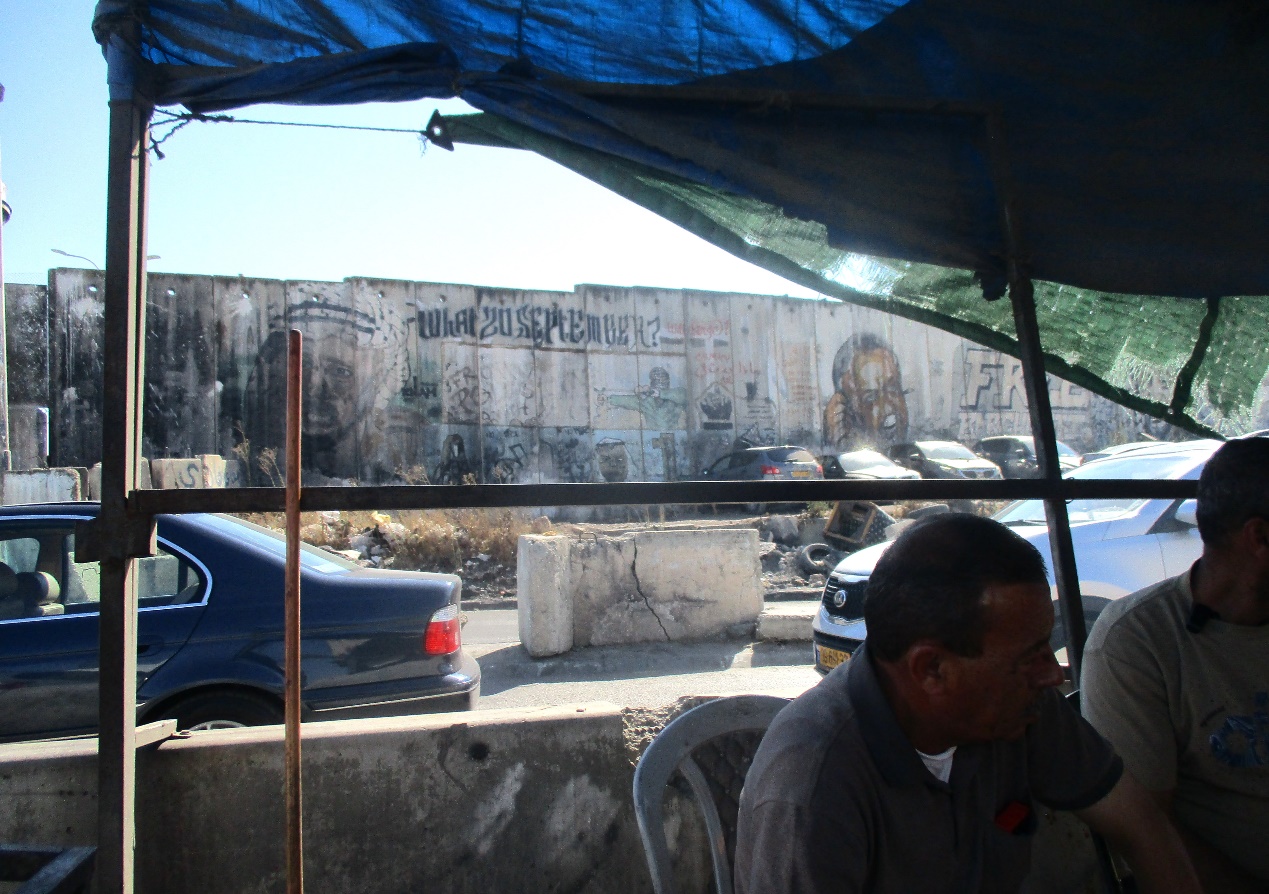 Tamar FleishmanJul-21-2026Qalandiya. Conversation in the shadow of the wall
-