
Solidarity tour in the Jordan Valley
Translator: Charles K .
.
Thanks to Ya’kov Manur and Jamila for organizing the tour.
Background:
In recent weeks, as the weather became hotter, the Civil Administration has found creative evil ways to deny water and dry up the Palestinian residents of the Jordan Valley. A large number of water wagons have recently been confiscated, the excuse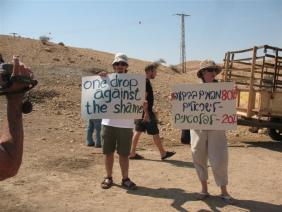 being that they’re used to steal water. Hundreds of residents, including infants, the ill and the elderly, have thus been condemned to thirst. An additional way of harassing the Palestinian residents – expulsion for a set period because of military exercises.
Illuminating facts:
The area of the Jordan Valley is more than 1 ½ million dunums, comprising about 30% of the West Bank. The Palestinian population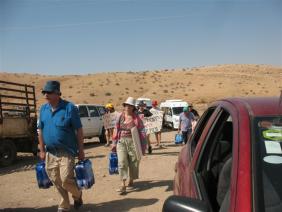 exceeds 60,000 people. There are 10,000 settlers. 88% is defined as Area C. 78% of the land is controlled by Jews. Most of the water available in the Jordan Valley is pumped by Mekorot. The settlers use 80% of the water. The remaining 20% is available to the Palestinians for household and agricultural use. The average water consumption in the Jordan Valley settlements: 1,300 liters per person, per day, including for agriculture. The average water consumption on the West Bank: 74 liters per person, per day; in the Palestinian villages in the Jordan Valley – only 20 liters per person, per day.
The worst apartheid exists in the Jordan Valley: 53% of the land has been declared “state land,” large areas of which were granted to the settlements – no less that 12% of the land in the Jordan Valley.
The bureaucracy of plunder: Confiscated lands are declared to be “state land”; land is taken for military purposes; Jordanian state lands are declared to be Israeli state lands; etc., etc. 45% of the area has been declared a “closed military region.” 20% of the area has been defined as nature reserves. Planning regulations don’t allow Palestinians to build, but permit settlers to build without limitations. Buildings constructed by Palestinians are repeatedly demolished. Israel violates almost every prohibition in international conventions relating to an occupying power, though it is a signatory to most of them.
The tour: Led by Fat’hi Khadarat, from Jordan Valley Solidarity
The tour began near where the Abu-El-Ajaj tribe lives, next to the Masu’a settlement. There used to be an UNRWA refugee camp here. An UNRWA school still operates.
The Bedouin are forbidden to transport water. In recent years many tents in which people lived were destroyed. The tribe’s mosque is located in the nearby Aryei army base.
A new settlement is planned between Masu’a and the army base, on the grounds of the demolished Gadi base (which was apparently erected where a Jordanian army base had been located prior to 1967). Fat’hi understands the new settlement will be a rehabilitation facility for troubled Israeli youth.
Soldiers showed up while he was explaining; later they’ll detain us at the Hamra junction.
The temperature has reached 43 degrees Celsius.
We continued past the Palestinian localities in the Jiftlik area which have access to water from Wadi Fara (Nahal Tirza) and got on the main road (Highway 57, connecting Adam junction on Highway 90 with the Hamra junction). At the Hamra junction, as we turned north, three soldiers descended upon us from the Hamra checkpoint and blocked our way. They told the drivers to get out, took their IDs and licenses; one of the soldiers stuffed them in his pocket.
At this point we tried to tell the soldiers that it’s illegal to confiscate IDs, nor is it clear by what authority they’re detaining us. The driver returned the Jewish driver’s documents. The phone call to Chana allowed us to continue the tour 15 minutes later. We could see by the expression on his face how unwillingly the soldier returned the Palestinian driver’s documents as well (a blue, Israeli, ID).
We drove north along the Alon road. This time I saw the Gochia checkpoint, closed and attached to the concrete cubes (on my previous shift, 12.7.12, I hadn’t seen the gate).
At Ein el Hilweh (Tevetz junction) we sat in the F. family’s tent and heard from them and from Fat’hi about the shortage of water, the thefts and harassment by the settlers and their difficulty maintaining their herd of cows.
A water truck filled the family’s containers; participants in the tour also had brought bottled water. Army vehicles and a police pickup truck were parked at the junction during our entire visit.
I think we have to show solidarity with other Bedouin encampments who suffer as much as the people we visited