Ar-Ram, Qalandiya, Sun 17.3.13, Afternoon
Translating: Ruth Fleishman
Qalandiya:
Despite the cold and despite the anguish of the body and the soul, a cancer 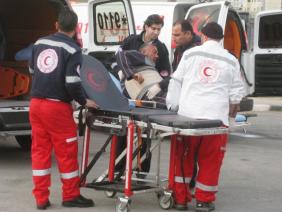 patient was forced to move with the remaining of his strength from an occupied territories stretcher to the one that came from Jerusalem, from the occupied territories ambulance to the Jerusalem ambulance, he had to present his belongings before the eyes of armed men who made sure the objects and their owner didn't pose a threat to the state of Israel.
And it is obligatory to remember and recite and make it known, that the weakest ones, these tortured patients of every age and gender, that are permitted by the rules of occupation to be hospitalized only after such procedures, and that millions of human beings had already stood in that very same spot, and that hundreds like them will find 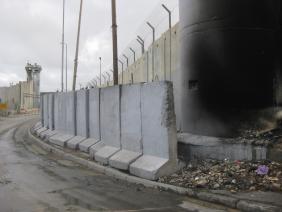 themselves in the same situation, in the same ambulance (or another like it) and the same stretcher, before the same armed men and regulations, at any time of the year, at any time of the day under any type of weather.
For they are all suspects and invisible in the eyes of occupation.
.
– Mahmud Jabari who had yet to turn sixteen was hunted down by soldiers on Thursday the 14th of March during a run-in between protesting Palestinian teenagers and military forces.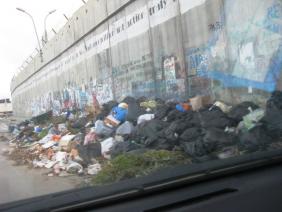
This was the third time Mahmud had seen the inside of an Israeli prison. According to the testimony of witnesses and from my own familiarity and personal acquaintancewith the lad, Mahmud never throws stones. But they didn't hesitate to arrest him again so as to use him as an "incriminating witness" that would hand names, names of those who did or did not throw stones. So that they could rely on his coerced testimony, with or without any relevance to the truth, to prosecute, convict and imprison other teenagers. On the following day of his arrest, Mahmud was released. Until next time.
– Our guests Guido and Damian who were making a video for the Jewish community in Argentina about the realities of the occupation were happy to interview Abdullah Tamimi, who recounted before them the story of his longings to his family's village, a place he had been to or seen.
Abdullah, who had come to terms with the fact that his family will never be able to return to its land and that only dreams of visiting the place where his ancestors are buried, kept repeating over and over again the sentence: "I am not a terrorist".
Being a Palestinian who had his rights as his property confiscated, andbeing of no status, Abdullah knows that in order to survive he must always prove himself to be of clean record and intentions. A kind of certificate of good conduct that in itself holds no guarantee for the future.
About Saris, the native village of Abdullah Tamimi's family:
http://www.zochrot.org/place/%D7%A1%D6%B7%D7%90%D7%A8%D6%B4%D7%99%D7%A1
(Many thanks for Eitan Boronstien for forwarding his link)
-Some cosmetic changes were made on the Palestinian side of the checkpoint building: the outer wall and the tower were painted and cleaned from inscription, and their uniform appearance was restored, in addition the yellow pole that blocked the traffic lane was removed.
People said that in the dead of night soldier armed with brushes came out of the checkpoint and did the job. They were so keen to cover the paintings and inscriptions that they reached the Raise's portrait, they came to close to it that they nearly covered Arafat's face which had become the symbol of the place. An order that was given at the last minute to stop the work was what saved Yasser Arafat's face.
No cosmetic work could clear the crimes of occupation, and neither could gestures or minor reliefs such as the fixing the drinking fountain, the opening an additional lane, speeding up the crossing procedures or a smile on the face of an armed man.
Behind all this exists a well operating monstrous and evil machine, one that has to be uprooted and not beautified.
Ar-Ram
It seems that the town is vanishing behind stacks of rubbish which are piling up on every street, between traffic lanes and along the separation wall, and their small drifts to great distances.
A-Ram
See all reports for this place-
two kilometers south of Qalandiya and 300 metres north of Neve Yaacov Junction, in Dahiyat el-Barid Quarter. Checkpoint has operated since 1991, in a Palestinian area annexed to Jerusalem in 1967. The checkpoint has been inactive since the middle of 2009.
The wall was built on the road that led to Jerusalem. Since then the situation in the town has deteriorated. Houses are abandoned and half finished, most of the businesses have closed. Severe neglect around the fence and on the streets. Those who could left. Updated January 2024
-
Qalandiya Checkpoint / Atarot Pass (Jerusalem)
See all reports for this place-
Click here to watch a video from Qalandiya checkpoint up to mid 2019 Three kilometers south of Ramallah, in the heart of Palestinian population. Integrates into "Jerusalem Envelope" as part of Wall that separates between northern suburbs that were annexed to Jerusalem in 1967: Kafr Aqab, Semiramis and Qalandiya, and the villages of Ar-Ram and Bir Nabala, also north of Jerusalem, and the city itself. Some residents of Kafr Aqab, Semiramis and Qalandiya have Jerusalem ID cards. A terminal operated by Israel Police has functioned since early 2006. As of August 2006, northbound pedestrians are not checked. Southbound Palestinians must carry Jerusalem IDs; holders of Palestinian Authority IDs cannot pass without special permits. Vehicular traffic from Ramallah to other West Bank areas runs to the north of Qalandiya. In February 2019, the new facility of the checkpoint was inaugurated aiming to make it like a "border crossing". The bars and barbed wire fences were replaced with walls of perforated metal panels. The check is now performed at multiple stations for face recognition and the transfer of an e-card. The rate of passage has improved and its density has generally decreased, but lack of manpower and malfunctions cause periods of stress. The development and paving of the roads has not yet been completed, the traffic of cars and pedestrians is dangerous, and t the entire vicinity of the checkpoint is filthy. In 2020 a huge pedestrian bridge was built over the vehicle crossing with severe mobility restrictions (steep stairs, long and winding route). The pedestrian access from public transport to the checkpoint from the north (Ramallah direction) is unclear, and there have been cases of people, especially people with disabilities, who accidentally reached the vehicle crossing and were shot by the soldiers at the checkpoint. In the summer of 2021, work began on a new, sunken entrance road from Qalandiya that will lead directly to Road 443 towards Jerusalem and Tel Aviv. At the same time, the runways of the old Atarot airport were demolished and infrastructure was prepared for a large bus terminal. (updated October 2021)
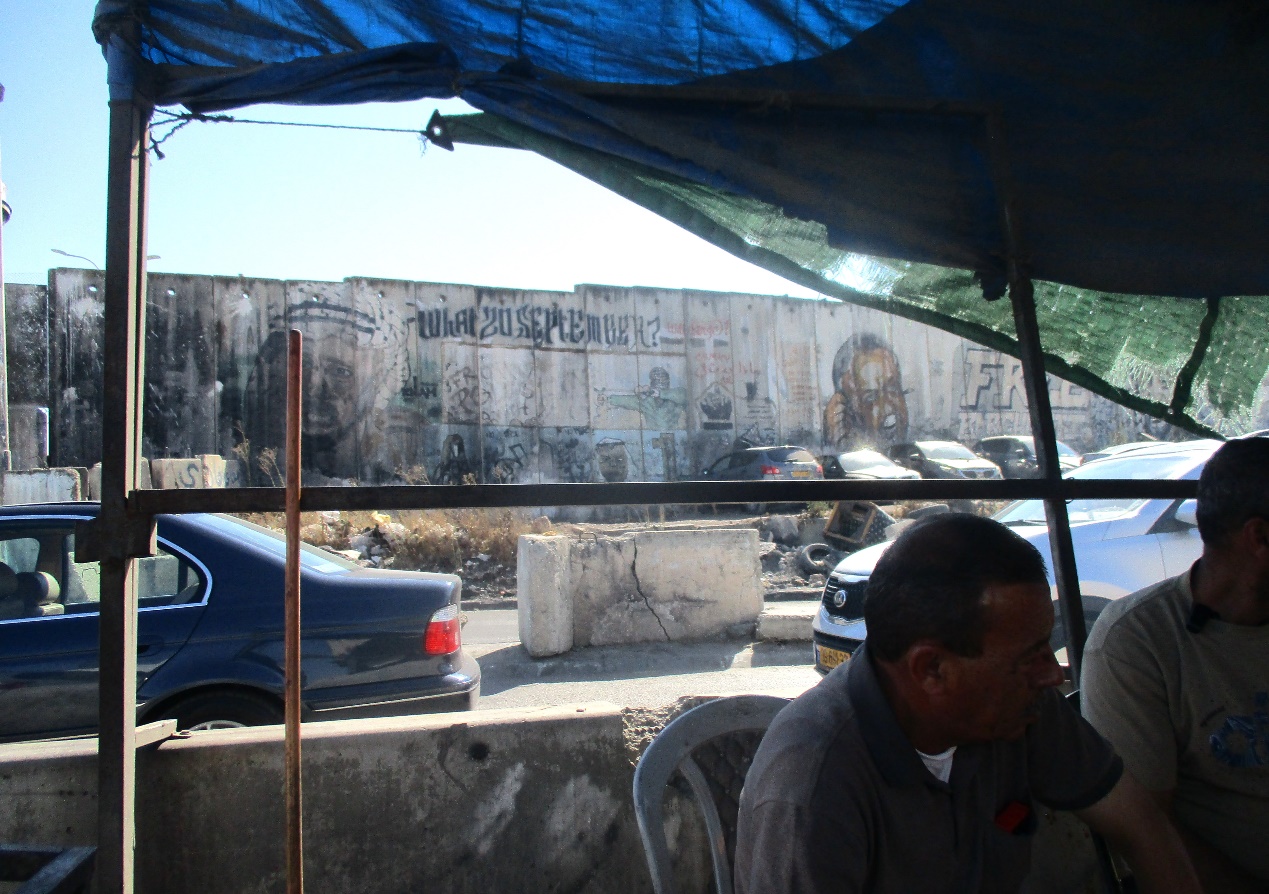 Tamar FleishmanJul-21-2026Qalandiya. Conversation in the shadow of the wall
-