
‘Azzun, ‘Azzun ‘Atma, Eliyahu Crossing, Habla, Tue 2.4.13, Afternoon
Translator: Charles K.
A shift during which we had various contacts with the army and representatives of security companies working for the Ministry of Defense.
The army’s clarification regarding the legality of commerce at the Habla plant nurseries.
A suggestion: During our shifts we should make lists of lands in the seam zone that aren’t being cultivated because the owners have trouble accessing them.
Car owners from Hars are transported from the junction to their workplaces in the Barkan industrial zone because there aren’t enough parking spaces there.
13:30 Habla checkpoint
A horse harnessed to an empty cart waits for its owner to return from document inspection. He opens the large gate and takes the cart through.
A group of army personnel on the other side of the checkpoint. Three civilian Israeli cars and two military vehicles park next to the security road.
Some officers approach us a few minutes later. Col. Ofer H. introduces himself as the commander responsible for the entire seam zone. He’s accompanied by a colonel – a unit commander – and a captain responsible for the compound who’s very familiar with the area. Col. Ofer wants to know whether we’re aware of the reason for the Habla checkpoint (an agricultural gate).
After we reply, he explains that the purpose of the gate is to enable Palestinian farmers on the West Bank to cultivate their lands that remained on the other side of the fence or to work in their plant nurseries: butthe sale of plants to Israelis by the nurseries is illegal, because they’re in fact importing merchandise to Israel. Passage of goods is permitted only at designated crossings – the nearest being Efrayim gate. It’s true that sales are on a retail basis but (he points to the rows of olive trees), the merchandise comes through the checkpoint in wholesale quantities. The army allows it because the State doesn’t want to harm the Palestinians’ livelihood; we should be proud of the army. When we ask why people returning home from work aren’t allowed to bring with them shirts they’d received or small household goods they’d found discarded, he replies infuriatingly that often those clothes have been stolen, along with the clothesline and clothespins.
We asked the purpose of his visit; he said that every few months they visit every location in the seam zone to see what the land situation is. He’s the one who testifies in court to contradict the Palestinians’ claims they’re not able to work their land because access is difficult. He declares he doesn’t depend on others’ reports but goes to see for himself and tries to identify reputed uncultivated land in the seam zone (lands made inaccessible elsewhere in the West Bank aren’t his responsibility). He tells us he respects us, that we’re doing difficult work.
With regard to the request by residents of Khirbet Asla that the gate also be opened in the middle of the day, the captain who’s in charge claims that the farmers, in the presence of the head of the village, preferred, (when they had to choose) that it be opened twice a day for half an hour rather than three times a day for fifteen minutes. Everything’s agreed and based on the farmers’ requests. With respect to the gate’s location, which makes it impossible for some of the farmers to reach their land with agricultural equipment or vehicles, he replied that they have to access their lands via the Thult gate. It was neither the time nor place to get into a long discussion about it. We should ask again in the villages.
Had we mentioned the unconscionable requirement that farmers must coordinate with the army access to their own land because the state decided to erect a fence , we would have been treated to a lecture about security.
The two red minibuses with pupils go through. Soldiers get on to inspect and Col. Ofer continues lecturing us and his officers about the importance of maintaining the security of Israel’s inhabitants and about how wonderful, powerful and moral the army is. He gave us his business card!
We drove through ‘Arab a-Ramadin. The children had all gone into their “homes” and the “streets” were deserted. The school is still standing; another room has been added. Earthworks are underway in the village center; a broad area has been prepared – for construction?
14:15 Eliyahu gate
We parked in the lot. To cross the road we proceeded on foot through the “security area” and were amazed by the spectacular landscaping in the strip dividing it from the road. The seasonal flowers under drip irrigation are in full bloom. The drainage channels are elaborately decorated in a Gaudian style (I just returned from Barcelona) with broken pieces of colorful tiles. We wanted to photograph. A security man appeared immediately declaring that we’re in a security installation to which entry is forbidden. Two additional security men arrived, allowed us (this once) to photograph the flowers and demanded we move to the bus stop across the road. They showed us that no people waited on line. To the right we noticed five dog cages. Four cars with Palestinian license plates and one with Israeli plates were being inspected on the other side. A security man arrived with two German shepherds; the sight was shocking, particularly for someone seeing it for the first time who didn’t know such things existed.
14:45 Azzun
On the way to Azzun we drove through Izbet Tabib, the tent and the remains of the protest against the demolition order for the school are still visible, and through H'irbet Asla, the village discussed previously with the army.
Two of Z’s sons were at his shop. We unloaded merchandise and acceded to his request to come home and meet his wife. Apparently the recent tests brought results, but he won’t be able to keep the appointment he has in Ichilov because he submitted the request to (re)enter Israel only one week in advance instead of two. His children (the little one is sick) again enchanted us. The covered porch at the entrance to the apartment has become a second-hand clothing store which Suhad runs.
16:00 Hars
From Azzun we drove back east on Highway 5. After driving through Al Funduq briefly to explain the problems of the village most of which is in Area C instead of Area B we returned to the junction and turned south on Highway 5066 that leads to Ariel via Emanuel.
We stopped at Hars to solve the mystery of the many cars parked at the village entrance. Most appeared in working order. The explanation: the cars belong to people who work in the Barkan industrial zone. They park where there’s room; their employers pick them up.
16:30 Azzun Atma
The crossing went quickly at the Shomron gate; no cars were detained.
There was no line at the Azzun Atma checkpoint. Few Palestinians arrived, mostly groups of 4-5 getting out of Israeli cars, a few on foot from the other side of the road carrying small marble panels. They went through quickly.
We waitedin vain for a Palestinian we’d arranged to meet regarding fines, he didn't show up, had to work late. It’s not clear why it can’t be done In a Palestinian post office, but that seems to be the procedure (meanwhile it turned out that if we give him the paperwork he can take care of it himself). We had a lively discussing with the soldiers who were interested in us. I. asked whether there was a bathroom there; a pleasant soldier opened the door to their “living quarters.” We were astounded to see the soldiers’ living conditions (in harsh contrast with the luxurious installations of the Security Company at Eliyahu Gate): the control tower has 2 narrow benches, one on top of the other, serving as beds, one filthy chemical toilet, a large water tank for washing.
It was sad and painful to see the effects of the occupation: the humiliating gate limiting the conquered Palestinians on the one hand, the occupying soldiers’ denigrating, inhumane living conditions on the other.
'Azzun
See all reports for this place-
Azoun (updated February 2019)
A Palestinian town situated in Area B (under civil Palestinian control and Israeli security control),
on road 5 between Nablus and Qalqiliya, east of Nabi Elias village. The inhabitants are allowed to construct and improve infrastructures. The Separation Fence has confiscated lands belonging to the town's people. In 2018 olive tree groves owned by one of its inhabitants were confiscated for the sake of paving a road to bypass Nabi Elias. Azoun population numbers 13,000, its economic state dire. Its infrastructures are poor, neglect and poverty rampant. In the meantime, the town council has completed paving an internal road for the inhabitants' welfare.
Because of its proximity to the Jewish settler-colony of Karnei Shomron and its outposts, the town suffers the intense presence of the Israeli army, especially at nighttime: soldiers enter homes, arrest suspects, trash the house and sometimes ruin it, as they do in numerous places in the West Bank. At times a checkpoint closes the entrance to the town, so no one can come in or get out.
-
'Azzun 'Atma
See all reports for this place-
'Azzun 'Atma
A Palestinian village of about 1,800 residents. The settlement of Sha'arei Tikva was established on its land adjacent to it, and the settlement of Oranit was established on its agricultural lands. By 2013, the separation fence had passed through the village and a checkpoint staffed by the army allowed the residents to cross from side to side. After building a massive wall surrounding the village and some of its agricultural lands, the residents went daily for five years to their lands that remained in the Seam Zone through the Oranit agricultural checkpoint (4). Since 2018 it has only opened during the olive harvest and the farmers have to pass daily at the Beit Amin / Abu Salman checkpoint (1447), about 3 kilometers north.From a report from March 24, 2021: "The farmers from Beit Amin and Azon Atma are happy that since February 21 the Oranit checkpoint .is going to be open 3 times a day, The farmers are really developing the place."
Report from July 14, 2024: "Ornit checkpoint is closed . The Beit Amin/Abu Salman agricultural checkpoint is closed (there is no contact with the military to check if it opens rarely), the Ezbat Jaloud checkpoint was opened once a day before the war.
Updated for July 2024
 Apr-11-2019Azoun: The main entrance to village blocked now for several weeks
-
Eliyahu CP (109) / Crossing
See all reports for this place-
Eliyahu CP (109) / Crossing This checkpoint, also known as the Fruit Crossing, is one of the main checkpoints between Israel and the West Bank. It is located on Route 55 between Alfei Menashe and the turn to Qalqilya and Zufin, more than 4 km east of the Green Line, in the separation fence, which separates Qalqilya from its lands to the south, thus leaving Alfei Menashe West of the fence - the Seam Zone. This checkpoint, a few kilometers across the Green Line, is intended for "Israeli settlement in the West Bank and the population of the Seam Zone." It is managed by a civil company. Palestinians with a special permit for their lands in the seam area are also allowed to pass through it, on foot, and sometimes by car.
-
Habla
See all reports for this place-
Habla CP (1393)
The Habla checkpoint (1393) was established on the lands of the residents of Qalqilya, on the short road that
connected it for centuries to the nearby town of Habla. The separation barrier intersects this road twice and cut off the residents of Qalqilya from their lands in the seam zone.(between the fence and the green line).
There is a passage under Road 55 that connects Qalqilya to the sabotage This agricultural barrier is used by the farmers and nursery owners established along Road 55 from the Green Line and on both sides of the kurkar road leading to the checkpoint.
This agricultural checkpoint serves the residents of Arab a-Ramadin al-Janoubi (detached from the West Bank), who pass through it to the West Bank and back to their homes. The opening hours (3 times a day) of this agricultural checkpoint are longer than usual, about an hour (recently shortened to 45 minutes), and are coordinated with the transportation hours of a-Ramadin children studying in the occupied in the West Bank.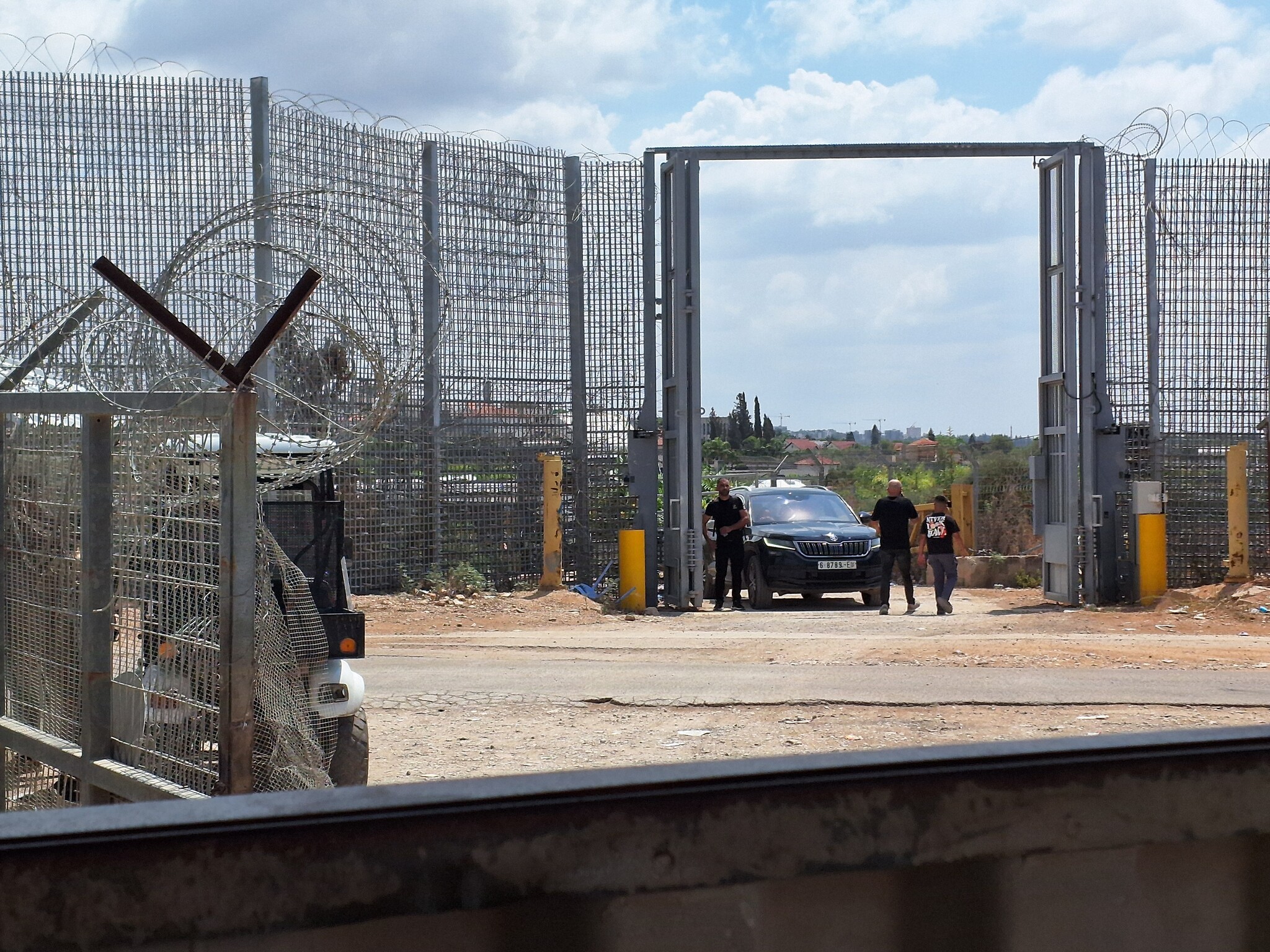 Ronit Dahan-RamatiAug-31-2026Habla. The gate is open
-
