
Back to reports search page

South Hebron Hills, Thu 30.5.13, Morning

Observers: Hagit Back and Michal Tzadik
May-30-2013
| Morning


South Mount Hebron
There are children and grown-ups who cannot go to the beach to swim  without a permit from the authorities. Why? Because they live in an occupied area, in which the State of Israel arbitrarily decides to consider some of the residents as an integral part of the state; while considering another part a war zone where some of the residents endanger its well-being.
So every summer, various organizations for peace make requests in the name of the children without rights and their caretakers, for permits to travel the 50 to 60 kilometers to the Mediterranean for a single day of fun.
We know that for all those who read our reports, the efforts to organize a day at the beach are no more than a 'fig leaf' for the occupation. You are probably saying to yourselves: 'This is indeed an enlightened occupation!  Fact! See how good we are and with the help of the women of MachsomWatch!' But that is just it — it is not so. We continue to oppose the occupation and none of our efforts can be interpreted as giving it legitimation. 
Simply — in the meantime there are children — a large number of children – whose horrible childhoods and lives progress with nothing to look forward to, no expectations at all. So we want to give them some joy, in the meantime, if only for one day a year. Maybe the self-satisfaction of someone will be disturbed by this theater of the absurd.
This one day does not 'make the bug kosher' as we say in Hebrew. We will not stop, we will continue to be in the CPs, in the villages and in these cities, to observe and to report on the injustices in the name of the law that the government and the IDF carry out in the occupied territories.
Still today we went to Batir to get all the permits for the day from A. He handed us four envelopes, and during the coming weeks children and caretakers will be able to leave the area of South Mount Hebron and other areas on the West Bank. With the envelopes, with the entrance permits to Israel for children of all ages, we drove to Hebron, to Umm elHeir and to Dahariya. We handed over the desired permits. Great!? No. They should really not need us and our activities. These people should be  free to live their lives freely.
On the road we again met H.. the owner of the olive grove that was destroyed, whose work permit was taken from him although he did no wrong. They accuse him of having stolen water and in October he will have to defend himself in court. Why? Who is he after all?!
He gave us some more documents to pass on to the people from Yesh Din [NGO, whose hebrew name translates to: "There is Law/Law Prevails"]. Perhaps they will succeed in moving the judicial system to see to some justice.

  • South Hebron Hills

    See all reports for this place
    • South Hebron Hills
      South Hebron Hills is a large area in the West Bank's southern part.
      Yatta is a major city in this area: right in the border zone between the fertile region of Hebron and its surroundings and the desert of the Hebron Hills. Yatta has about 64,000 inhabitants.
      The surrounding villages are called Masafer Yatta (Yatta's daughter villages). Their inhabitants subsist on livestock and agriculture. Agriculture is possible only in small plots, especially near streams. Most of the area consists of rocky terraces.

      Since the beginning of the 1980s, many settlements have been established on the agricultural land cultivated by the Palestinians in the South Hebron Hills region: Carmel, Maon, Susia, Masadot Yehuda, Othniel, and more. Since the settlements were established and Palestinians cultivation areas have been reduced; the residents of the South Hebron Hills have been suffering from harassment by the settlers. Attempts to evict and demolish houses have continued, along with withholding water and electricity. The military and police usually refrain from intervening in violent incidents between settlers and Palestinians do not enforce the law when it comes to the investigation of extensive violent Jewish settlers. The harassment in the South Hebron Hills includes attacking and attempting to burn residential tents, harassing dogs, harming herds, and preventing access to pastures. 

      There are several checkpoints in the South Hebron Hills, on Routes 317 and 60. In most of them, no military presence is apparent, but rather an array of pillboxes monitor the villages. Roadblocks are frequently set up according to the settlers and the army's needs. These are located at the Zif Junction, the Dura-al Fawwar crossing, and the Sheep Junction at the southern entrance to Hebron.

      Updated April 2022


      בין הדגלים תלתלית חוסמת מעבר אל שביל העפר
      Yael Zoran
      Apr-15-2026
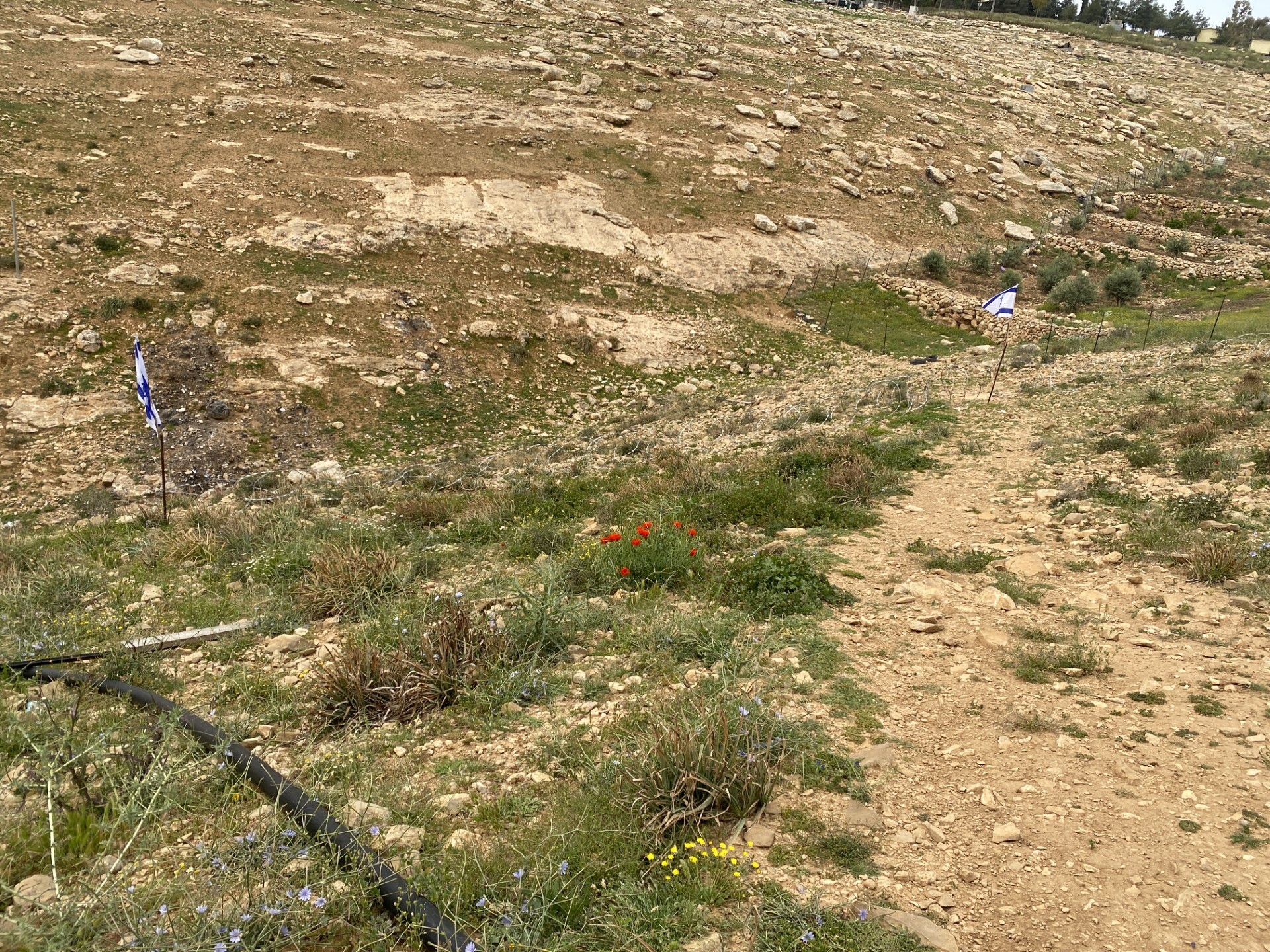
      Between the flags, barbed wire blocks passage to the dirt path.
Donate