
Abu Dis, Ras Abu Sbitan (Olive Terminal), Fri 12.7.13, Morning
Olive Terminal
WE reached the checkpoint at 9:45. An officer (rank of captain) came up to us, 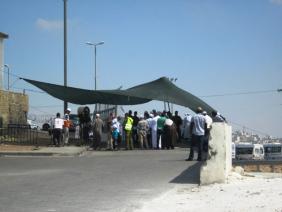 introduced himself and told us that the checkpoint operates without problems, and without pressure, and that the army tries to be flexible. And indeed, we saw that the officer was courteous and flexible in his dealings with people.
On the other side were armed Palestinian policemen, assisting with crossing. Also an ambulance of the Red Crescent with a medical team. The officer listed the varieties of permits given for the day to women and men over 40, children up to the age of 12 accompanied by parents, and in certain instances to children up to the age of 16.
We went up to the Palestinian policemen and they too confirmed that all was proceeding properly. We notice that they were co-ordinated with the Israeli officer. Around 10:30 the stream of people crossing increased. A man of c. 35 who had come from a distant village with his wife asked for our assistance in crossing in order to be able to join his wife. The officer promised to let them through.
At 10:00 an officer of higher rank arrived. He too came up to us and explained that this year permits were easier than in the past year. Men of 60 and over may cross freely all month. According to him, most do not go for prayers, and "that's OK with us" he said. He emphasized that "not all is perfect here", but they try to accommodate those crossing at the checkpoint. This year Palestinian policemen and women deal with youths who have no permits. Many are refused. He tells how they provided a permit for a Palestinian merchant, a partner in Amnir paper recycling, who had been refused permits for ten years because someone had snitched on him.
A young man of about 19, who supported a very bent old man, was detained by the soldiers. The Red Crescent people offered a wheelchair, but the man refused. The high ranking officer claimed that the young man had no connection to the old man who was acting in order to help the young man to cross. And indeed, we realized that after the old man crossed, he became miraculously upright.
At 10:25 when the stream of people increased, crossing proceeded rapidly. The border-police commander of Jerusalem Envelope arrived, and he too came up to us to say that they do their best for "the customer." Since this is the first Friday of Ramadan, he said, the pressure is not yet great.
At 10:30 the Red Crescent ambulance left, but the medical team remained. Towards 11:00 the officers and policemen left. A soldier asked us to move back to a place without shade. The same soldier had previously detained a 9-year old child whose family had forgotten to bring the permit. Luckily another female soldier present allowed the child to cross.
The general impression was that both army and police had prepared for the holiday and definitely attempted to show flexibility.
Abu Dis / Lazarus gate (formerly The Wicket)
See all reports for this place-
Abu Dis / Lazarus Checkpoint/Gate (east of the former “wicket”)
Construction of the wall in the Abu Dis area blocked all the gaps that allowed people to cross from al-Ezariya to the neighbourhoods of Abu Dis and Ras al 'Amud that are located within Jerusalem’s municipal boundary. The Lazarus checkpoint is a gate in the wall adjacent to the Lazarus Monastery. Until 2011 it had a door for pilgrims to al-Ezariya and for the monastery’s kindergarten pupils from al-Ezariya. The crossing is currently closed, but the site has infrastructure for conducting inspections.
-
Ras Abu Sbitan (Olive Terminal)
See all reports for this place-
A large checkpoint/crossing to the area of a-Tur, Abu Dis and the Old City; only for pedestrians. Located on Jerusalem’s municipal boundary.
One of the major crossings in Jerusalem’s central sector. It is located on the separation fence between the northern portion of the al-Ezariya neighborhood and the neighborhood of a-Tur and the rest of East Jerusalem. It is manned by Border Police soldiers and private security companies and operates 24 hours a day. Palestinians are forbidden to go through, other than permanent residents of East Jerusalem (holders of blue ID cards) and holders of work and commercial permits who are allowed through only on foot.
-
