
‘Azzun ‘Atma, Beit Furik, Eliyahu Crossing, Habla, Huwwara, Jit Junction , Za’tara (Tapuah), Mon 29.7.13, Morning
The occupation routine; everything is operating and organized, the way the occupier knows how. It's really getting better each time, and only the sadness of those who don’t make it to “the promised land” or stable employment are left out of the orderly arrangements.
06:30 'Azzun 'Atma. Many people here already, more than usual, who’d gone through the checkpoint and wait outside, and some who were caught going through the holes in the fence also wait, sitting – because that’s how they must wait – next to the checkpoint for their IDs to be returned to them so they can go back to their own land and homes that aren’t in the promised land.
Vehicle access to the checkpoint for residents of the village living on the Israeli side of the fence is blocked by plastic barriers on the Israeli side and by concrete barriers on the Palestinian side, so when a car arrives the plastic barriers must be moved, the gate opened and the car must then slalom through the concrete barriers to Palestine.
We talked to one of those caught going through a hole in the fence. He said his employer doesn’t have any work at the moment, so he doesn’t have a permit. His employer has to deduct NIS 2200 per month from his salary (when he works) and pay the state of Israel for Bituach Leumi, money that the worker is supposed to get back some time (pension?), and other things. The whole story is very strange; I’ll try to inform Kav LaOved. Such things lead to illegal employment because the contractor doesn’t declare what he pays and doesn’t pay taxes and the state loses. Four of the detainees who had permits were eventually released; they’d gone through the hole in the fence to avoid standing in line; they were “lightly” punished.
Overall, the checkpoint operated rapidly and the line quickly shortened. Many people outside had already gone by the time we left – the fortunate who found work.
There’s a sign between the checkpoint and Oranit junction (see photo):
A commercial and industrial park will be built here.
Shomron Gate – Nahal Raba
To benefit the local residents
It’s signed by the “local” settlements: Oranit, Sha’arei Tikva, Elkana, Etz Efraim. Part of it has been blacked out.
So, I don’t get it – the sign stands on a site that will soon be behind the fence. Will the “park” have a special gate for Israeli residents? Or does “local residents” refer to Palestinians from 'Azzun 'Atma? And on what land will it be built? Whose land?
07:15 Habla. It opened at 06:30; most people have already crossed. People arrive in dribs and drabs but there’s no real line.
07:45 Eliyahu checkpoint. There is no one on the pedestrian line, nor any vehicles being inspected, but neither is there sufficient irrigation and all the lovely flowers are wilting. On the other hand, everywhere things have been newly painted in fluorescent colors. Rachel asks whether there’s a design specification dealing with “checkpoint design.”
Jit junction. A new road has been paved along the escarpment north of Highway 60, and at a high spot in Sufa a pillbox has been erected which isn’t manned.
Four jeeps were scattered alongside Highway 60 on the way to Huwwara, observing – are they waiting for riots? And if so, what will they protect, if anything?
Between the two entrances from Highway 60 to the Gil’ad Farm lighting has been installed which would do the Country Club junction on the coastal road proud – and all that for illegal settlers. On the other hand, the old checkpoint and parking lot at Huwwara, which are not in use, are illuminated by day, the lighting competing with the sun. Crazy – and at our expense.
The Huwwara checkpoint is open and unmanned, and also the one at Beit Furiq. The entrance to Beit Dajan from the road to Alon Moreh (Madison) is open.
The Za’tara junction is unmanned.
The entrance to Salfit from the road to Ariel is open – the two yellow gates are up and it seems that entry is unrestricted, but at the guard post at the entrance to Ariel, a little distant from the entrance to Salfit but overlooking it, is a soldier observing – at least, that’s what it looks like.
'Azzun 'Atma
See all reports for this place-
'Azzun 'Atma
A Palestinian village of about 1,800 residents. The settlement of Sha'arei Tikva was established on its land adjacent to it, and the settlement of Oranit was established on its agricultural lands. By 2013, the separation fence had passed through the village and a checkpoint staffed by the army allowed the residents to cross from side to side. After building a massive wall surrounding the village and some of its agricultural lands, the residents went daily for five years to their lands that remained in the Seam Zone through the Oranit agricultural checkpoint (4). Since 2018 it has only opened during the olive harvest and the farmers have to pass daily at the Beit Amin / Abu Salman checkpoint (1447), about 3 kilometers north.From a report from March 24, 2021: "The farmers from Beit Amin and Azon Atma are happy that since February 21 the Oranit checkpoint .is going to be open 3 times a day, The farmers are really developing the place."
Report from July 14, 2024: "Ornit checkpoint is closed . The Beit Amin/Abu Salman agricultural checkpoint is closed (there is no contact with the military to check if it opens rarely), the Ezbat Jaloud checkpoint was opened once a day before the war.
Updated for July 2024
 Apr-11-2019Azoun: The main entrance to village blocked now for several weeks
-
Beit Furik checkpoint
See all reports for this place-
One of the three internal checkpoints that closed on the city of Nablus - Beit Furik to the east, Hawara to the south, Beit Iba to the west. The checkpoint is located at the junction of Roads 557 (an apartheid road that was forbidden for Palestinians), leading to the Itamar and Alon Morea settlements and Road 5487. The checkpoint was established in 2001 for pedestrians and vehicles; The opening hours were short and the transition was slow and very problematic.Allegedly, the checkpoint is intended to monitor the movement to and from Nablus of the residents of Beit Furik and Beit Dajan, being the only opening outside their villages. Since May 2009 the checkpoint is open 24 hours a day, the military presence is limited, vehicles can pass through it without inspections, except for random inspections. (Updated April 2010)
-
Eliyahu CP (109) / Crossing
See all reports for this place-
Eliyahu CP (109) / Crossing This checkpoint, also known as the Fruit Crossing, is one of the main checkpoints between Israel and the West Bank. It is located on Route 55 between Alfei Menashe and the turn to Qalqilya and Zufin, more than 4 km east of the Green Line, in the separation fence, which separates Qalqilya from its lands to the south, thus leaving Alfei Menashe West of the fence - the Seam Zone. This checkpoint, a few kilometers across the Green Line, is intended for "Israeli settlement in the West Bank and the population of the Seam Zone." It is managed by a civil company. Palestinians with a special permit for their lands in the seam area are also allowed to pass through it, on foot, and sometimes by car.
-
Habla
See all reports for this place-
Habla CP (1393)
The Habla checkpoint (1393) was established on the lands of the residents of Qalqilya, on the short road that
connected it for centuries to the nearby town of Habla. The separation barrier intersects this road twice and cut off the residents of Qalqilya from their lands in the seam zone.(between the fence and the green line).
There is a passage under Road 55 that connects Qalqilya to the sabotage This agricultural barrier is used by the farmers and nursery owners established along Road 55 from the Green Line and on both sides of the kurkar road leading to the checkpoint.
This agricultural checkpoint serves the residents of Arab a-Ramadin al-Janoubi (detached from the West Bank), who pass through it to the West Bank and back to their homes. The opening hours (3 times a day) of this agricultural checkpoint are longer than usual, about an hour (recently shortened to 45 minutes), and are coordinated with the transportation hours of a-Ramadin children studying in the occupied in the West Bank.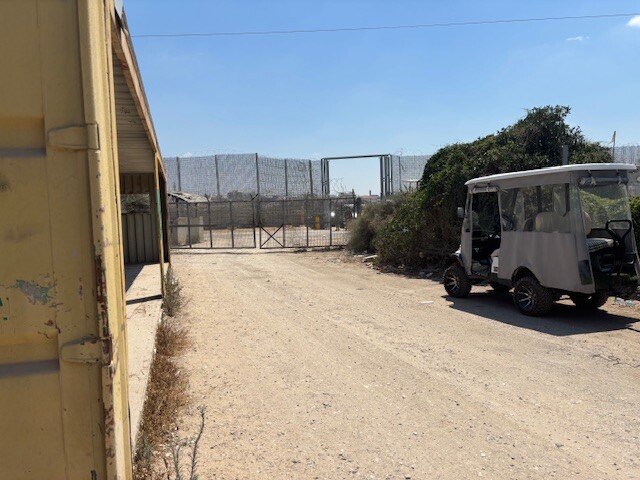 Nina SebaAug-18-2025Habla: The gate is in the process of closing
-
Huwwara
See all reports for this place-
The Huwwara checkpoint is an internal checkpoint south of the city of Nablus, at the intersection of Roads 60 and 5077 (between the settlements of Bracha and Itamar). This checkpoint was one of the four permanent checkpoints that closed on Nablus (Beit Furik and Awarta checkpoints to the east and the Beit Iba checkpoint to the west). It was a pedestrian-only barrier. As MachsomWatch volunteers, we watched therre since 2001 two shifts a day - morning and noon, the thousands of Palestinians leaving Nablus and waiting for hours in queues to reach anywhere else in the West Bank, from the other side of the checkpoint the destination could only be reached by public transport. In early June 2009, as part of the easing of Palestinian traffic in the West Bank, the checkpoint was opened to vehicular traffic. The passage was free, with occasional military presence in the guard tower. Also, there were vehicle inspections from time to time. Since the massacre on 7.10.2023, the checkpoint has been closed to Palestinians.
On February 26, 2023, about 400 settlers attacked the town's residents for 5 hours and set fire to property, such as houses and cars. Disturbances occurred in response to a shooting of two Jewish residents of Har Bracha by a Palestinian Terrorist. The soldiers stationed in the town did not prevent the arson and rescued Palestinian families from their homes only after they were set on fire. No one was punished and Finance Minister Smotrich stated that "the State of Israel should wipe out Hawara." Left and center organizations organized solidarity demonstrations and support actions for the residents of Hawara.Hawara continued to be in the headlines in all the months that followed: more pogroms by the settlers, attacks by Palestinians and a massive presence of the army in the town. It amounted to a de facto curfew of commerce and life in the center of the city. On October 5, 2023, MK Zvi established a Sukkah in the center of Hawara and hundreds of settlers backed the army blocked the main road and held prayers in the heart of the town all night and the next day. On Saturday, October 7, 23 The "Swords of Iron" war began with an attack by Hamas on settlements surrounding Gaza in the face of a poor presence of the IDF. Much criticism has been made of the withdrawal of military forces from the area surrounding Gaza and their placement in the West Bank, and in the Hawara and Samaria region in particular, as a shield for the settlers who were taking over and rioting.
On November 12, 2023, the first section of the Hawara bypass road intended for Israeli traffic only was opened. In this way, the settlers can bypass the road that goes through the center of Hawara, which is the main artery for traffic from the Nablus area to Ramallah and the south of the West Bank. For the construction of the road, the Civil Administration expropriated 406 dunams of private land belonging to Palestinians from the nearby villages. The settlers are not satisfied with this at the moment, and demand to also travel through Hawara itself in order to demonstrate presence and control.(updated November 2023)
. Shoshi AnbarMay-18-2025Huwara: The old houses in Area C
-
Jit Junction
See all reports for this place-
The checkpoint is located on Route 60 near at the junction with Route 55, near the village of Jit. There was a checkpoint for vehicles passing between the north and south of the West Bank, which was abolished towards 2010. Since then, surprise checkpoints have been set up there from time to time with a police or Border Police vehicle, and vehicles and their passengers are inspected.
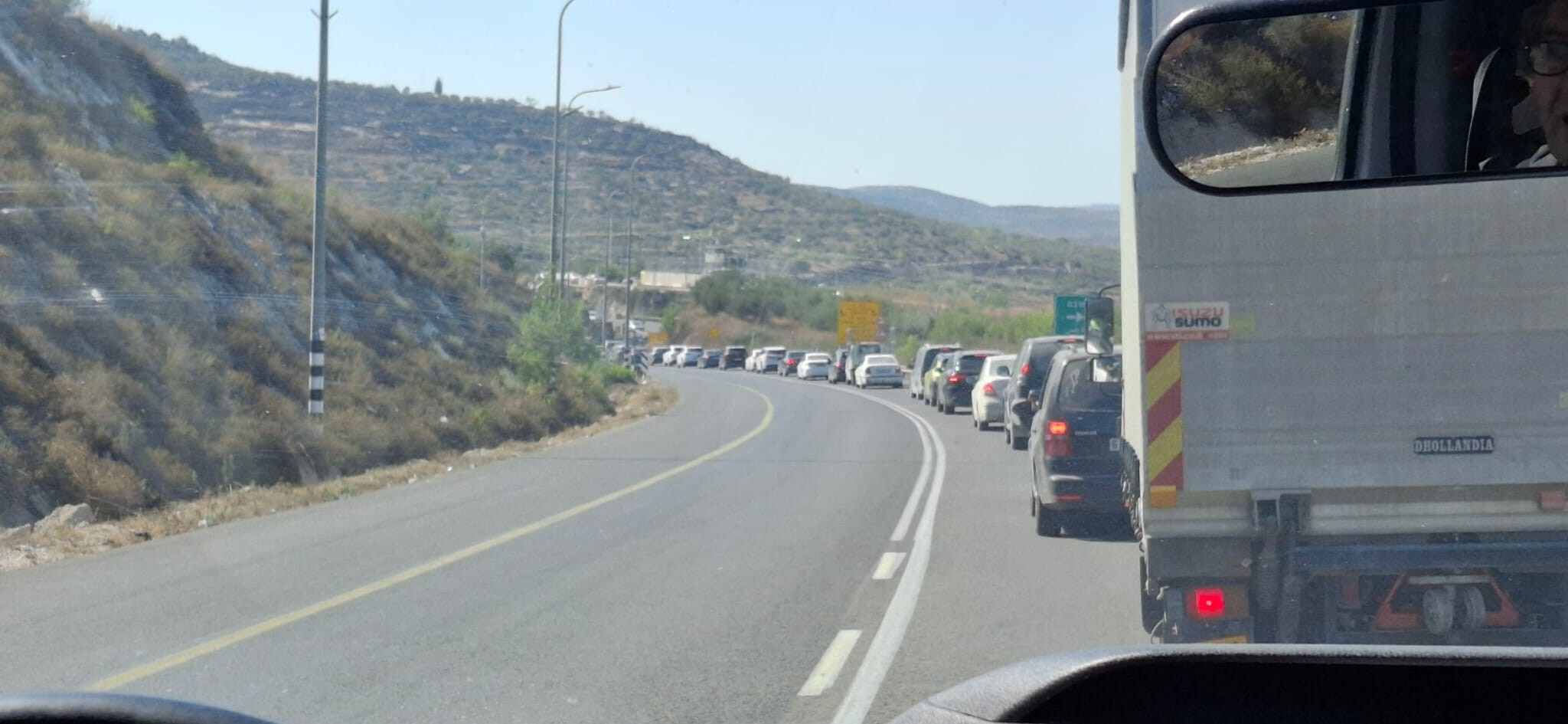 Anat PolakJul-17-2025Yitzhar Road, Jit Junction: traffic jam
-
Za'tara (Tapuah)
See all reports for this place-
Za'tara (Tapuah) Za'tara is an internal checkpoint in the heart of the West Bank, at the intersection of Road 60 and Road 505 (Trans-Samaria), east of the Tapuah settlement. This checkpoint is the "border" marked by the IDF between the north and south of the West Bank, in accordance with the policy of separation between the two parts of the West Bank that has been in place since December 2005. At the Za'tara checkpoint, there are separate routes for Israelis and Palestinians. In the route for Israelis, there are no inspections and the route for Palestinians inspects. The queue lengthens and shortens suits. The checkpoint is open 24 hours a day. The checkpoint is partially staffed and the people who pass through it are checked at random.
 Shoshi AnbarSep-27-2023Za'atra (Tapuah Intersection). Signs
-