
South Hebron Hills

We decided to visit localities along Highway 317. We drove to the Metzudat Yehuda checkpoint because we hadn’t been there in a while. We were particularly interested to see what happens to the children from Imnazil who go through the checkpoint twice a day because their school is on the other side of the fence. Everything was deserted because the schools in the Palestinian Authority are on strike. No one knows for how long. It depends on whether salaries will be paid.
Umm el Hir
So we drove to Umm el Hir to support their endless struggle against the wickedness and stupidity of all the Israeli institutions.
Eid showed us their main clay baking oven that had been vandalized again the day before yesterday – so often they’ve lost count.
For thirty years they’ve baked bread there for the small village. Thirty years that they’ve been neighbors of the Carmel settlement.
We were glad to see it operating again. They’d brought dried dung, cleaned out the pit and laid a new fire.
Light smoke rises; Eid explains that sometimes, when there’s an east wind, the smell of the smoke from the dung reaches the tender nostrils of the Carmel settlers living in the new neighborhood, 100 meters away beyond the fence. They can’t stand the smell so they extinguish the fire with water and vandalize the oven.
The village is subject to demolition orders; their case is in court. So the settlers asked for demolition orders against the oven as well. The judge tells them: How can you demolish a structure that doesn’t exist? Is a clay oven a structure? Meanwhile, Eid says, “We need bread to eat.” All the notables from all the authorities came to see what could be done.
Avi Biton, the regional brigade commander, deserves credit for honestly trying to solve the problem. He suggested constructing a gas oven. “Will you provide and pay for the gas?” the locals ask. The oven has to remain hot; the goat dung is free. The authorities say it’s complicated.
So Eid says, “Provide us with bread. A truck brings bread to Carmel every day. It can bring us bread also. We’re neighbors, just beyond the fence.” It turns out that’s also complicated.
The day before yesterday, the settlers vandalize the oven, the army even brought a tracker who discovered that the track led to the home of the nearest settler. “So what happened?”, I asked. Eid laughs and shrugs – “Nothing, as always.”
“You know,” he tells me, “Carmel’s veteran settlers are good neighbors; we get along with them. They’ve been here since 1980; they behave well, and they’ve also helped us solve problems. But the younger generation in the new neighborhood is terrible.”
We see a shed on a hill about one kilometer east of Umm el Hir with a seesaw and an Israeli flag. It turns out the shed was erected about a year ago, and on Friday and Saturday the settlers go there to pray. Their intent is obvious – to build an additional neighborhood to encircle Umm el Hir and eventually connect to Carmel.
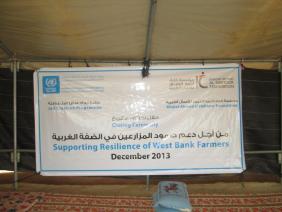
Between the homes of the new neighborhood and this strange thing the residents of Umm el Hir planted a new olive grove, with the help of UNWRA, and fenced it well, hoping the settlers wouldn’t destroy it.
In general, whatever helps them live decently – solar electric panels, toilets, etc. – comes from the Village Group and donations from various organizations. But solving the bread problem – that’s too complicated a project for the Israeli government.
South Hebron Hills
See all reports for this place-
South Hebron Hills
South Hebron Hills is a large area in the West Bank's southern part.
Yatta is a major city in this area: right in the border zone between the fertile region of Hebron and its surroundings and the desert of the Hebron Hills. Yatta has about 64,000 inhabitants.
The surrounding villages are called Masafer Yatta (Yatta's daughter villages). Their inhabitants subsist on livestock and agriculture. Agriculture is possible only in small plots, especially near streams. Most of the area consists of rocky terraces.Since the beginning of the 1980s, many settlements have been established on the agricultural land cultivated by the Palestinians in the South Hebron Hills region: Carmel, Maon, Susia, Masadot Yehuda, Othniel, and more. Since the settlements were established and Palestinians cultivation areas have been reduced; the residents of the South Hebron Hills have been suffering from harassment by the settlers. Attempts to evict and demolish houses have continued, along with withholding water and electricity. The military and police usually refrain from intervening in violent incidents between settlers and Palestinians do not enforce the law when it comes to the investigation of extensive violent Jewish settlers. The harassment in the South Hebron Hills includes attacking and attempting to burn residential tents, harassing dogs, harming herds, and preventing access to pastures.
There are several checkpoints in the South Hebron Hills, on Routes 317 and 60. In most of them, no military presence is apparent, but rather an array of pillboxes monitor the villages. Roadblocks are frequently set up according to the settlers and the army's needs. These are located at the Zif Junction, the Dura-al Fawwar crossing, and the Sheep Junction at the southern entrance to Hebron.
Updated April 2022
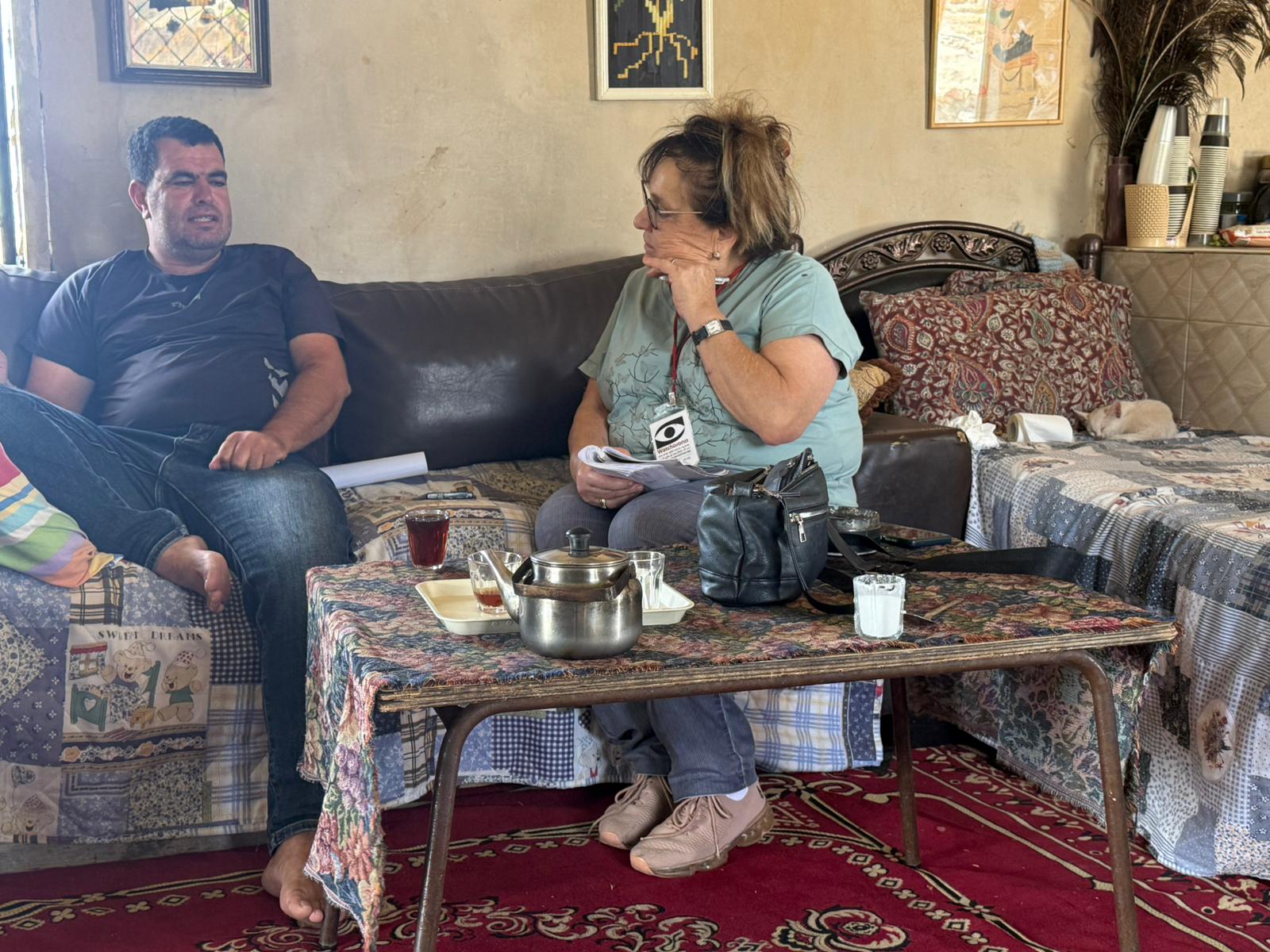 Muhammad D.Aug-31-2026Michal with B'Tselem researcher Nasser Nawaja'a in Susiya
-
