
South Hebron Hills
The purpose: Creative activities at the Hashem al Daraj kindergarten, together with Huda
The topic: Harvesting olives
About 20 children were present, a wide range of ages (the reason for the small number was a party at another family’s home). The activity was intended for the older children. The children had gone outside to eat when we arrived (most seemed to be eating pitas baked on a shallow iron dome over a fire, without any filling or side dishes). The children were very happy and excited to see us. They all wanted to shake hands.
The activity: All the children went back into the kindergarten; Huda read a story about the olive harvest. The children seemed very interested. Apparently there was also a discussion about olive trees (we’d brought branches). Huda had brought olives, and so had we; she distributed them to the children.
About 15 older children remained for the creative activity. We showed a picture we’d prepared. We handed out pages with a picture of an olive tree. Each page had the child’s name on it – so the child could bring his picture home. The activity involved pasting tree trunks, branches, leaves and olives made of crepe paper and tulle. One child at each table was sent outside to bring earth, which the children also pasted on their pictures. Then they colored the rest of the picture. When they’d finished we hung them up. The children wanted to take their pictures home; Huda finally decided to leave them hanging to decorate the kindergarten.
There’s a problem hanging pictures – we’ll try to continue installing nails and screws in the walls (we began last year). The heaters haven’t been hung yet either.
A photo from the workshop: The olive tree album, November, 2013:https://picasaweb.google.com/113044451662544057850?authkey=Gv1sRgCNS_j8qy0sCOGA
“Staff” meeting:
We had tea and cookies. We felt the activity had been very successful. We talked about Huda continuing independently. We’d brought large sheets of poster board on which Huda and Amana, her assistant, will draw olive trees. Huda will work with small groups of five children; each one will cut out large leaves and olives on which their names will be written, and paste them on the tree. That will be a joint activity for all the children. The goal is to make more meaningful the time the children spend in the kindergarten, to work individually with each of them, and to encourage Huda to be more independent and not depend on our presence.
We learned that Huda assembles the women from the village (all of them? Only those with children in the kindergarten?) for health education, according to guidelines from the Palestinian Authority which also supplies educational materials. Very good!
South Hebron Hills
See all reports for this place-
South Hebron Hills
South Hebron Hills is a large area in the West Bank's southern part.
Yatta is a major city in this area: right in the border zone between the fertile region of Hebron and its surroundings and the desert of the Hebron Hills. Yatta has about 64,000 inhabitants.
The surrounding villages are called Masafer Yatta (Yatta's daughter villages). Their inhabitants subsist on livestock and agriculture. Agriculture is possible only in small plots, especially near streams. Most of the area consists of rocky terraces.Since the beginning of the 1980s, many settlements have been established on the agricultural land cultivated by the Palestinians in the South Hebron Hills region: Carmel, Maon, Susia, Masadot Yehuda, Othniel, and more. Since the settlements were established and Palestinians cultivation areas have been reduced; the residents of the South Hebron Hills have been suffering from harassment by the settlers. Attempts to evict and demolish houses have continued, along with withholding water and electricity. The military and police usually refrain from intervening in violent incidents between settlers and Palestinians do not enforce the law when it comes to the investigation of extensive violent Jewish settlers. The harassment in the South Hebron Hills includes attacking and attempting to burn residential tents, harassing dogs, harming herds, and preventing access to pastures.
There are several checkpoints in the South Hebron Hills, on Routes 317 and 60. In most of them, no military presence is apparent, but rather an array of pillboxes monitor the villages. Roadblocks are frequently set up according to the settlers and the army's needs. These are located at the Zif Junction, the Dura-al Fawwar crossing, and the Sheep Junction at the southern entrance to Hebron.
Updated April 2022
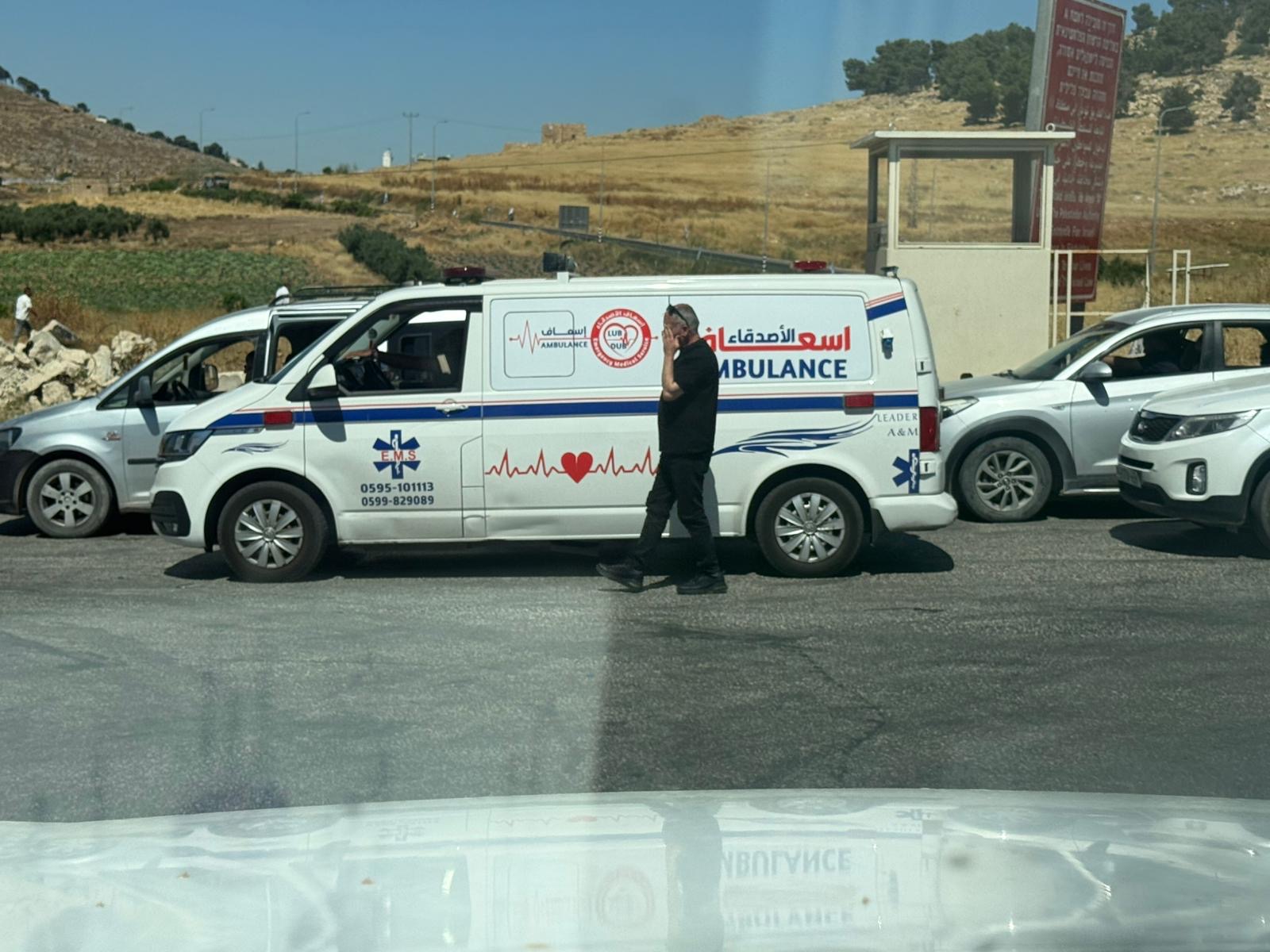 Yael ZoranJun-18-2026An ambulance is waiting in front of the closed checkpoint in El-Fawwar
-