
‘Anata-Shu’afat, Ras Abu Sbitan (Olive Terminal)
6:45 Shuafat Refugee Camp
Military police and private guards are at the checkpoint — no border police. We don't know whether this will be the regular combination. The turnstile leading to the pedestrian crossing at the exit from the camp is not operating, but the the gate next to it is wide open. One turnstile less is fine — not clear why so many turnstiles were required in the first place.
Transportation of children studying in Jerusalem leaves as usual, and we chat with the locals. The dispute with UNRWA workers is not over, but the committee of the camp's residents has received donations from Europe, which they use as much as possible for cleaning up operations while the money lasts. In the wake of the UNRWA strike, the children in the camp have not been studying for 2 months! — with the exception of the municipal boys' school in the market building next to the checkpoint.
With respect to the terrorist from Ras Al Hamis, affiliated with Al Queida, and caught before he managed to perform an attack in Binyanei Ha-Ooma and elsewhere, the residents say that he is not a veteran local but arrived only a short time ago. The place, they say, is a paradise for illegal operations because the nearby parking lot is a site for widespread drug trafficking at night to which many come, including youths from the Jerusalem area. The residents suffer from the crime and violence but are unable to do anything about it.
Vehicular traffic is smooth, with short inspections. Again, no border police around, and the guards follow in the footsteps of the military police.
8:00 Olive Terminal (Ras al Sabitan)
The checkpoint was very crowded when we arrived, only one station open, and plenty of irritation. But soon another station opened, and the pressure decreased. On the Palestinian side, 30 whose ID's had been taken and not returned, stood and waited. The new difference of procedure lies in the fact that the ID's were appropriated not when they tried to cross the checkpoint or pass over the barbed wire covering the remaining opening between the wall and checkpoint fence — but took place in the parking lot during a collective check by border police at 6:00 a.m.
We immediately called the DCO representative at the checkpoint, who said he would look into it. When nothing happened, we called the checkpoint commander who said that in principle the police and the border police are allowed to take documents for inspection also in Area B, and this is what they do for the General Security Services (Shabak). We said that this is a delay tactic which on the face of it cannot be legal since no misdemeanor was committed. He said the documents would soon be returned, and indeed this happened within a few minutes.
A young man, almost a boy, came up to us and showed a permit torn to pieces which had been returned to him. He said it was a perfectly valid permit issued by the liaison office in Hebron. Most of his friends refused to leave and said they would wait for him because he's a family member. Again we spoke with the checkpoint commander, who said that the permit was indeed valid, but issued to a merchant for a business meeting, and the young man admitted that he had bought it in Hebron for 3000 shekels in order to be able to cross and work in construction in Jerusalem. He said there are networks dealing with the sale of improper permits for vast sums; people buy them in the hope of crossing without too many questions and acquiring work. The youth looked very miserable, and refused to accept his misfortune, also when those surrounding him explained the situation. Who knows what he had had to do to acquire such a vast sum? And did he not think that his youthful appearance would betray him?
We left with a heavy heart — Palestinians, in their desperate situation, are easy prey to every kind of scam, including lawyers who charge exorbitant sums and do nothing.
We gave Silvia's phone number to a couple of older men who are trying to figure out why they are refused. The work of Silvia and her colleagues is blessed
Checkpoint Shu'afat camp / Anata-Shu'afat (Jerusalem)
See all reports for this place-
The Shu’afat checkpoint is located in the northern part of East Jerusalem at the exit from the village of Anata and the Shu’afat refugee camp, which are located in the area annexed to Jerusalem in 1967. The refugee camp borders the Shu’afat neighborhood to the west, Pisgat Ze’ev to the north, the French Hill neighborhood to the south and the planned expansion of Ma’aleh Adumim to E-1 in the east. It was established in 1966 for 1948 refugees from the West Bank and was populated after the Six Day War by persons who had been expelled from the Jewish Quarter. Today its population comprises some 25,000 people holding blue ID cards and some 15,000 people with Palestinian ID cards. The camp lacks adequate infrastructure and services, and suffers from poverty, neglect and overcrowding. All its buildings are connected to the public electricity and water infrastructure, but not all are connected to the sewer system. The camp’s services are provided by UNRWA, except for those such as health clinics and transportation of pupils to schools in Jerusalem. In 2005, the Israeli High Court of Justice rejected a suit by the residents requesting that the route of the separation fence be drawn such that the camp would remain on the Israeli side, but conditioned its approval of the route on the establishment of a convenient and rapid crossing facility for the inhabitants of the neighborhood, most of whom are residents of Jerusalem.
A temporary checkpoint operated there until December, 2011. It was extremely congested during rush hours, and dangerous for pedestrians (especially children) because of inadequate safety provisions. The new checkpoint was inaugurated south of the old one, for public and private transportation and for pedestrians, intended solely for the residents of the camp – holders of blue ID cards, and those with Palestinian ID cards who possess appropriate permits. There are five vehicle inspection stations at the checkpoint, and two for pedestrians (one of which is currently closed) where scanners have been installed but are not yet operating. According to the army, representatives of government agencies will also be present to provide services to residents of the neighbourhood. The pedestrian lanes are very long, located far from the small parking lots, and accessible through only a single revolving gate.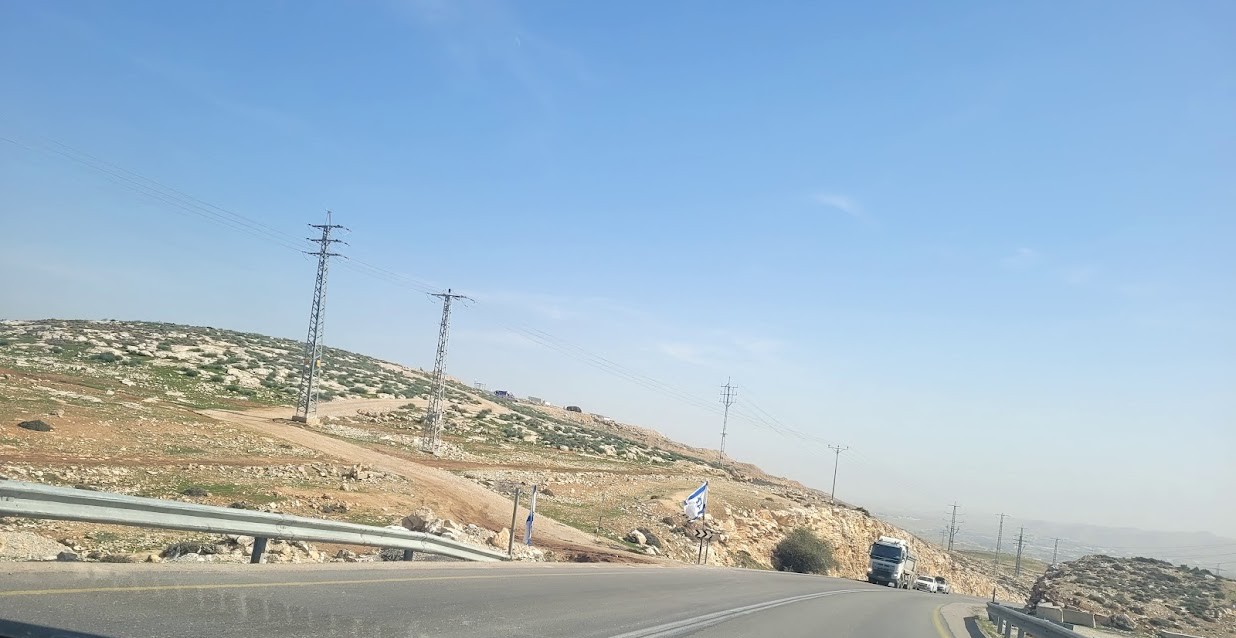 Anat TuegJan-25-2026Anata: A new outpost has been built south of the junction
-
Ras Abu Sbitan (Olive Terminal)
See all reports for this place-
A large checkpoint/crossing to the area of a-Tur, Abu Dis and the Old City; only for pedestrians. Located on Jerusalem’s municipal boundary.
One of the major crossings in Jerusalem’s central sector. It is located on the separation fence between the northern portion of the al-Ezariya neighborhood and the neighborhood of a-Tur and the rest of East Jerusalem. It is manned by Border Police soldiers and private security companies and operates 24 hours a day. Palestinians are forbidden to go through, other than permanent residents of East Jerusalem (holders of blue ID cards) and holders of work and commercial permits who are allowed through only on foot.
-