
Hamra (Beqaot), Ma’ale Efrayim, Za’tara (Tapuah)
A tour with the“Sadaka-Re’ut” Jewish-Arab youth movement
We travelled in a minibus the youth movement had rented, ten enthusiastic, curious young people. Most knew almost nothing about what’s going on in the occupied territories or in the Jordan Valley. The previous evening one of the group leaders telephoned to tell me that parents were worried about the trip to the territories under present conditions; I promised we wouldn’t travel through dangerous areas. The youths were also fairly apprehensive at the beginning but calmed down during the trip. So I changed the plan, eliminated the visit to Bardala whose purpose was to show how the Mekorot water company pumping of water from deep in the aquifer (the Palestinians are not allowed to sink deep wells) has dried up the Palestinians’ wells. I wanted to show the abandoned Palestinian pumps next to those belonging to Mekorot.
At the Tapuach and Ma’ale Efrayim checkpoints there were no soldiers going (09:30 and 09:45) or returning (16:45 and 17:00). In general, there was much less military presence than usual along the route.
We met a Palestinian who works in the vineyard of the Beqa’ot settlement, a man aged 60+, who told us that the 10 kilometers from his home in Tamun to his job becomes a 30 kilometer trip every day because the road to his home is blocked and he must make a long detour via the Hamra checkpoint.
We visited Burhan Darajma, in Al Malih, to offer our condolences; Sahar, his son, had been shot by IDF soldiers last Saturday when, according to the residents’ report, he was grazing his sheep. He was 18 when he died. At noon his father and another local found him dead, a bullet wound in his heart. The army claimed Sahar had been killed by dud ammunition that had exploded in his hand. But, according to the witnesses, there were no wounds on his hands or anywhere else on his body. Only an entry wound to the heart. He was brought to Abu Kabir for an autopsy and then to Abu Dis for an autopsy by a Palestinian pathologist. The report is expected on Sunday. The father was very moved by the visit and was surprised to see a mixed group of Jewish and Arab youths so comfortable with one another. The father and eyewitnesses who’d found the body told us repeatedly about the bullet wound to the youth’s heart.
If he had really been shot by a soldier, the question arises – why? He was about 500 meters from the army base, so he couldn’t be accused of an “infiltration attempt” or of threatening the army. But I assume the army will find a publicly acceptable reason, not that the public is particularly interested anyway.
Then we visited Khalet Makhul, the locality recovering from the extensive demolition it suffered six months ago, and met with the Bisharat family. The Supreme Court hearing on the villagers’ case is scheduled for 1.10.14 – please save the date –it’s very important for us to be there. They’ve asked us to help all or some of them obtain entry permits to Israel so they can come to the hearing that will determine their fate.
10:15 Hamra checkpoint – There were no cars at this hour; at 14:30, on our way back, 3-4 cars were on line in each direction.
We stopped briefly at the ruins of Al Hajaj. Every time I see the piles of stones, which one month ago had been the homes of families, my breath stops. It’s hard to describe the horror of that row of rubble. The young people were also stunned.
We visited the new offices of Jordan Valley Solidarity. The youths heard an explanation about the Jordan Valley and the organization’s activities; it’s slogan is “Al Baqa’a Muq’awwama” – “To exist is to resist” – and about their unique form of resistance, expressed in their support of the extremely poor population of the Jordan Valley, helping them remain on their land.
Hamra (Beqaot)
See all reports for this place-
One of the Jordan Rift Valley checkpoints that prevent direct transit between the West Bank and the Jordan Valley, in addition to Tayasir Checkpoint. Located next to Hamra settlement, on Route 57 and the Allon Road.
Read about the peple of the Jordan Valley and the quiet transfer happening there.
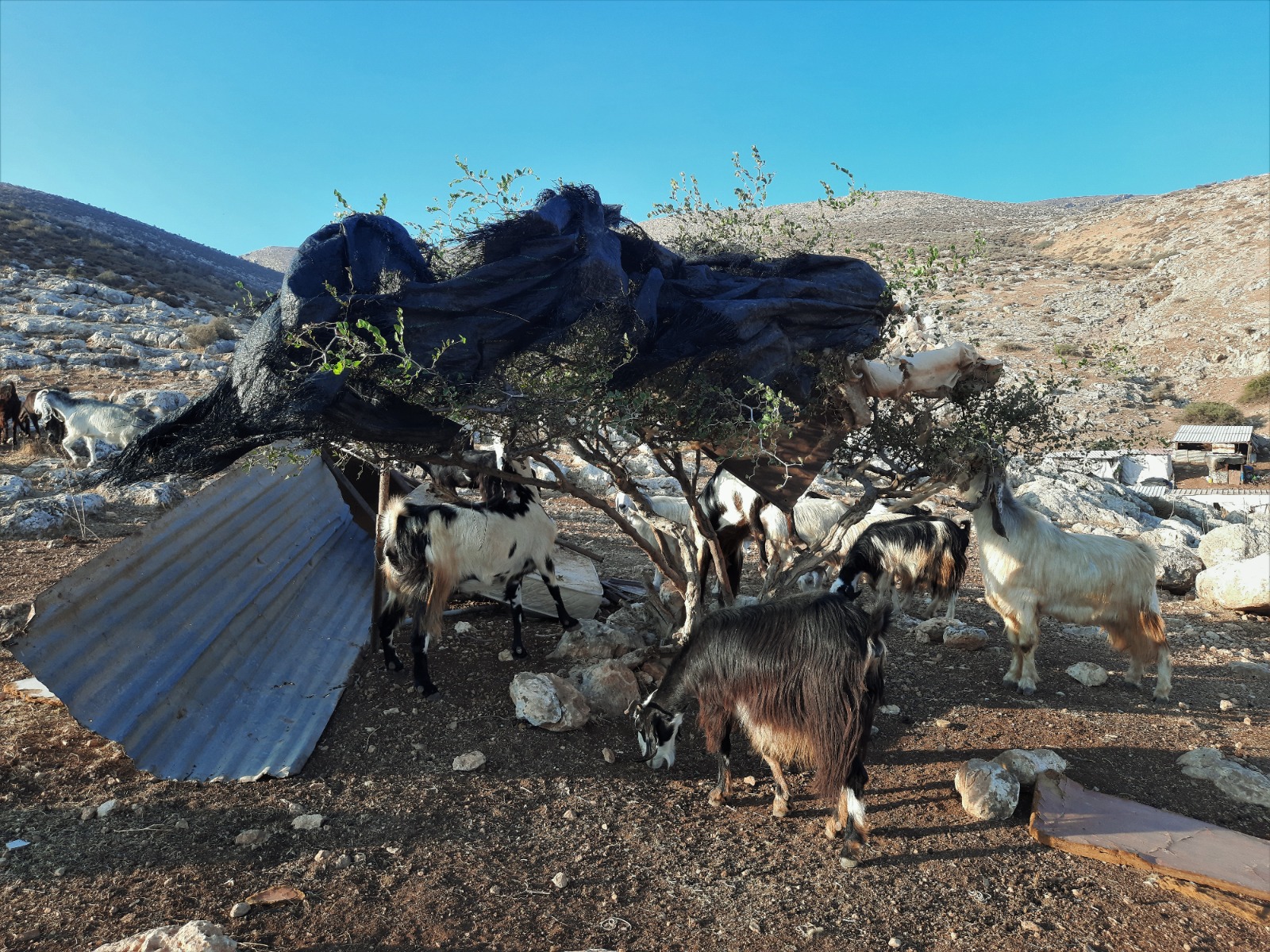 Shahar ShilohNov-3-2021Ein Shibli: grazing begins close to home
-
Ma'ale Efrayim
See all reports for this place-
Ma'ale Efrayim On the road connecting Route 90 (the Jordan Valley road) to the Allon Road.
-
Za'tara (Tapuah)
See all reports for this place-
Za'tara (Tapuah) Za'tara is an internal checkpoint in the heart of the West Bank, at the intersection of Road 60 and Road 505 (Trans-Samaria), east of the Tapuah settlement. This checkpoint is the "border" marked by the IDF between the north and south of the West Bank, in accordance with the policy of separation between the two parts of the West Bank that has been in place since December 2005. At the Za'tara checkpoint, there are separate routes for Israelis and Palestinians. In the route for Israelis, there are no inspections and the route for Palestinians inspects. The queue lengthens and shortens suits. The checkpoint is open 24 hours a day. The checkpoint is partially staffed and the people who pass through it are checked at random.
 Shoshi AnbarSep-27-2023Za'atra (Tapuah Intersection). Signs
-