
‘Azzun ‘Atma, Jurish, Za’tara (Tapuah)
Jurish, Za’tara, ‘Azzun ‘Atma
Hadas reports:
14:10 All along the road to Jurish we see Palestinians harvesting olives.
14:30 Za’tara junction
There is a jeep on guard at the settlers’ hitchhiking station toward Tel Aviv.
Settlers have erected a sign at the junction:
“Long live Israel", "Prepare for a new settlement"
We saw no soldiers inspecting vehicles in either direction.
An army jeep is parked off to the side of the settlers’ hitchhiking station towards Ramallah.
14:50 Jurish We worked with the girls.
17:40 Za’tara junction
On the way back to Tel Aviv we saw an army jeep in the fenced area and soldiers standing in the guard tower.
We saw no soldiers inspecting vehicles in either direction – toward Nablus or toward Ramallah.
17:50 Hars junction
Two army jeeps parked near the groves.
18:00 ‘Azzun ‘Atma checkpoint. We saw no Palestinians going through.
In a conversation with S., one of the girls, she said she’s exhausted because she’s been working with her family on the olive harvest. They work from six in the morning until six in the evening.
Shosh reports:
The English lesson in Jurish.
We were three: Anna, Hadas and Shosh. We drove with Nadim from Rosh Ha’ayin, arriving at 14:45. We waited about 15 minutes for the girls to show up.
The core of 12-13 bright, alert high school students arrived, highly motivated. They were ready for the tour we’d promised last week. The first half of the class was devoted to the lesson, the second half to a tour in the village.
They’d prepared for the tour. They wore their elegant clothes, all kitted out, so they weren’t able to exercise. They are usually well-dressed but this time they were glorious. It seems the girls, who don’t ordinarily have much freedom of movement, viewed the tour as a happy opportunity, a chance to dress up. We learned the lovely garments were bought in Nablus; the local shop doesn’t carry fashionable items. Some of the girls proudly pointed out their homes and asked us to describe our own neighborhoods. They were particularly interested in Tel Aviv.
The class was devoted to review of material from the previous lesson and creating stories based on the vocabulary learned at the beginning of the lesson. Today we studied in groups. Each group presented its story and heard comments from the others. The subjects were based on their own lives and immediate environment. The class hasn’t yet gotten used to reviewing last week’s lesson and doing homework. But things have improved. S., the unofficial leader, is helpful.
The class ended with everyone feeling good, as usual. The girls again said they enjoy classes with us, unlike school, which is boring.
'Azzun 'Atma
See all reports for this place-
'Azzun 'Atma
A Palestinian village of about 1,800 residents. The settlement of Sha'arei Tikva was established on its land adjacent to it, and the settlement of Oranit was established on its agricultural lands. By 2013, the separation fence had passed through the village and a checkpoint staffed by the army allowed the residents to cross from side to side. After building a massive wall surrounding the village and some of its agricultural lands, the residents went daily for five years to their lands that remained in the Seam Zone through the Oranit agricultural checkpoint (4). Since 2018 it has only opened during the olive harvest and the farmers have to pass daily at the Beit Amin / Abu Salman checkpoint (1447), about 3 kilometers north.From a report from March 24, 2021: "The farmers from Beit Amin and Azon Atma are happy that since February 21 the Oranit checkpoint .is going to be open 3 times a day, The farmers are really developing the place."
Report from July 14, 2024: "Ornit checkpoint is closed . The Beit Amin/Abu Salman agricultural checkpoint is closed (there is no contact with the military to check if it opens rarely), the Ezbat Jaloud checkpoint was opened once a day before the war.
Updated for July 2024
 Apr-11-2019Azoun: The main entrance to village blocked now for several weeks
-
Jurish
See all reports for this place-
Jurish
An ancient village, of which 62% of the lands were defined after the 1995 agreements as Area B, while the remaining 38% Area C. Israel confiscated 17 dunams of the village's land for the construction of the Israeli Migdalim settlement, in addition to expropriating land for Road 505. In mid-2016, a road was blocked by the IDF (partly paved by the Palestinian Authority) that connected Jurish to Road 505. This is the shortest way to get to Jurish from the main road, without bypassing another 6.5 km through Qusra.
From 2014 to mid-2016, volunteers from the Watch checkpoint in the village held English, yoga and Hebrew classes for girls.
-
Za'tara (Tapuah)
See all reports for this place-
Za'tara (Tapuah) Za'tara is an internal checkpoint in the heart of the West Bank, at the intersection of Road 60 and Road 505 (Trans-Samaria), east of the Tapuah settlement. This checkpoint is the "border" marked by the IDF between the north and south of the West Bank, in accordance with the policy of separation between the two parts of the West Bank that has been in place since December 2005. At the Za'tara checkpoint, there are separate routes for Israelis and Palestinians. In the route for Israelis, there are no inspections and the route for Palestinians inspects. The queue lengthens and shortens suits. The checkpoint is open 24 hours a day. The checkpoint is partially staffed and the people who pass through it are checked at random.
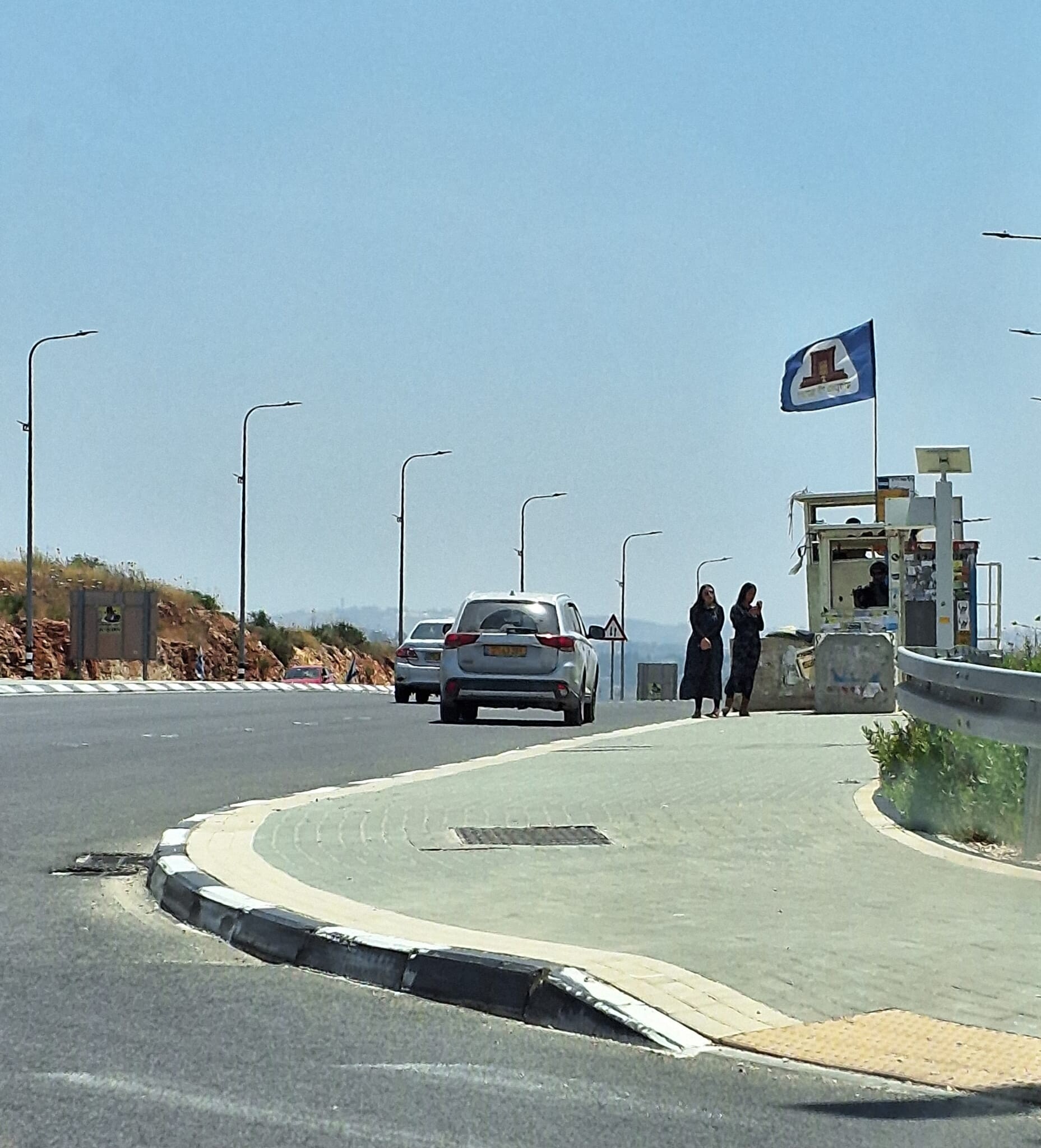 Ronit Dahan-RamatiJun-9-2026Za'atara (Tapuach Junction). The Temple Flag Above a Station
-