
Eyal Crossing, Irtah (Sha’ar Efrayim)
Irtah/Sha'ar Efraiym crossing –
4.55 The parking lot for the transits and taxi’s is still closed – it seems constructions or repairs are going on there – resulting in a chaos of cars on the road leading towards it. Why does this take over a month, as a road to a settlement can be built in a day?
5.02 The Terminal opens the turnstiles and the usual run to the magnometer starts. What we see and hear is the same as
reported 13/11, 9/11 and the weeks before this week: crowds, noise of cans, young workers climbing the fences to
jump the queue. (picture of Nurit Popper of 13/11/14)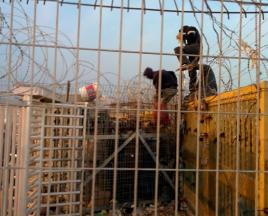
5.07 The first laborers exit at the Israeli side, but as there are just three (!!) of the 14 checking-booths open, most workers are stuck inside for much longer. This is further emphasized by the noise we hear from the inside of the Terminal. Both fluorescent lights at the exit are broken down: darkness prevails.
5.35 One more checking booth is being opened. When the turnstile at the exit is closed for a few minutes the large crowd that gets stuck there is afterwards not being released by opening the extra gate as was assured to us, but has to find its way out by pushing through the turnstile one by one. Construction on the business-center is slowly progressing;
5.45 We return to the entrance side and see, what we did not notice before that the side-gate is not locked and to 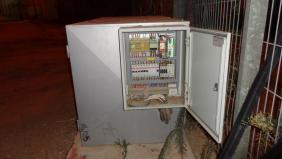
our astonishment that the electricity-box next to it is open! Also here carelessness/negligence?
5.50 The crowd has diminished greatly. Building of the new entrance: the ground is leveled and a concrete floor is poured.
Eyal crossing
6.10 We inquired if Palestinians experienced any difficulties by the use of public transport but most workers claimed they did not have any problems. Only one worker said once when a bus-driver did not want to let him get on the bus, a policeman who was called to the scene told the driver he was acting against the law and forced him to take the Palestinian to Ariel as he requested.
Eyal Checkpoint / Crossing
See all reports for this place-
Eyal Checkpoint is intended for pedestrians and Palestinians only. This is the main barrier for workers to cross from the center of the West Bank. Workers with a work permit to enter Israel can pass through it for trade, medicine, and visiting prisoners. The checkpoint was built on the Green Line north of Qalqilya in the separation barrier that surrounds the city. The checkpoint began operating in 2004 by the military. Opening hours on weekdays from 04:00 to 19:00. We started holding shifts there in 2007. We arrived at the checkpoint before it opened at 4 in the morning. We reported on the difficult conditions and the long and cramped queues of workers who must continue their journey by commuting to work throughout Israel. At the end of June 2009, the checkpoint was operated by a civil security company, The transit time has been gradually shortened, today it is faster, but the Palestinians still have to arrive very early to make it to the transportation. Usually, about 15,000 people pass through.
-
Irtah (Sha'ar Efrayim)
See all reports for this place-
The checkpoint is for Palestinians only. It is the main barrier to the passage of workers from the northern West Bank to Israel. Workers with a permit to work in Israel and also for trade (with appropriate permissions), medicine, and visiting prisoners. One can cross the checkpoint only on foot. The checkpoint is located north of Road 557 and south of Tulkarm. Operated by a civil security company, opening hours: between 4:00 and 19:00 on weekdays. As members of Machsom Watch, we began our shifts to this location in 2007. We arrived before it opened at 4 in the morning and report since, on the harsh conditions and the long and crowded queues of workers. The workers who pass by continue their journey by transportation to work throughout Israel. In the first period of its activity, about 3,000 and then 5,000 people passed through this checkpoint every day. Due to the small number of checking points and arbitrary delays for long periods of time in the "rooms", workers feared losing their transportation. Hence workers leave their homes at 2:30 at night to be among the first. Today, 15,000 pass and the transition is faster. Workers are still leaving their homes very early to get past the checkpoint at 7 p.m. In an adjacent compound, there is a terminal for the transfer of goods on a commercial scale, using the back-to-back method.
-