
Hebron, South Hebron Hills
A bright, clear morning. The Southern Hebron Hills that are dry all year are green and lovely. Remnants of snow at higher elevations and the bare vineyards have large puddles in them. As Bialik wrote: “The sun shone, etc.”
We drove on Highway 317. The settlement of Susiya has grown and another new, impressive neighborhood is under construction. You can see where Nissan Slomianski is sending our money.
At the turn to the Mitzpeh Ya’ir outpost above the road, there’s a “locality” in the valley, called Gawayyis. The Jabarin and Abu’aram families live there in tents, trying to make a living from their sheep and olive trees. In 2001 they were expelled from the caves which were right next to the road to the outpost. They showed us the remains of their bake oven, their water cistern and their buildings. Why were they expelled? To develop the area for settlers. Mitzpeh Ya’ir stands on their land. G. asks the settlers, did someone sell you the land that had belonged to us since Turkish times? The settler replies, “the land has been ours for 2000 years; we don’t have to buy it.” They moved down to the valley, about one kilometer from where they’d lived. On Sunday, 11.1.15, the settlers cut down 45 trees in the grove near them that was accessible. Hagit sent photographs yesterday.
We returned today to see it again. The residents arrive and continue telling us what’s happened to them in recent years. They gave us the names of the settlers from Mitzpeh Ya’ir and from Susiya who keep harassing them and this time broke another 300 trees in an area farther away which we couldn’t reach because of the mud. The tracks led to Mitzpeh Ya’ir… So what? Again nothing will be done.
He said that two weeks ago he and his wife were beaten when they grazed their sheep on their land. Shepherds from the village of Susya also graze on their land and fight with them. He shows us a pile of complaints he filed with the police in recent years, about which nothing had been done. But when a settler filed a complaint against him he was handcuffed immediately and fined him even though he hadn’t done anything.
G. tells us that last summer they harvested the wheat, piled it up in stacks by the road near Susiya. Settlers from Susiya came and set fire to the entire crop. When they complained to the police they were told the settlers are hoodlums and set fire to a police car and they’re unable to control them. G. asked the policeman, “So why do you arm them?” Did he receive an answer? Three guesses.
Where can we go? they ask. This is our home, our life.
Hebron
Quiet, rinsed clean, remnants of snow everywhere. Pupils are still on winter break. The routine continues at the Cave of the Patriarchs, tourist groups walking around.
Everything continues normally at the checkpoints. TIPH police walk on Shuhadeh Street. We were told a shop (which is closed, of course) next to Beit Hadassah was broken into a few days ago. We telephoned M., our friend, who confirmed it, another attempt by settlers to take over abandoned property. The army came and this time made them leave and closed the shop again. There’s now no sign of what happened.
Hebron
See all reports for this place-
According to Wye Plantation Accords (1997), Hebron is divided in two: H1 is under Palestinian Authority control, H2 is under Israeli control. In Hebron there are 170,000 Palestinian citizens, 60,000 of them in H2. Between the two areas are permanent checkpoints, manned at all hours, preventing Palestinian movement between them and controlling passage of permit holders such as teachers and schoolchildren. Some 800 Jews live in Avraham Avinu Quarter and Tel Rumeida, on Givat HaAvot and in the wholesale market.
Checkpoints observed in H2:
- Bet Hameriva CP- manned with a pillbox
- Kapisha quarter CP (the northern side of Zion axis) - manned with a pillbox
- The 160 turn CP (the southern side of Zion axis) - manned with a pillbox
- Avraham Avinu quarter - watch station
- The pharmacy CP - checking inside a caravan with a magnometer
- Tarpat (1929) CP - checking inside a caravan with a magnometer
- Tel Rumeida CP - guarding station
- Beit Hadassah CP - guarding station
Three checkpoints around the Tomb of the Patriarchs
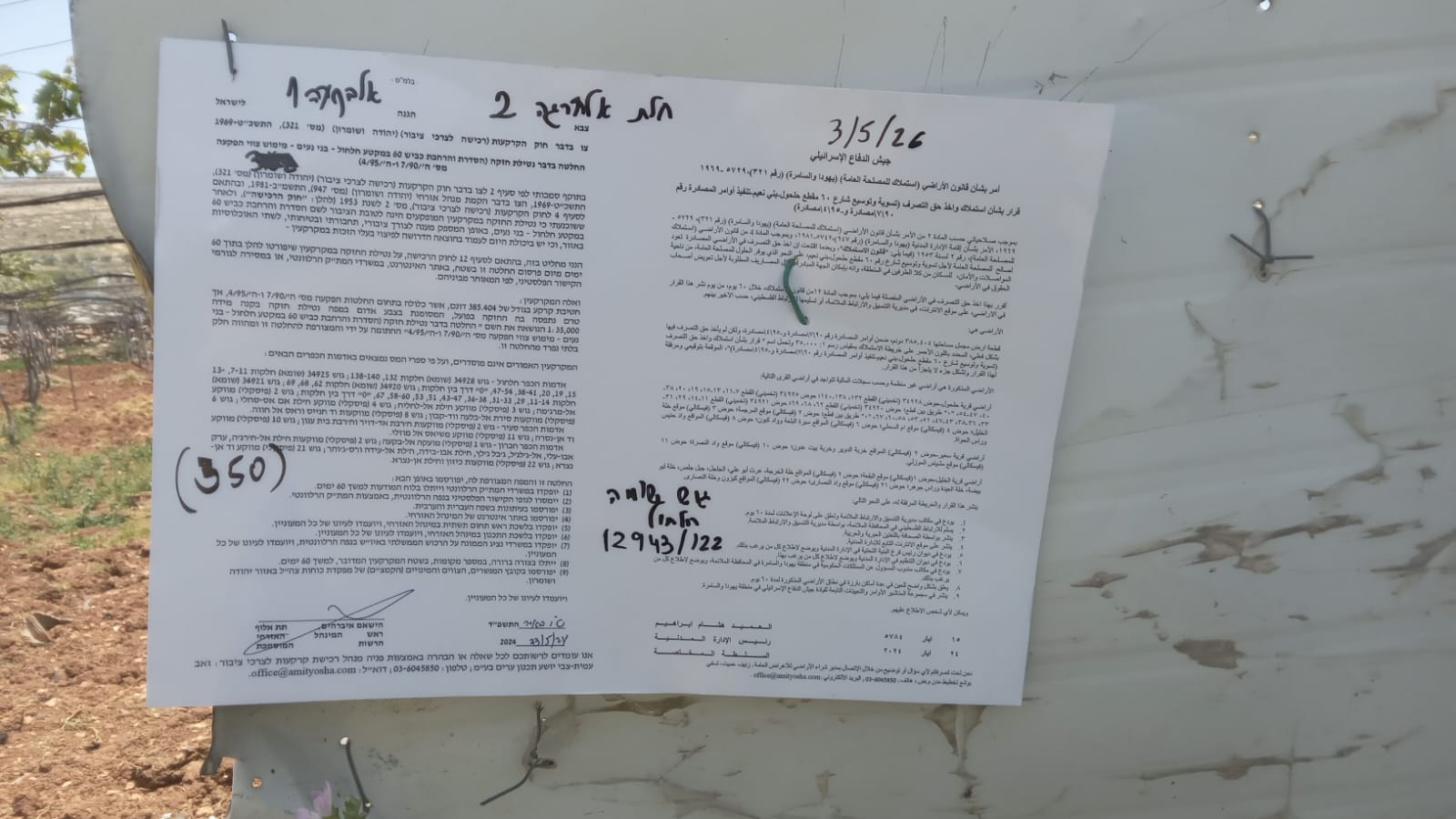 Muhammad D.May-13-2026Hebron - Request for compensation for land expropriation
-
South Hebron Hills
See all reports for this place-
South Hebron Hills
South Hebron Hills is a large area in the West Bank's southern part.
Yatta is a major city in this area: right in the border zone between the fertile region of Hebron and its surroundings and the desert of the Hebron Hills. Yatta has about 64,000 inhabitants.
The surrounding villages are called Masafer Yatta (Yatta's daughter villages). Their inhabitants subsist on livestock and agriculture. Agriculture is possible only in small plots, especially near streams. Most of the area consists of rocky terraces.Since the beginning of the 1980s, many settlements have been established on the agricultural land cultivated by the Palestinians in the South Hebron Hills region: Carmel, Maon, Susia, Masadot Yehuda, Othniel, and more. Since the settlements were established and Palestinians cultivation areas have been reduced; the residents of the South Hebron Hills have been suffering from harassment by the settlers. Attempts to evict and demolish houses have continued, along with withholding water and electricity. The military and police usually refrain from intervening in violent incidents between settlers and Palestinians do not enforce the law when it comes to the investigation of extensive violent Jewish settlers. The harassment in the South Hebron Hills includes attacking and attempting to burn residential tents, harassing dogs, harming herds, and preventing access to pastures.
There are several checkpoints in the South Hebron Hills, on Routes 317 and 60. In most of them, no military presence is apparent, but rather an array of pillboxes monitor the villages. Roadblocks are frequently set up according to the settlers and the army's needs. These are located at the Zif Junction, the Dura-al Fawwar crossing, and the Sheep Junction at the southern entrance to Hebron.
Updated April 2022
 Muhammad D.Jul-13-2026Michal with O.
-