‘Einabus, Jama’in, Kifl Harith, Qira, Urif, Zeta
09:00 We left from the Rosh Ha’ayin train station.
We take Highway 5 east. A huge traffic jam in the other direction. It begins at Kafr Qassem and extends to the Shomron checkpoint. A police checkpoint is apparently the reason. All along the road are signs, “We’re tired of apologizing,” from Bennett’s party. Also signs for Eli Yishai’s “Yahad” and for the Likud.
At this time of the morning the villages along the way – Kifl Harith and Qira – are still slumbering. Stores are closed, few people in the street. On the other hand, the exit road from Zeita is blocked. Local residents operate a large cement mixer to lay a foundation for their new house. A happy sight. Nadim doesn’t linger and continues on an alternate route. We pass through Jama’in and Einabus. Life there proceeds normally. Shops are open, much traffic and people in the streets. We saw no military presence anywhere along our route.
10:00 We reached Urif after learning that settlers from Yitzhar attacked the school. The procedure is already familiar: the settlers come down the path to the village, throw rocks at the school. Then soldiers show up, and in order to “protect” the settlers they begin firing tear gas at the pupils. No one was injured this time.
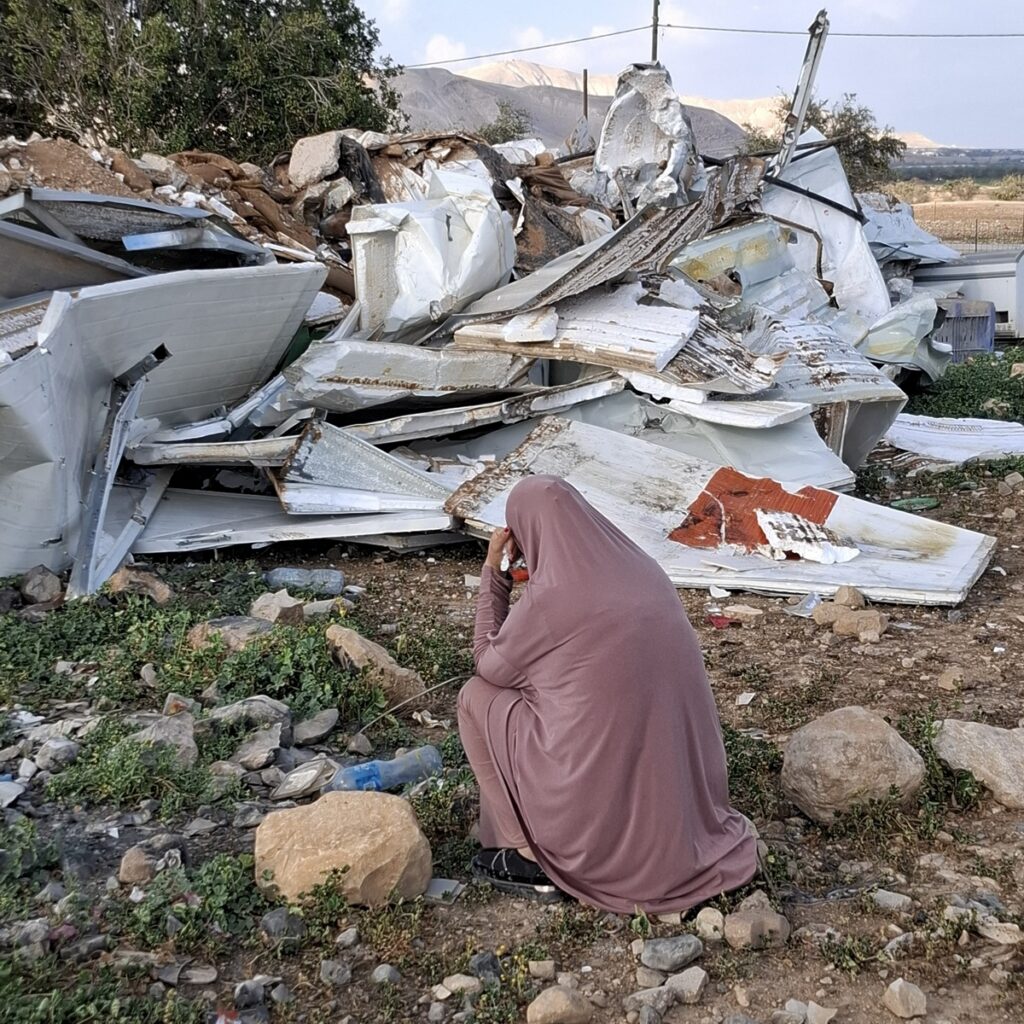
We meet three council members at the municipal building, a woman and two men, one active in B’Tselem. They report new harassment by Yitzhar settlers. The day before we came they placed six pre-fabs, not yet occupied, on land belonging to the village. The villagers filed a complaint with the Palestinian DCL regarding the trespass and also announced it on their website (an innovation allowing direct and rapid contact between the villagers and other villages in the area). But our interlocutors have no illusions. They say the Shabak has already identified the site). As we all surely remember, a few months ago Yitzhar settlers attacked reservists who came to the settlement. More than once they’ve punctured tires of military vehicles, including those belonging to senior officers who came to speak with them. Now, it turns out, the settlers and the army have reconciled: one hand washes the other. The army cooperates with the settlers to steal village lands. The council members say that Yitzhar’s takeover of the land is carried out with the open assistance of the army which declares the land a closed military area and thereby prevents access by the landowners. The “military area” rapidly comes into the hands of settlers from Yitzhar.
Another type of harassment carried out directly by the army occurred last October. Since 1994 the village has had an electrical grid. But today, after more than twenty years, the electricity supply is insufficient and must be expanded. After long negotiations with the occupation authorities the village gained approval to expand the electricity supply. Soldiers arrived in October, broke the lock of the substation and installed a new lock. In response, villagers broke the “military” lock. Punishment came quickly: for more than four months the village electric bill, determined on the basis of estimates, has rocketed and now amounts to NIS 60,000/month more than in the past.
But the settlers don’t depend only on the army to do their work: besides sporadic attacks, the settlers attack seasonally, during April-May, when the wheat has already ripened and can be set afire easily (like a wicked settler told one of the villagers: “You sow – and I’ll reap.”). This is the season for school baccalaureate exams. Attacks by settlers on the school are intended to prevent it from administering exams and thereby severely harm the pupils’ future.
In 2013, arson of the fields was accompanied by serious violence: a settler from Yitzhar attacked a boy, bound him and shot him. Next to the bleeding child he placed a knife, “proof” that he shot in self-defense. Luckily, the boy lived. He was hospitalized in Jordan for two months but now limps.
There’s not enough room to describe the daily harassment the villagers suffer from the Yitzhar settlers. And where are the police stationed there?
“They’re there so the settlers don’t attack soldiers. They don’t care about attacks on Palestinians,” the council members tell me.
We pass the school on our way out. A path from the top of the hill, where Yitzhar is located, leads straight to the school. That evil path is marked all along its length by olive trees that have been cut down and burned.
12:00 Back to Rosh Ha’ayin.
'Einabus
See all reports for this place-
'Einabus
A village in the Nablus district, west of Hawara, numbering about 3,000 people. 85% of the village's land in Area B, 15% in Area C. 114 dunams of its land were expropriated to establish the violent settlement of Yitzhar and its outposts. Due to the proximity and violence of the settlers sitting on the top of the mountain to invade the village lands, the inhabitants of Einabus regularly suffer from harassment by settlers throwing stones, smashing windows, cutting down olive groves, as well as arson of vehicles and fields. All these were intensified in the second decade of the 21st century.
-
Jamma'in*
See all reports for this place-
Jamma'in*
Jamma'in is a small town, with some of the best quarries in the area. The stone is sold all over Palestine and Israel and even outside the country. The city also has an industrial area. Although they are close to the Ariel and Tapuach settlements, Jama'in farmers have no daily problems with settlers. Harassment occurs mainly during the October harvest season - the settlers sometimes try to drive the farmers out of their plots. Jama'in has its own info-icon water reservoir tower. The water is obtained from sources and paid for by the Palestinian Authority. The city has one clinic that opens only 2-3 days a week. The biggest problem is that there is only one hospital in Nablus in an area of about 10,000 residents. This hospital is too small, does not have enough equipment, and not enough doctors.
Zeita / jama'in is a village of about 3000 inhabitants near Jama'in and Ariel. In the 1980s, land was taken from the village and transferred to settlements. Farmers in the village have lost some of their income. The settlements are located on the ridges, further away from Zeita, which is in the valley. The village does not often suffer from harassment.
The water sources for Zeita and Jama'in that have supplied water to the villages for centuries have been confiscated by the Mekorot company and the water is flowed to Ariel. Without a reasonable info-icon water supply the villages cannot develop agriculture or any industry.
The electricity comes from the Israeli Electric Company through Ariel and Jama'in.
The IDF oversees the main roads and entrances to the villages. -
Jama'in is a small town, with some of the best quarries in the area. The stone is sold all over Palestine and Israel and even outside the country. The city also has an industrial area. Although they are close to the Ariel and Tapuach settlements, Jama'in farmers have no daily problems with settlers. Harassment occurs mainly during the October harvest season - the settlers sometimes try to drive the farmers out of their plots. Jama'in has its own info-icon water reservoir tower. The water is obtained from sources and paid for by the Palestinian Authority. The city has one clinic that opens only 2-3 days a week. The biggest problem is that there is only one hospital in Nablus in an area of about 10,000 residents. This hospital is too small, does not have enough equipment, and not enough doctors. Zeita is a village of about 3000 inhabitants near Jama'in and Ariel. In the 1980s, land was taken from the village and transferred to settlements. Farmers in the village have lost some of their income. The settlements are located on the ridges, further away from Zeita, which is in the valley. The village does not often suffer from harassment. The water sources for Zeita and Jama'in that have supplied water to the villages for centuries have been confiscated by the Mekorot company and the water is flowed to Ariel. Without a reasonable info-icon water supply the villages cannot develop agriculture or any industry. The electricity comes from the Israeli Electric Company through Ariel and Jama'in. The IDF oversees the main roads and entrances to the villages.
-
Kifl Harith
See all reports for this place-
Kifl Harith
This is a Palestinian located north-west of the settler-colony town of Ariel, 18 kilometers south of the city of Nablus. It numbers 3, 206 inhabitants, as of 2007. 42% of the village lands lie in Area B, and 58% in Area C. In 1978, some hundreds of dunams of the village’s farmland was sequestered in order to found the settler-colony of Ariel – in total 5,184 dunams from the Palestinian communities of Salfit, Iscaqa, Marda, and Kifl Harith. Dozens of square kilometers were also confiscated for paving road no. 5 as well as road 505 and their buffer zones, and the Israeli electricity company’s power station. Over the years the village has suffered harassment by sometimes-armed settler-colonists, even casualties. In 1968 the army’s rabbinate ruled the maqam site Nabi Yanoun (sanctified grave of the Prophet Yanoun) is in fact the tomb of Joshua, Son of Nun. Another structure in the village, named Nabi Tul Kifl by the Palestinians, has been identified by the Israeli authorities as to the tomb of Caleb, Son of Yefuneh. These sites are located in the heart of the village, near the mosque, and at times of Jewish religious festivities and pilgrimages, the center of the village is illuminated by projectors and thousands of Jews arrive, protected by hundreds of Israeli soldiers. During such a period, a night curfew is imposed on the village and the villagers are forced to stay shut inside their homes.
-
Qira
See all reports for this place-
Qira
This village is located in the Salfit district of the northern West Bank, 19 kilometers south-west of Nablus. The village population numbered 1,387 as of 2016. 97.6% of the village lands are categorized as Area B, whereas the 2.3% remaining are in Area C. The Separation Fence erected around the settler-colony city of Ariel separates Qira from its local town Salfit, and necessitates a detour of about 20 kilometers.
In 2010-2015, the women’s center in the village held meetings and workshops shared by the village women and children with members of MachsomWatch.
For further information: http://vprofile.arij.org/salfit/pdfs/vprofile/Qira_vp_en.pdf
-
Zeta South (564)
See all reports for this place-
Zeta South (564) Agricultural checkpoint. Allows passage to farmers whose lands have been imprisoned beyond the Separation Barrier. The crossing is allowed for special permit holders, for three days a week: noon and afternoon for 15 minutes at a time. The Palestinians who need to pass are complaining about the short times and the few days they can work on their land.
-