
Qalandiya
5:10 All the stations are open. All the turnstiles are active. And still – the queue reaches the beigel vendor.
The toilets are open to the public.
We "measure times" – 20 minutes to pass from the enclosure to the exit from the trail .
5:20 A bus with about 80 workers arrives. The queue stretches till the parking lot. Since we arrived the turnstiles were opened just once.
5:20-5:30 The turnstiles were opened twice.
5:35 Another big group of people. The queue stretches to the parking lot. A tense atmosphere. We try to catch the attention of the soldier in the aquarium – so that he should enable to let more people pass – there is no reaction.
5:40 Two policemen arrive. One, in an exceptional gesture, decides to open the humanitarian gate.
A disappointment for the elderly men – the policeman enables only women to pass before before the proper time. The men quickly return to their place in the queue to the enclosures ( there is of course a merit to these gestures, but on the other hand they strengthen and establish the arbitrariness and the dependence – today a policemen may be positively inclined, tomorrow he may not. Everything depends on him).
5:50 The queue stretches far into the parking lot. Long minutes of inertness. As said before there is tension in the air.
5:55 The DCO soldier arrives five minutes before time and opens the humanitarian gate, many women and elderly men pass. In the meantime – the flow of people through the turnstile continues to be very slow. The queues remain long and frustrating.
6:10 It cannot be said that we didn't foresee this – blows, trampling; The queue break up.
We talk with the DCO soldier – somebody who knows us and has a nice attitude. He doesn't get excited by the assaults, says it is their problem. On the other hand, he said, it seems that the CP cannot contain so many people, especially in view of the present change in regulations – work permits from the age of 22 and free passage from the age of 55. Somebody shows us his wounds resulting from the assaults (was it he who attacked or was he assaulted?) – a wounded hand and shoulder.
6:30 An attempt to form new queues under the shed. Parallelly there still remains a mass of "pushers" at the head of the queue.
6:33 Another assault from the "block" when the turnstiles are opened. The queues are again broken up.
6:40 We have to leave at the peak of the tumult. We pass through the humanitarian gate – to passage no. 5.
6:45 – 7:10 – 25 minutes of waiting at passage no. 5. No wonder there is no flow at the turnstiles. It seems that the soldiers – three of them – went to buy drinks. We shout from time to time to draw their attention and to make them open, but there is no reaction. When they return the queue proceeds slowly.
We met today people who were late for work, who were afraid of the boss who is annoyed by the lateness, elder men and women who were afraid they would miss their turn for the doctor at the hospital. The inability of the people standing in queue – day after day – to change their situation, to choose a different route, to complain… create feelings of humiliation, frustration and rage. That is how the morning of their working day in the areas of the state of Israel commences.
Qalandiya Checkpoint / Atarot Pass (Jerusalem)
See all reports for this place-
Click here to watch a video from Qalandiya checkpoint up to mid 2019 Three kilometers south of Ramallah, in the heart of Palestinian population. Integrates into "Jerusalem Envelope" as part of Wall that separates between northern suburbs that were annexed to Jerusalem in 1967: Kafr Aqab, Semiramis and Qalandiya, and the villages of Ar-Ram and Bir Nabala, also north of Jerusalem, and the city itself. Some residents of Kafr Aqab, Semiramis and Qalandiya have Jerusalem ID cards. A terminal operated by Israel Police has functioned since early 2006. As of August 2006, northbound pedestrians are not checked. Southbound Palestinians must carry Jerusalem IDs; holders of Palestinian Authority IDs cannot pass without special permits. Vehicular traffic from Ramallah to other West Bank areas runs to the north of Qalandiya. In February 2019, the new facility of the checkpoint was inaugurated aiming to make it like a "border crossing". The bars and barbed wire fences were replaced with walls of perforated metal panels. The check is now performed at multiple stations for face recognition and the transfer of an e-card. The rate of passage has improved and its density has generally decreased, but lack of manpower and malfunctions cause periods of stress. The development and paving of the roads has not yet been completed, the traffic of cars and pedestrians is dangerous, and t the entire vicinity of the checkpoint is filthy. In 2020 a huge pedestrian bridge was built over the vehicle crossing with severe mobility restrictions (steep stairs, long and winding route). The pedestrian access from public transport to the checkpoint from the north (Ramallah direction) is unclear, and there have been cases of people, especially people with disabilities, who accidentally reached the vehicle crossing and were shot by the soldiers at the checkpoint. In the summer of 2021, work began on a new, sunken entrance road from Qalandiya that will lead directly to Road 443 towards Jerusalem and Tel Aviv. At the same time, the runways of the old Atarot airport were demolished and infrastructure was prepared for a large bus terminal. (updated October 2021)
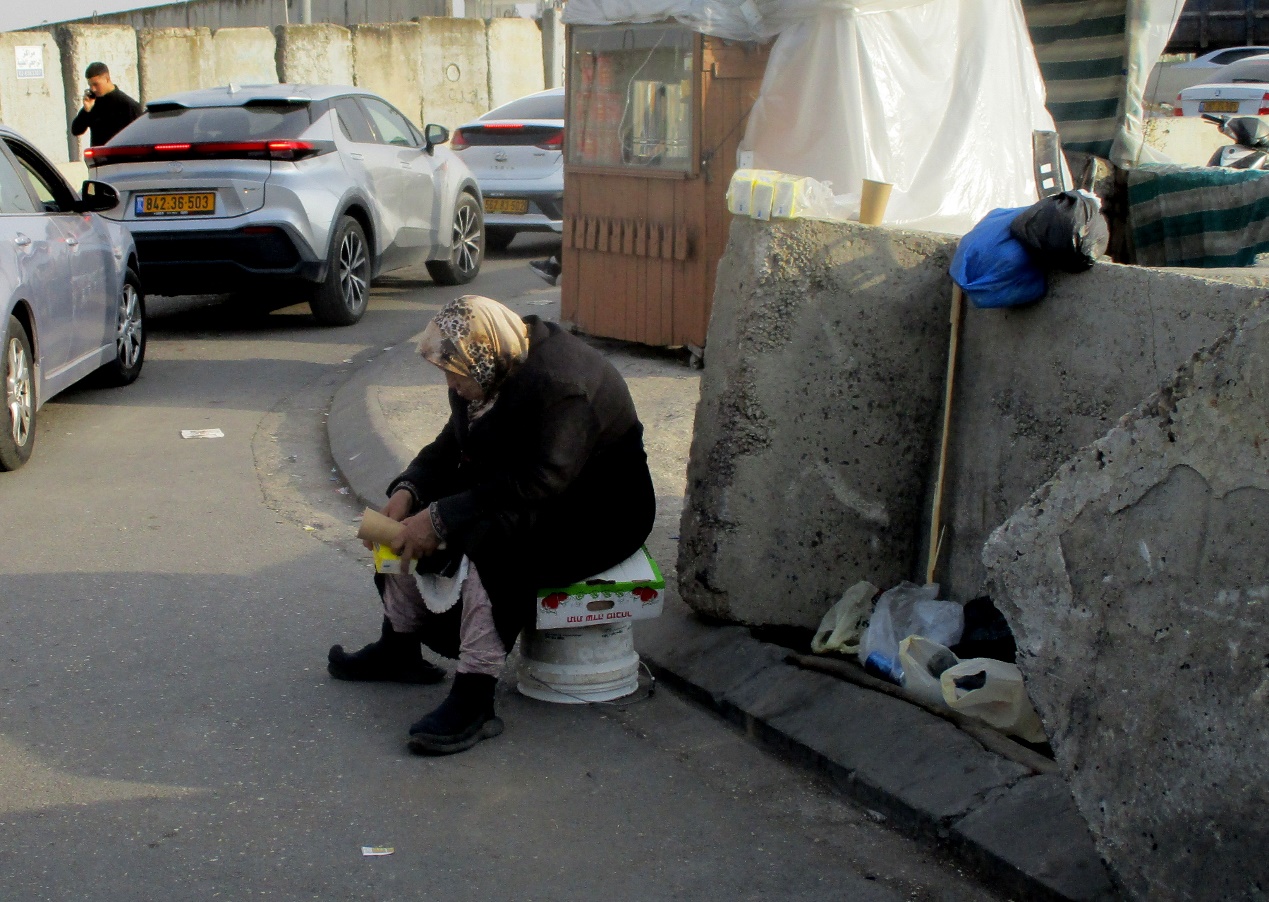 Tamar FleishmanOct-11-2026Qalandiya. Female Beggar
-
