
‘
We met in Qira to coordinate plans for activities with the women and to part temporarily from Sally-Ann.
‘Azzzun – A meeting at the municipality following intensification of the army’s harassment of the village.
Habla – Serious complaints from those using the crossing about the behavior of the new army unit operating it.
10:00 Qira. We were almost the first to arrive, as usual, and by 10:30 a large group of women had gathered at the center.
Today’s meeting was devoted to an evaluation of the activities and (temporarily) parting from Sally Ann who’ll be devoting her time to a new project at the Suzanne Dellal Center. The women asked us to continue with the physical exercises and useful handicrafts for the family.
The women will look into the possibility of teaching English to village children.
11:45 Azzun. We came to the village after a phone call from Daphna B. regarding the growing harassment by the army in recent nights. The women in Qira also confirmed there were problems and youths had been arrested.
We went to the municipality and met M., who summarized the main problems behind the continuing and increasing abuse of villagers by the army.
About ten years ago Israel closed the road inside the village from ‘Azzun to Highway 5. More than a year ago Yesh Din prepared a suit in the High Court to open it.
M. took us to see the road blocked by a checkpoint/yellow iron gate, paralleled by a high metal fence erected a few months ago on which are cameras. An electricity pole erected there three months ago supplies electricity for the security apparatus, including the cameras.
He explained that, unlike the previous situation, where the blocked road ran near houses of the Qaddum settlement, this is different. Although the road is close to the one built to the Ma’ale Shomron settlement, it’s not near the homes.
He says that Yesh Din had determined the army declared the location to be “a special security location” so there’s no chance of succeeding in the High Court, and the suit might even be damaging. A few months ago the village contacted the “Center for Defense of the Individual.” They also took up the matter, but the suit they were working on was ready for filing at about the time the Molotov cocktail was thrown and injured the Israeli toddler, and the attorneys recommended they wait to file it.
A short time ago they inquired again about filing the suit. Since then, says M., the army has intensified its confrontations with the residents. Recently a Druze unit was sent, which treats the residents very harshly. They search houses violently, sometimes block the road from ‘Azzun to Jayyus, and additional internal roads, prevent families from reach the well and the playground and particularly harass the youths.
The villages began to demonstrate on Fridays, demanding the road be opened. During this past Friday’s demonstration the army entered the village, fired smoke grenades and also arrested three youths aged 15-19.
On the way we picked up M., an acquaintance, who was going from ‘Azzun to ‘Izbet Tabib. He told us that on Thursday twenty villagers were arrested at a demonstration and held for a two-hour interrogation.
At the exit from ‘Izbet Tabib a jeep and a command car were parked by the roadside next to the fence.
12:55 Habla. Before we arrived, Anat S. (who’d been there that morning with participants in one of the military preparatory programs) called our attention to the fact this morning there were problems at the crossing because of the behavior of a new military unit stationed there.
The soldiers arrived at 13:10, opened wide the gates in both directions, but until 13:30 allowed through only people coming from Habla. They didn’t send them through the security room, but inspected and interrogated them at the gate.
One person who works in the area volunteered to us that this morning the soldiers stopped one of the children (about 14 years old) and beat him. They also made the school bus wait at the gate almost until 08:30. When the driver asked them to hurry up they reprimanded him rudely, as they did the person who told us. Again we heard the question: “What are we, donkeys? Aren’t we human beings?
Another man who passed said that inside soldiers are beating one of the Palestinians who came to the checkpoint. We heard complaints about the “new” soldiers from a number of people.
Before we left we tried to talk to the soldiers about what we saw and heard. They weren’t receptive. And then we told (with assertive politeness) two who were near us that rumor of their improper behavior has spread throughout the region, and they should be aware of the fact… Nothing in the soldier’s expression indicated whether he heard, understood, cared…
'Azzun
See all reports for this place-
Azoun (updated February 2019)
A Palestinian town situated in Area B (under civil Palestinian control and Israeli security control),
on road 5 between Nablus and Qalqiliya, east of Nabi Elias village. The inhabitants are allowed to construct and improve infrastructures. The Separation Fence has confiscated lands belonging to the town's people. In 2018 olive tree groves owned by one of its inhabitants were confiscated for the sake of paving a road to bypass Nabi Elias. Azoun population numbers 13,000, its economic state dire. Its infrastructures are poor, neglect and poverty rampant. In the meantime, the town council has completed paving an internal road for the inhabitants' welfare.
Because of its proximity to the Jewish settler-colony of Karnei Shomron and its outposts, the town suffers the intense presence of the Israeli army, especially at nighttime: soldiers enter homes, arrest suspects, trash the house and sometimes ruin it, as they do in numerous places in the West Bank. At times a checkpoint closes the entrance to the town, so no one can come in or get out.
-
'Izbet a-Tabib
See all reports for this place-
'Izbet a-Tabib
-
Habla
See all reports for this place-
Habla CP (1393)
The Habla checkpoint (1393) was established on the lands of the residents of Qalqilya, on the short road that
connected it for centuries to the nearby town of Habla. The separation barrier intersects this road twice and cut off the residents of Qalqilya from their lands in the seam zone.(between the fence and the green line).
There is a passage under Road 55 that connects Qalqilya to the sabotage This agricultural barrier is used by the farmers and nursery owners established along Road 55 from the Green Line and on both sides of the kurkar road leading to the checkpoint.
This agricultural checkpoint serves the residents of Arab a-Ramadin al-Janoubi (detached from the West Bank), who pass through it to the West Bank and back to their homes. The opening hours (3 times a day) of this agricultural checkpoint are longer than usual, about an hour (recently shortened to 45 minutes), and are coordinated with the transportation hours of a-Ramadin children studying in the occupied in the West Bank.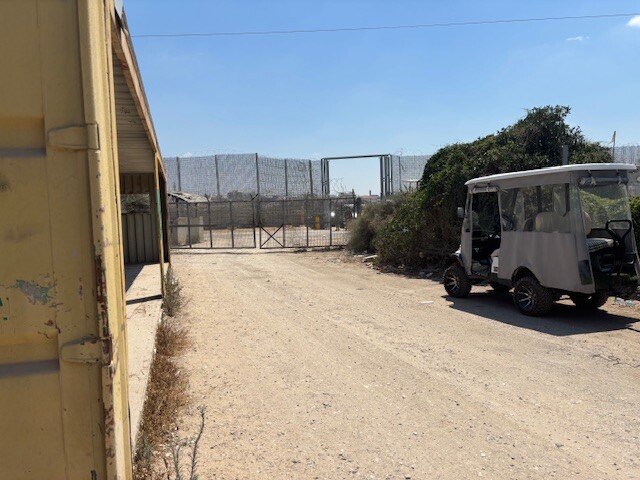 Nina SebaAug-18-2025Habla: The gate is in the process of closing
-
Qira
See all reports for this place-
Qira
This village is located in the Salfit district of the northern West Bank, 19 kilometers south-west of Nablus. The village population numbered 1,387 as of 2016. 97.6% of the village lands are categorized as Area B, whereas the 2.3% remaining are in Area C. The Separation Fence erected around the settler-colony city of Ariel separates Qira from its local town Salfit, and necessitates a detour of about 20 kilometers.
In 2010-2015, the women’s center in the village held meetings and workshops shared by the village women and children with members of MachsomWatch.
For further information: http://vprofile.arij.org/salfit/pdfs/vprofile/Qira_vp_en.pdf
-