
Hebron, Tarqumiya
10:30-15:00
Keeping our promise to Z, who lives next to the Cave of the Patriarchs.
Today we started at Tarqumiyya. The Palestinian side is, of course, almost empty at this hour. But, nevertheless, we met people who’d been blacklisted and who asked for our assistance. As usual, we gave them Sylvia’s phone number; we hope she’ll be able to help them.
Highway 35
Normal traffic. We saw no military presence.
Hebron
Children and adults again at Federman farm.
At the entrance, at Kiryat Arba, a large group of people walking toward the Cave of the Patriarchs.
No visible changes for the time being at Beit Hameriva. The shop on the ground floor, intended to welcome soldiers, is still empty. But Hassidic music, like that coming from Beit Gutnick next to the Cave of the Patriarchs, already can be heard.
We went to the Worshippers route.
People living in the house next to the monument to General Dror Weinberg and his soldiers tell us that soldiers are stationed on the roof of the adjoining house (which the IDF refers to as the “grass widow” procedure). “It’s always like that on Saturday and holidays,” they say. So we climbed the improvised stairs of a building being enlarged and reached the top floor which is the continuation of the roof, on which new rooms are being constructed, and soldiers are sitting or standing on the unfinished floor, and the tray with what’s left of their food is also on the floor. The soldiers are surprised and embarrassed at having been discovered by unwelcome visitors. They call their commanders, stressed… We didn’t confront them. The Jebel Johar neighborhood is also clearly visible from the roof, of course, to the left of the Cave of the Patriarchs, and Wadi el Hurus, between Kiryat Arba and the Zion route, an example of the situation throughout the city. Soldiers deployed and observing at many locations. Some can be identified by the camouflage netting they stretch over the roofs. But with no one to complain, the invasive, injurious activity continues and continues, for security reasons, of course.
The Cave of the Patriarchs
The entrance is crowded with visitors, most, according to their dress, orthodox or ultra-orthodox. The souvenir shops, ‘Abed’s and others’, are open. He’s renovating a space next to his shop. He tells us happily that it’s for his son.
The Ibrahamiyya school is closed, the shops also, it’s 13:00. “Why?” we ask. “It’s late,” passersby tell us.
We went to Z., the woman who lives next to the Palestinian entrance to the Cave of the Patriarchs, who asked us two weeks ago to come during the holiday to see what it’s like for them. This time she welcomed us and was happy to report that people had to pass through her home only during the first two days of the holiday. It’s been quiet all week, no particular problems. We prepared her for the possibility of problems during the last two days of the holiday. Soldiers are posted about every hundred meters throughout the area.
Many visitors next to Beit Hadassah; they’ve come from the museum of the Jewish community in Hebron.
A soldier at the entrance to Tel Rumeida asks what we’re doing, but we convince him to let us drive on.
Still no settlers in Beit Hamachpela. Only flags flying.
Again I understand, through the eyes of our colleagues from the center of the country and their reactions, what an inconceivable and brutal situation exists in Hebron, surrounded as it is on all sides by Kiryat Arba which keeps trying to swallow more and more of it.
We stopped at A.’s metal shop. He was glad to tell us he travels for work to Netivot and to Modi’in. His brother had told us that he reached Kiryat Shmona.
So, H2 contains areas of severe conflict with settlers as well as apparent coexistence.
This time we were able to leave the city via the Border Police base, Ashmoret Yitzhak, located right in the midst of Palestinian homes whose movements are restricted because of it.
When we leave through the Tarqumiyya checkpoint we’re interrogated – who are we, where have we come from, where are we going.
This time they were satisfied with our responses and didn’t detain us for additional inspection.
Hebron
See all reports for this place-
According to Wye Plantation Accords (1997), Hebron is divided in two: H1 is under Palestinian Authority control, H2 is under Israeli control. In Hebron there are 170,000 Palestinian citizens, 60,000 of them in H2. Between the two areas are permanent checkpoints, manned at all hours, preventing Palestinian movement between them and controlling passage of permit holders such as teachers and schoolchildren. Some 800 Jews live in Avraham Avinu Quarter and Tel Rumeida, on Givat HaAvot and in the wholesale market.
Checkpoints observed in H2:
- Bet Hameriva CP- manned with a pillbox
- Kapisha quarter CP (the northern side of Zion axis) - manned with a pillbox
- The 160 turn CP (the southern side of Zion axis) - manned with a pillbox
- Avraham Avinu quarter - watch station
- The pharmacy CP - checking inside a caravan with a magnometer
- Tarpat (1929) CP - checking inside a caravan with a magnometer
- Tel Rumeida CP - guarding station
- Beit Hadassah CP - guarding station
Three checkpoints around the Tomb of the Patriarchs
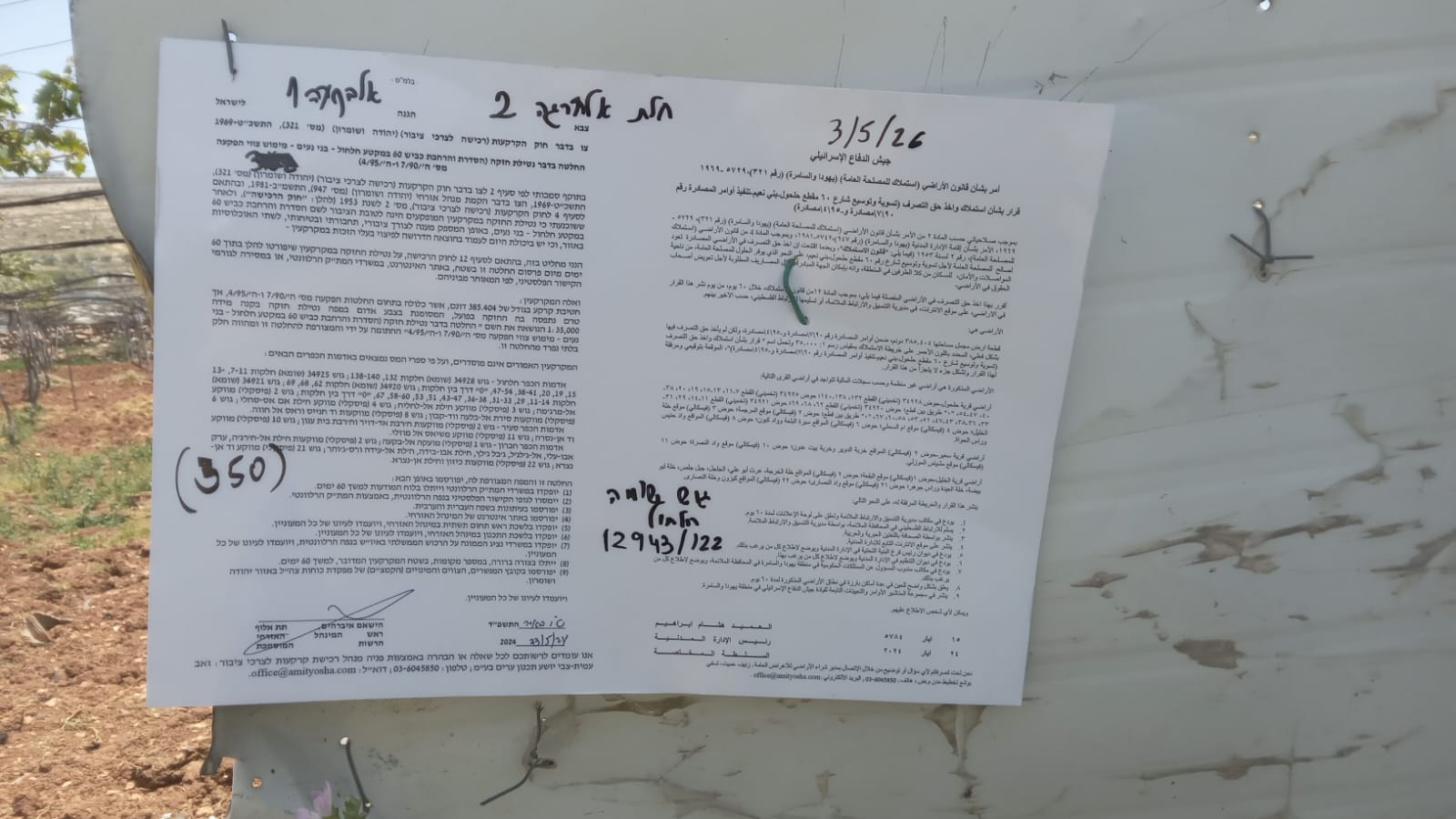 Muhammad D.May-13-2026Hebron - Request for compensation for land expropriation
-
Tarqumiya CP
See all reports for this place-
The Tarqumiya Checkpoint is one of the largest and busiest checkpoints where people and goods cross into Israel. It is located on the Separation Barrier close to the Green Line, on Road 35 (connecting Beer Sheva and Hebron). It is run by the Israel Defense Ministry’s Crossings Administration with civilian secuirty companies running the day to day operations. The checkpoint is indeed open to vehicles in both directions 24/7, but Palestinians are prevented from crossing in vehicles, except in special cases. MachsomWatch activists visit the checkpoint as it opens at 3:45 am, in order to observe the daily passage of nearly 10,000 Palestinian workers. The workers arrive from throughout the Southern West Bank. Our activists report on the tremendous overcrowding at this checkpoint; they have observed young men climbing and scrambling on the fences and roofs of the ‘access cages’. This is how the work day begins for those who ‘build the land of Israel’. updated November 2019
-