Qalandiya
Qalandiya,
In very harsh and extreme weather conditions, while the soldiers (rightly) sit in air-conditioned comfort, the Palestinians are standing crowded into a boiling hot area, while huge fans hang above them, dusty and useless. One elderly woman, who "had been waiting here for half an hour" (as she said) finally reached the end of the line and, just as she crossed it, they yelled out "sacer!" The exhausted woman, who no longer even had the strength to speak, simply collapsed on the iron bars. "Open for her…let her through…look at her! Just let her through.." people were yelling at the female soldier standing there, but she was already busily eating; she didn't glance at her and didn't want to notice her, didn't see and didn't want to see.
The observation of hundreds of the "back to back procedures", a noxious procedure during which the suffering and pain of a sick man is exposed publicly, does not dampen my anger and frustration, and does not change this custom to something one can get used to or for which one can find justifications.
In the afternoon, while the weather is still considered extreme and harsh, a diabetic patient of about 75 was brought from Ramallah for treatment at Mukassad Hospital in East Jerusalem, because the hospitals in the West Bank are not sufficiently equipped to treat him properly according to his condition.
In this extreme and harsh weather, Mahmud arrives, in a wheel chair, to the Palestinian side of the checkpoint. He wants to return home. A wheel chair cannot go through the regular pedestrian lane. Mahmud rolls himself to the gate where there is a sign indicating that it is the humanitarian gate, but the gate for handicapped people was closed and locked.
Mahmud tries to get the attention of the female soldier at the front station, he waves his hands and yells, "Soldier, soldier!" But the soldier sits behind thick windows of protective glass, protected not only against bullets but also against the voice. Only after a lot of waving of arms and shouts does the soldier give a look, recognizes the problem (yes, a Palestinian who has special needs is a "problem") makes a gesture signifying "wait", speaks on the telephone and makes another gesture of "wait". Mahmud waited, and I waited with him.
After 20 minutes of waiting in the shed at the opening of the checkpoint, which was steaming hot and suffocating despite the awning, at a distance of one or one and a half meters from her, she turned her back and attended to her own private business.
As the minutes went by, when I realized that Mahmud was really becoming weak, and maybe ready to give up, he refused my offer to buy him a drink. "Thanks, I ate and drank before I came," he said, and my nerves at least were becoming frayed, so I called the Humanitarian hotline and they promised to bring the subject up with the relevant authorities. Another ten minutes passed, and I called again. "The subject is being treated, there seems to be a problem." they said to me. I also called the DCO, which is within the checkpoint, and I told the clerk about the handicapped man who was sitting in his wheel chair for more than half an hour and all that he wanted was to get home and someone simply has to open the locked gate. "That will take a few more minutes", she said. "How many is "a few more" minutes", I asked, a question which annoyed her, so, instead of answering or doing anything, she just hung up.
I called the Hotline again and nagged them again. "I'm not on the ground so I don't really know what a", Matan answered, the clerk on duty who at least listened politely. But I remained "on the ground" with Mahmud and my phone.the problem is there, but the issue has been handed over to the higher ranks at Qalandiy
And Mahmud, who sat withdrawn into himself most of the time, every few minutes, when his despair got the better of him, would raise his head toward me and, in order to encourage both me and himself, he would say, "In Gaza it is even worse!"
Even time which crawls eventually ends, after one hour and twenty minutes a guard arrived, opened the lock in the gate and Mahmud was able to continue on his way 0 home. While he was crossing the threshold of the gate, the female soldier opened the bars of her armed window,stuck out a hand, waved it at me and yelled, "Yaalah, fly out of here, you whore!" I took wing and flew. But I did not shut my mouth. I made contact with the organization "Israel Accessibility" whose goal is "To advance accessibility in order to allow handicapped people and their families to be part of the society, equally, by right, with honor and complete independence." http://www.aisrael.org
I informed them about the tortures which Mahmud underwent until he succeeded in crossing through the Kalandia checkpoint. I said that I know that they treat the issue of accessibility for handicapped people within the State of Israel, and that Kalandia is not within the State of Israel, but the city of Ariel is also not, and nevertheless….
My report was received with astonishment and support, the details of the case were documented and passed along to the legal consultant of the organization, Att. Rotem Spector, who ;promised to try to deal with the IDF authorities to make sure that cases like this will not be repeated.
Anyway, "It is worse in Gaza."
Qalandiya Checkpoint / Atarot Pass (Jerusalem)
See all reports for this place-
Click here to watch a video from Qalandiya checkpoint up to mid 2019 Three kilometers south of Ramallah, in the heart of Palestinian population. Integrates into "Jerusalem Envelope" as part of Wall that separates between northern suburbs that were annexed to Jerusalem in 1967: Kafr Aqab, Semiramis and Qalandiya, and the villages of Ar-Ram and Bir Nabala, also north of Jerusalem, and the city itself. Some residents of Kafr Aqab, Semiramis and Qalandiya have Jerusalem ID cards. A terminal operated by Israel Police has functioned since early 2006. As of August 2006, northbound pedestrians are not checked. Southbound Palestinians must carry Jerusalem IDs; holders of Palestinian Authority IDs cannot pass without special permits. Vehicular traffic from Ramallah to other West Bank areas runs to the north of Qalandiya. In February 2019, the new facility of the checkpoint was inaugurated aiming to make it like a "border crossing". The bars and barbed wire fences were replaced with walls of perforated metal panels. The check is now performed at multiple stations for face recognition and the transfer of an e-card. The rate of passage has improved and its density has generally decreased, but lack of manpower and malfunctions cause periods of stress. The development and paving of the roads has not yet been completed, the traffic of cars and pedestrians is dangerous, and t the entire vicinity of the checkpoint is filthy. In 2020 a huge pedestrian bridge was built over the vehicle crossing with severe mobility restrictions (steep stairs, long and winding route). The pedestrian access from public transport to the checkpoint from the north (Ramallah direction) is unclear, and there have been cases of people, especially people with disabilities, who accidentally reached the vehicle crossing and were shot by the soldiers at the checkpoint. In the summer of 2021, work began on a new, sunken entrance road from Qalandiya that will lead directly to Road 443 towards Jerusalem and Tel Aviv. At the same time, the runways of the old Atarot airport were demolished and infrastructure was prepared for a large bus terminal. (updated October 2021)
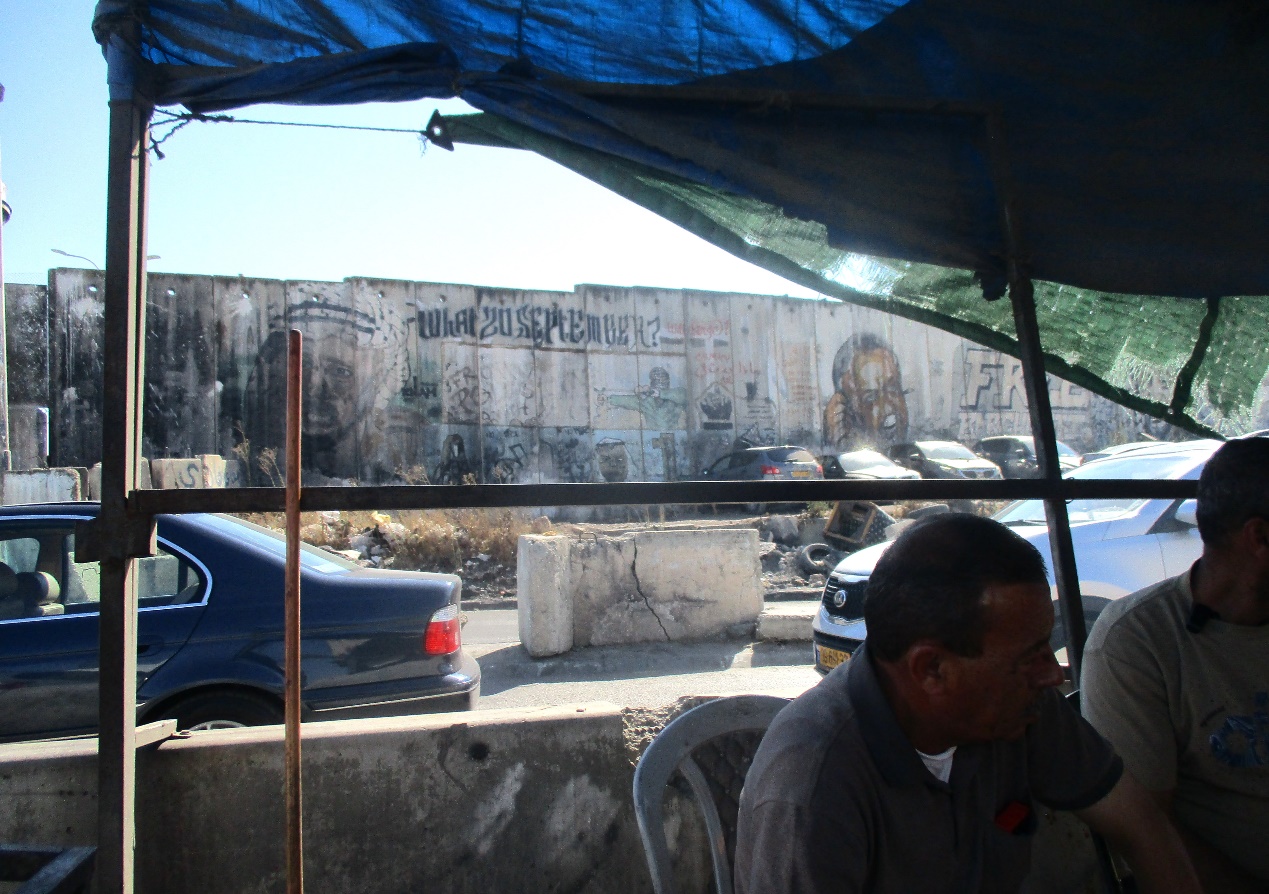 Tamar FleishmanJul-21-2026Qalandiya. Conversation in the shadow of the wall
-