
Qalandiya
A busy morning but relatively reasonable. The Humanitarian Gate was opened but it was operated by a soldier who didn’t know the rules and the checkpoint was closed too early.
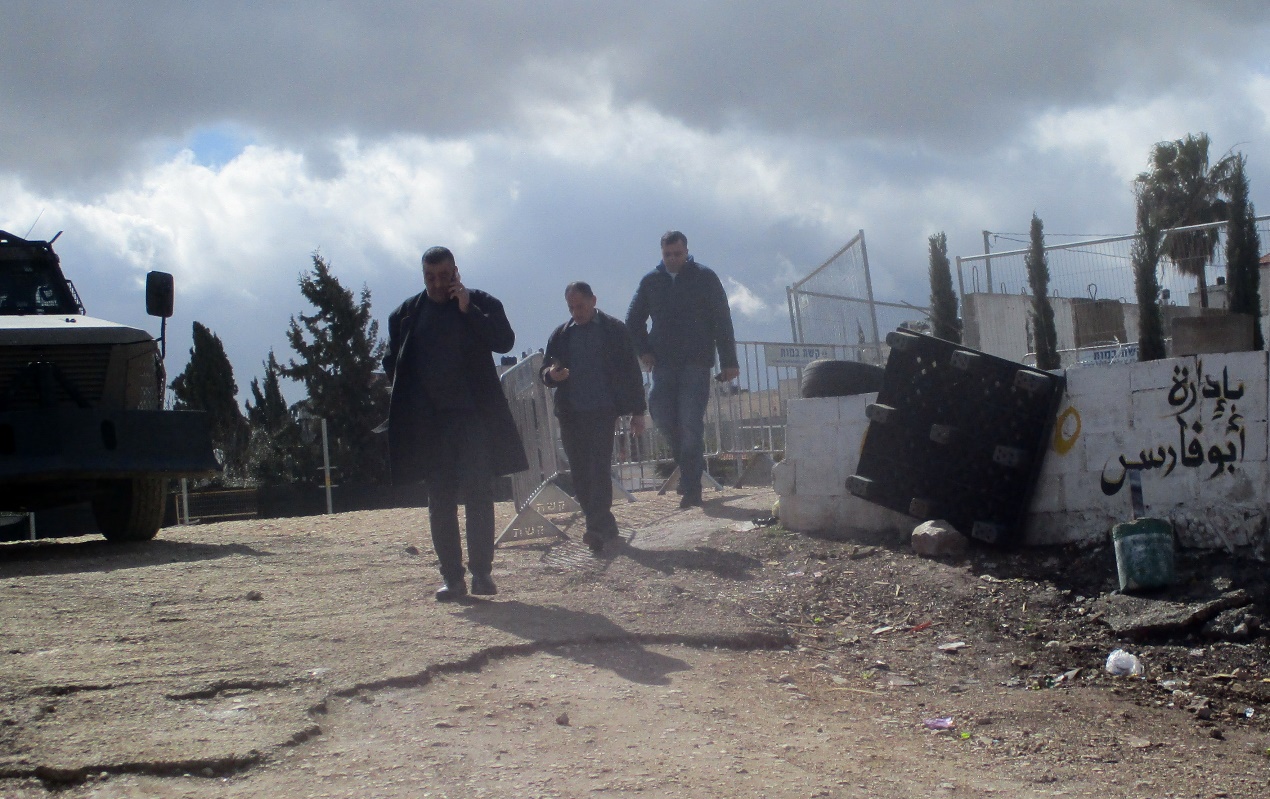
5:15 it is still dark and cold. People who had already passed the checkpoint are sitting around a fire waiting for transportation to work. Many vehicles, most of them public transportation from East Jerusalem. Individuals and groups are saying the Morning Prayer near the entrance to the checkpoint. Inside all five windows are operating despite the illuminated sign above that has an X in red light. 3 lines are arranged till the edge of the shed. The vendors of pretzels and cakes (inside) and coffee (outside) are already here. Here, too, there are people who pray and join the line by the end of the prayer. They allowed women to integrate into the line at the entrance into the paddocks.
5:45 a policewoman and a policeman joined the woman-soldier in the aquarium. Now all windows have illuminated signs with a V in green. The lines get longer and reach the parking lot but order is kept. H. our acquaintance comes over to talk with us. He says that yesterday again the lines were very messy. He works in a bakery in the Mahane Yehuda Market, using an ancient oven – a tourist attraction. Some shoppers began returning to the market as well as a few tourists’ groups, but the situation is still far from normal and everywhere around there are lots of security forces. He had a long conversation with the commander of the border police in the market (a Druze), who came to the bakery, was honored with pita and Zaatar, and was surprised to hear that H. resides in the occupied territories. Immediately after he left two policewomen arrived and checked his documents. The Druze commander came back and advised him to keep a low profile in these days and to avoid talking too much… H. a good conversationalist, knowledgeable about the Israeli way of life and speaks fluent Hebrew, explained to him that he is a veteran in the market for 30 years now and everybody knows him.
6:15 a soldier arrived with a key to the Humanitarian Gate (in our previous shifts people preferred to wait at the regular lines since the order was maintained). The soldier is apparently new to the job and did not know who exactly could pass. Women with permits can pass here regardless of their destination (work or hospital). He sent some of them to the regular line, as well as other people with permits. Only after people protested and we turned to him too he consulted the policemen and let all the women pass. Adults who are allowed to pass without permits were required to wait till 8am. Another policeman, policewoman and two security guards arrived. The policewoman explained to the soldier who could pass through the Humanitarian Gate. It started to rain and the people waiting outside in the shed got wet, most of them did not have umbrellas.
6:40 – The lines shrunk till under the shed, the rain stopped, and we went outside for a tea break. When we returned the lines again went all the way into the parking lot and begun to dwindle only after seven. At around 7:15 we joined one of the queues. Despite the massive presence of security forces and a representative of DCL it was decided not to reopen the Humanitarian Gate. Just then a father arrived with three young children who pass every day on their own to school. They let him pass before us and we could see that they were very experienced: each one had in his school satchel his Israeli birth certificate clad in protective plastic and folded in a side pocket. The older one helped the younger children to lay their satchels inside the scanner and they showed their birth certificates. He put the umbrella in a plastic tray and invited me to put my purse in the tray… it took us about 25 minutes to pass.
Qalandiya Checkpoint / Atarot Pass (Jerusalem)
See all reports for this place-
Click here to watch a video from Qalandiya checkpoint up to mid 2019 Three kilometers south of Ramallah, in the heart of Palestinian population. Integrates into "Jerusalem Envelope" as part of Wall that separates between northern suburbs that were annexed to Jerusalem in 1967: Kafr Aqab, Semiramis and Qalandiya, and the villages of Ar-Ram and Bir Nabala, also north of Jerusalem, and the city itself. Some residents of Kafr Aqab, Semiramis and Qalandiya have Jerusalem ID cards. A terminal operated by Israel Police has functioned since early 2006. As of August 2006, northbound pedestrians are not checked. Southbound Palestinians must carry Jerusalem IDs; holders of Palestinian Authority IDs cannot pass without special permits. Vehicular traffic from Ramallah to other West Bank areas runs to the north of Qalandiya. In February 2019, the new facility of the checkpoint was inaugurated aiming to make it like a "border crossing". The bars and barbed wire fences were replaced with walls of perforated metal panels. The check is now performed at multiple stations for face recognition and the transfer of an e-card. The rate of passage has improved and its density has generally decreased, but lack of manpower and malfunctions cause periods of stress. The development and paving of the roads has not yet been completed, the traffic of cars and pedestrians is dangerous, and t the entire vicinity of the checkpoint is filthy. In 2020 a huge pedestrian bridge was built over the vehicle crossing with severe mobility restrictions (steep stairs, long and winding route). The pedestrian access from public transport to the checkpoint from the north (Ramallah direction) is unclear, and there have been cases of people, especially people with disabilities, who accidentally reached the vehicle crossing and were shot by the soldiers at the checkpoint. In the summer of 2021, work began on a new, sunken entrance road from Qalandiya that will lead directly to Road 443 towards Jerusalem and Tel Aviv. At the same time, the runways of the old Atarot airport were demolished and infrastructure was prepared for a large bus terminal. (updated October 2021)
 Tamar FleishmanFeb-27-2026Qalandiya: On the way to prayer
-