
Beit Furik, Huwwara, Wed 24.10.07, Afternoon
Natanya translating
Summary.
Because of the terrorist attack at Ariel the atmosphere at the checkpoint and in the surrounding villages is very tense. The checking is slow and nervous. The soldiers are too busy seeing to the order of the checkpoint which angers the Palestinians, a false charge is made against us and the checkpoint is closed because of our presence.
14.45 Ariel. We went through the police station at Ariel because Daphna had promised to collect the cell phones of Zacharia of the Rabbis for Human Rights which had been confiscated. There was a great bustle both inside and outside the station because of the attack.
15.20 At the entrance to the village of Marda were three soldiers in an army vehicle standing at the turning to the village. No one allowed out or allowed in. The soldiers said that the entrance to the village had been blocked two hours earlier because of the shooting. 6-7 farmers who had just finished the olive harvest wanted to return home to Jamaiem but the soldiers do not allow them through and tell them to come back in a couple of hours. At Jamaiem is the burnt car which was involved in the attack.
15.30 At the entrance to Jamaiem also are army vehicles and soldiers and here too the entrance to the village is blocked. A young man who wants to enter is sent back because higher up the village is also blocked.
A long truck with a bulldozer on it which looks very threatening is standing next to the blocked area. We wonder if it has been brought to destroy homes in the village.
A bit further on we see three elderly people stealing into the village along a very difficult path.
15.40 Crossroads of Tapuach is open with 12 cars waiting.
15.43 Huwwara.
Although this village unlike other villages in the area is not under curfew all the roads leading from it in the direction of Jamaiem are blocked by army vehicles.
15.55 Checkpoint of Huwwara.
One can see the nervousness and tension on all the faces. The lines of those coming from Nablus are stretched out and now and again one hears cries of anger and knocking on the turnstiles from those standing there, 100s who stand for 3-4 hours. The soldiers are tense. They ignore our presence almost completely. There is also a check of those entering which is unusual. Two soldiers checking the ids of anyone wishing to pass including women and children. Suddenly one of the checking areas stops working and only one is left in action. The anger of those waiting increases and now and again cries of "Allah is great" arise. After 20 minutes Daphne phones the centre to complain about the situation and asks for reinforcements from the DCO. There is one detainee who Racheli manages to speak to and he says he has been there about half an hour and he says that he was only speaking to a friend. He was freed at 16.45 after three captains from the DCO arrived.
16.10 Another detainee. Slightly older. Later it appears that he is the driver of a car which appears on the list of stolen cars and when he was told to wait for the police he tried to run away. When we left he was still there.
16.30 Because of the arrival of the captains of the DCO there were sufficient soldiers and immediately two soldiers got busy trying to bring order in the lines and to straighten them and this they continued doing during our entire shift. This with their rifles in their hands so that everything should look orderly. It rouses the anger to see elderly people being forced to carry out these orders which are only for "education". We are told the the entrance to Jamaiem and Haris have been opened.
17.00 Suddenly the police arrive. Rachelia and Tamar are at Beit Furik and we are told by the soldiers who up to now have ignored us that we have been summoned to go to the police vehicle. The policeman informs us that the soldiers summoned them because we have been interfering in their work. This is especially annoying as during the entire shift we had no contact with the soldiers and it was obvious that this was just to harass us. We explain this to the policeman who calls the commander who summoned him. He throws out all sorts of accusations such as "They bothered me the whole time, they crossed the white line" etc. but cannot bring up one specific incident and says he cannot remember faces. The policeman is not sympathetic to us and continues to scold but it is obvious that he also realizes that he was summoned for no reason.
17.15 On the way home we see that the entrance to Kifil Harat is blocked and there too is a bulldozer.
16.50 Beit Furik
(observiners: Racheli and Tamar). When we arrive the soldiers immediately call out that the checkpoint should be closed until we leave and they did so. Everything came to a stop. We were unable to get the centre to help us so left. The soldiers instigated the Palestinians to see us as responsible for this. We went back to Huwwara where we met two captains of the DCO, H. and R. They were angry that this had been done and asked us to go back with them which we did. When we got there the checkpoint was again closed. The captains ordered it to be opened immediately and reprimanded the commander. A long discussion ensues about where we can stand and we refused to take the area of the turnstiles saying that from there we cannot do our work. We said that we would stand opposite the post at the end of the cement fence. The captains of the DCO understood and said that they would handle the matter with the brigade. The important thing is that the captains said that it is forbidden to close the checkpoint no matter what. We have their number and they said that they would answer all our calls.
Beit Furik checkpoint
See all reports for this place-
One of the three internal checkpoints that closed on the city of Nablus - Beit Furik to the east, Hawara to the south, Beit Iba to the west. The checkpoint is located at the junction of Roads 557 (an apartheid road that was forbidden for Palestinians), leading to the Itamar and Alon Morea settlements and Road 5487. The checkpoint was established in 2001 for pedestrians and vehicles; The opening hours were short and the transition was slow and very problematic.Allegedly, the checkpoint is intended to monitor the movement to and from Nablus of the residents of Beit Furik and Beit Dajan, being the only opening outside their villages. Since May 2009 the checkpoint is open 24 hours a day, the military presence is limited, vehicles can pass through it without inspections, except for random inspections. (Updated April 2010)
-
Huwwara
See all reports for this place-
The Huwwara checkpoint is an internal checkpoint south of the city of Nablus, at the intersection of Roads 60 and 5077 (between the settlements of Bracha and Itamar). This checkpoint was one of the four permanent checkpoints that closed on Nablus (Beit Furik and Awarta checkpoints to the east and the Beit Iba checkpoint to the west). It was a pedestrian-only barrier. As MachsomWatch volunteers, we watched therre since 2001 two shifts a day - morning and noon, the thousands of Palestinians leaving Nablus and waiting for hours in queues to reach anywhere else in the West Bank, from the other side of the checkpoint the destination could only be reached by public transport. In early June 2009, as part of the easing of Palestinian traffic in the West Bank, the checkpoint was opened to vehicular traffic. The passage was free, with occasional military presence in the guard tower. Also, there were vehicle inspections from time to time. Since the massacre on 7.10.2023, the checkpoint has been closed to Palestinians.
On February 26, 2023, about 400 settlers attacked the town's residents for 5 hours and set fire to property, such as houses and cars. Disturbances occurred in response to a shooting of two Jewish residents of Har Bracha by a Palestinian Terrorist. The soldiers stationed in the town did not prevent the arson and rescued Palestinian families from their homes only after they were set on fire. No one was punished and Finance Minister Smotrich stated that "the State of Israel should wipe out Hawara." Left and center organizations organized solidarity demonstrations and support actions for the residents of Hawara.Hawara continued to be in the headlines in all the months that followed: more pogroms by the settlers, attacks by Palestinians and a massive presence of the army in the town. It amounted to a de facto curfew of commerce and life in the center of the city. On October 5, 2023, MK Zvi established a Sukkah in the center of Hawara and hundreds of settlers backed the army blocked the main road and held prayers in the heart of the town all night and the next day. On Saturday, October 7, 23 The "Swords of Iron" war began with an attack by Hamas on settlements surrounding Gaza in the face of a poor presence of the IDF. Much criticism has been made of the withdrawal of military forces from the area surrounding Gaza and their placement in the West Bank, and in the Hawara and Samaria region in particular, as a shield for the settlers who were taking over and rioting.
On November 12, 2023, the first section of the Hawara bypass road intended for Israeli traffic only was opened. In this way, the settlers can bypass the road that goes through the center of Hawara, which is the main artery for traffic from the Nablus area to Ramallah and the south of the West Bank. For the construction of the road, the Civil Administration expropriated 406 dunams of private land belonging to Palestinians from the nearby villages. The settlers are not satisfied with this at the moment, and demand to also travel through Hawara itself in order to demonstrate presence and control.(updated November 2023)
.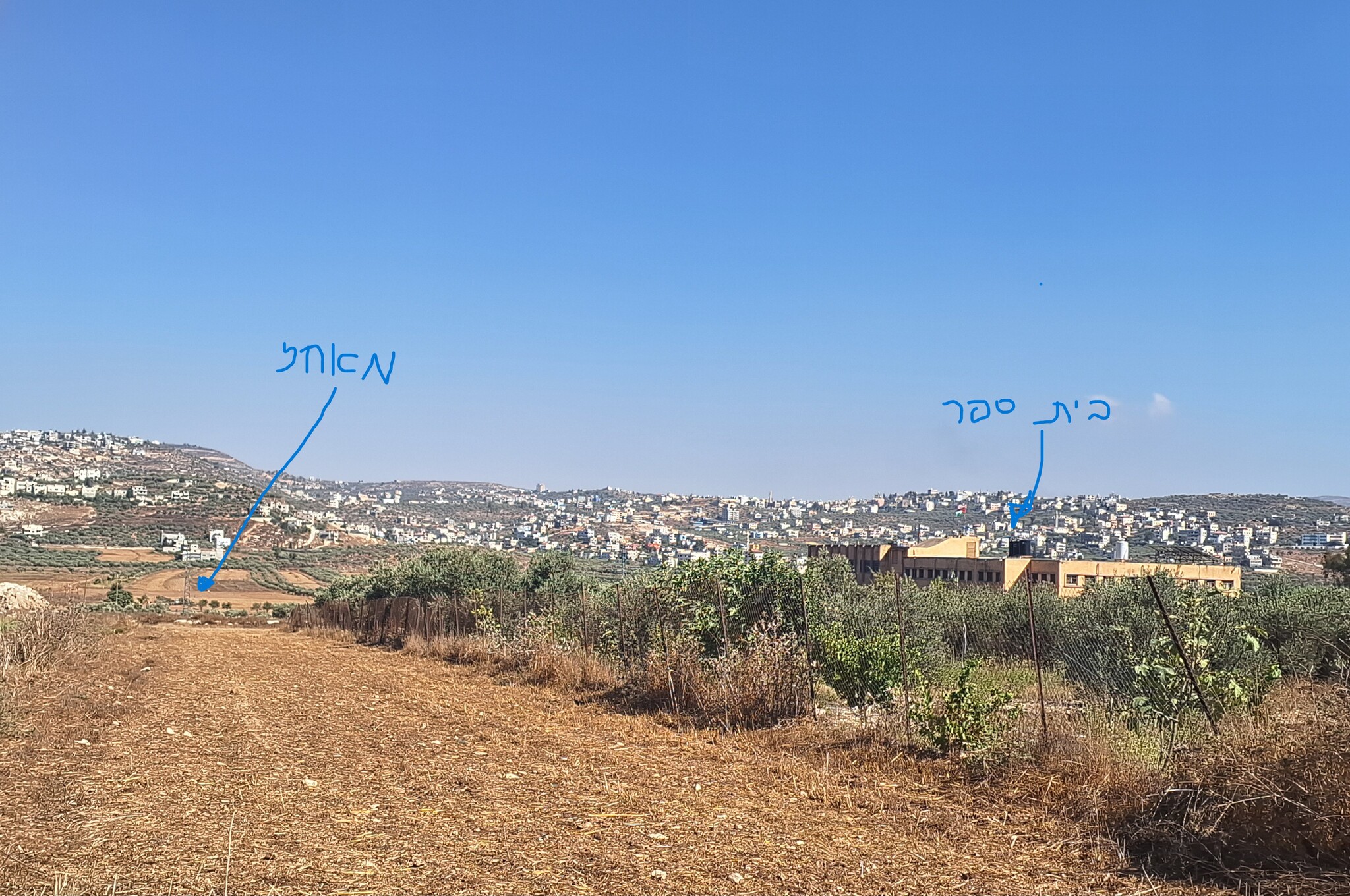 Ronit Dahan-RamatiAug-24-2026Huwara: The school on the outskirts of town and an outpost hidden among the trees
-
