
PM
Tarqumiya 23/2/2004 Watchers: Miki L., Mira B. (reporter) We arrived at the CP around 3.30pm. There were just a few workers. The CP commander, a soldier named Dima, asked to stand in either side of the CP, but not in the middle. He was very polite. We stood on the Palestinian side. More workers arrived and passed the CP quickly with no interruptions.The Palestinians seemed very pleased to see us. They offered oranges that they carried from their day work.Around 5pm we noticed some problems and arguments on the Israeli side of the CP. We realized that there is a closure in the occupied (conquered) territories, and only people living in these places were allowed to pass. This restriction caused problems to many Israeli employers that usually drive their workers to their villages. The workers were left without any means of transportation.A major problem aroused when an Israeli Arab from Haifa, named Rami, whose mother lives in Hebron, wanted to cross the CP towards Hebron. He claimed that he left his wife and small baby with his mother this morning and went to Israel for the day (for work or so). In the morning they documented his passage from the Palestinian side to Israel, but nobody told him that there might be a problem on his way back. Since he lives in Haifa he was not allowed to cross back (as according to the new closure regulations only residents are allowed to pass). He claimed that he is on his way to pick his wife and baby. He also claimed that his baby is sick (asthma) and his mother has heart problems.We called the Moked (Center for the Defense of the Individual). They talked with us and with him in Arabic. They promised to check and call back. We also tried the officer Asaf from DCO Hebron — but no luck. In DCO Hebron they said they cannot help, but suggested to talk with the Operations. In the meantime, we asked Dima, the CP commander, to contact his superiors. We explained to him that this is a humanitarian problem that he should be proud to help solve. In the beginning he played the big boss, but then apparently called some lieutenant colonel from the near by military camp. This guy came, we talked to him, and then, all of a sudden, he allowed Rami to cross. We don’t know whether the people from the Moked indeed called the CP authorities, but this is a possibility.Our questions: If a closure must be set without any prior warning, why there are no instructions for handling exceptional cases like this? If employers cannot drive their workers home, why there is no alternative transportation? It is very clear to us that this guy, Rami, would probably have spent the night in the CP haven’t we be there.
Hebron
See all reports for this place-
According to Wye Plantation Accords (1997), Hebron is divided in two: H1 is under Palestinian Authority control, H2 is under Israeli control. In Hebron there are 170,000 Palestinian citizens, 60,000 of them in H2. Between the two areas are permanent checkpoints, manned at all hours, preventing Palestinian movement between them and controlling passage of permit holders such as teachers and schoolchildren. Some 800 Jews live in Avraham Avinu Quarter and Tel Rumeida, on Givat HaAvot and in the wholesale market.
Checkpoints observed in H2:
- Bet Hameriva CP- manned with a pillbox
- Kapisha quarter CP (the northern side of Zion axis) - manned with a pillbox
- The 160 turn CP (the southern side of Zion axis) - manned with a pillbox
- Avraham Avinu quarter - watch station
- The pharmacy CP - checking inside a caravan with a magnometer
- Tarpat (1929) CP - checking inside a caravan with a magnometer
- Tel Rumeida CP - guarding station
- Beit Hadassah CP - guarding station
Three checkpoints around the Tomb of the Patriarchs
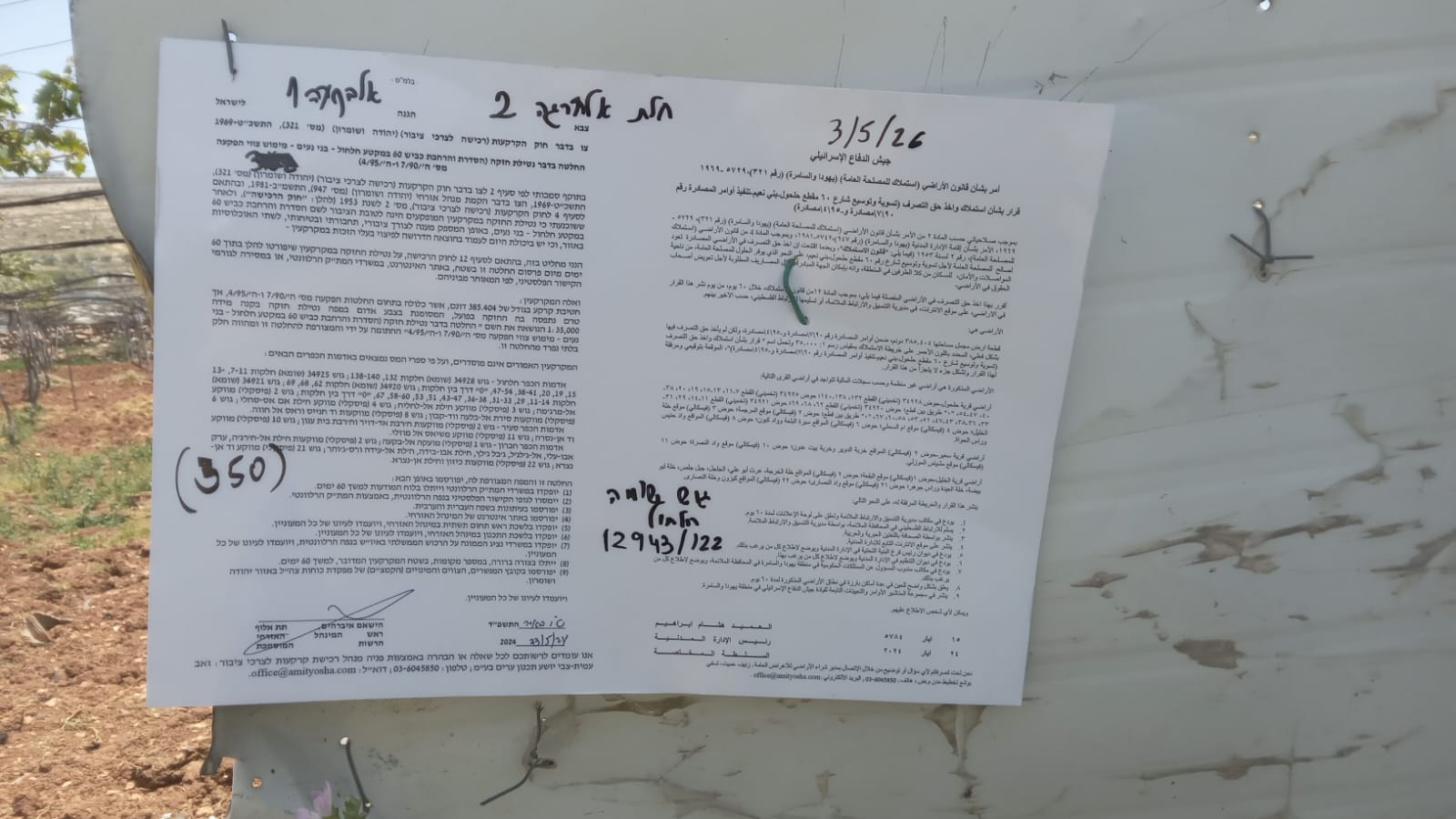 Muhammad D.May-13-2026Hebron - Request for compensation for land expropriation
-