
Huwwara, Beit Iba, Qusin PM
HUWWARA, BEIT IBA, Wednesday 21 July 2004 AMObservers: Shalva C., Miriam L., Keren P., Hanna A. (reporting) colour=red>08:15 — Huwwara North Traffic was sparse and there were not many people leaving Nablus.Huwwara South There were about 10 detainees [who were being held pending security cross-checks on their ID details by the General Security Services (GSS, also known, from the Hebrew acronym, as the Shabak or Shin Bet), a process that can take some considerable time, especially if the checkpoint soldiers do not notify the GSS as each case comes through, but instead wait until they have several ID cards. During this time, the detainees, generally men between the ages of 16 and 30 or 35, are virtually prisoners at the checkpoints since the soldiers hold their ID cards until clearance comes through from the GSS]. The commander, R., said he wasn’t interested in holding them and would let them go as soon as he had the answers.Two women with Jordanian passports weren’t allowed to go through to work in Nablus because they didn’t have Palestinian ID cards. Under present conditions, they can’t get them and they were afraid to go to the District Co-ordinating Office (DCO) [the army section that handles civilian matters and usually has representatives at the checkpoints , ostensibly to alleviate the lot of the Palestiniains] lest that result in their being expelled. One had a little boy with her. We couldn’t manage to soften the soldiers’ hearts.R. tried to avoid us and was tough on the people waiting, and his attitude affected his men. From time to time they went over to the people in line and “disciplined” them. For example, if someone put a foot on the step at the beginning of the concrete area, the soldier M. would stop letting people through until the man concerned had moved his foot. The soldiers also approached the Palestinians with rifles at the ready and aimed. R. also went over to the line, shouted at people and pushed an elderly man who’d moved out of the line. When we commented that rifles were aimed all too easily, he dismissed us with a wave of the hand: “Nothing’s going to happen.”Ambulances are increasingly used at checkpoints. The sick with escorts and without passage permits were almost automatically diverted to ambulances. In this case, one escort was allowed to join the patients and the soldiers claimed that it was also free. Some found an alternative solution (for example, an escort with a passage permit). But there were some, such as an agitated father carrying a child burning with fever, who didn’t give up. After we interceded, he hitched a ride from an ambulance.09:40 — Qusin checkpoint When we arrived, the pressure was easing. Several taxis were detained at the gas station. It transpired that they were allowed to travel (if they had permits) only in specific sectors and on certain roads. L., the commander, began releasing them after four hours. He said that until several days ago, he could have confiscated vehicles for four days, but under a new regulation, the “punishment” is only four hours. The taxis and minibuses were crowded with passengers who’d just been checked at previous checkpoints. Why impose a collective punishment on them which is intended for the drivers?A new taxi arrived with the driver’s family, including several small children, inside . They were from the Jenin area. His permit was made out “for all checkpoints” How was he to know it was restricted to the Jenin area? The repeated claim of the soldiers in such situations is : “They know…” They called someone in the DCO and soon continued on their way.A passing settler saw us and immediately telephoned somebody. When we were already in the car, a woman settler arrived and shouted at us: “You’re trying to curry favor with the Arabs.”Beit Iba There were about 10 drivers here whose vehicles had been confiscated.An elderly father was clutching an envelope with medical test results: he’d been delayed because his son was not allowed through. The father was ready to return home, but the son’s ID details had been submitted for checking and the soldiers ordered him to wait. A teacher who said that he came through the checkpoint every day was also detained.The commander, A., negotiated with us about the length of detention. How will they learn, otherwise ? he asked. Shalva and Keren persuaded him and he agreed to release them at 11:00 instead of 12:00..
Beit Iba
See all reports for this place-
A perimeter checkpoint west of the city of Nablus. Operated from 2001 to 2009 as one of the four permanent checkpoints closing on Nablus: Beit Furik and Awarta to the east and Hawara to the south. A pedestrian-only checkpoint, where MachsomWatch volunteers were present daily for several hours in the morning and afternoon to document the thousands of Palestinians waiting for hours in long queues with no shelter in the heat or rain, to leave the district city for anywhere else in the West Bank. From March 2009, as part of the easing of the Palestinian movement in the West Bank, it was abolished, without a trace, and without any adverse change in the security situation.
 Jun-4-2014Beit-Iba checkpoint 22.04.04
-
Huwwara
See all reports for this place-
The Huwwara checkpoint is an internal checkpoint south of the city of Nablus, at the intersection of Roads 60 and 5077 (between the settlements of Bracha and Itamar). This checkpoint was one of the four permanent checkpoints that closed on Nablus (Beit Furik and Awarta checkpoints to the east and the Beit Iba checkpoint to the west). It was a pedestrian-only barrier. As MachsomWatch volunteers, we watched therre since 2001 two shifts a day - morning and noon, the thousands of Palestinians leaving Nablus and waiting for hours in queues to reach anywhere else in the West Bank, from the other side of the checkpoint the destination could only be reached by public transport. In early June 2009, as part of the easing of Palestinian traffic in the West Bank, the checkpoint was opened to vehicular traffic. The passage was free, with occasional military presence in the guard tower. Also, there were vehicle inspections from time to time. Since the massacre on 7.10.2023, the checkpoint has been closed to Palestinians.
On February 26, 2023, about 400 settlers attacked the town's residents for 5 hours and set fire to property, such as houses and cars. Disturbances occurred in response to a shooting of two Jewish residents of Har Bracha by a Palestinian Terrorist. The soldiers stationed in the town did not prevent the arson and rescued Palestinian families from their homes only after they were set on fire. No one was punished and Finance Minister Smotrich stated that "the State of Israel should wipe out Hawara." Left and center organizations organized solidarity demonstrations and support actions for the residents of Hawara.Hawara continued to be in the headlines in all the months that followed: more pogroms by the settlers, attacks by Palestinians and a massive presence of the army in the town. It amounted to a de facto curfew of commerce and life in the center of the city. On October 5, 2023, MK Zvi established a Sukkah in the center of Hawara and hundreds of settlers backed the army blocked the main road and held prayers in the heart of the town all night and the next day. On Saturday, October 7, 23 The "Swords of Iron" war began with an attack by Hamas on settlements surrounding Gaza in the face of a poor presence of the IDF. Much criticism has been made of the withdrawal of military forces from the area surrounding Gaza and their placement in the West Bank, and in the Hawara and Samaria region in particular, as a shield for the settlers who were taking over and rioting.
On November 12, 2023, the first section of the Hawara bypass road intended for Israeli traffic only was opened. In this way, the settlers can bypass the road that goes through the center of Hawara, which is the main artery for traffic from the Nablus area to Ramallah and the south of the West Bank. For the construction of the road, the Civil Administration expropriated 406 dunams of private land belonging to Palestinians from the nearby villages. The settlers are not satisfied with this at the moment, and demand to also travel through Hawara itself in order to demonstrate presence and control.(updated November 2023)
.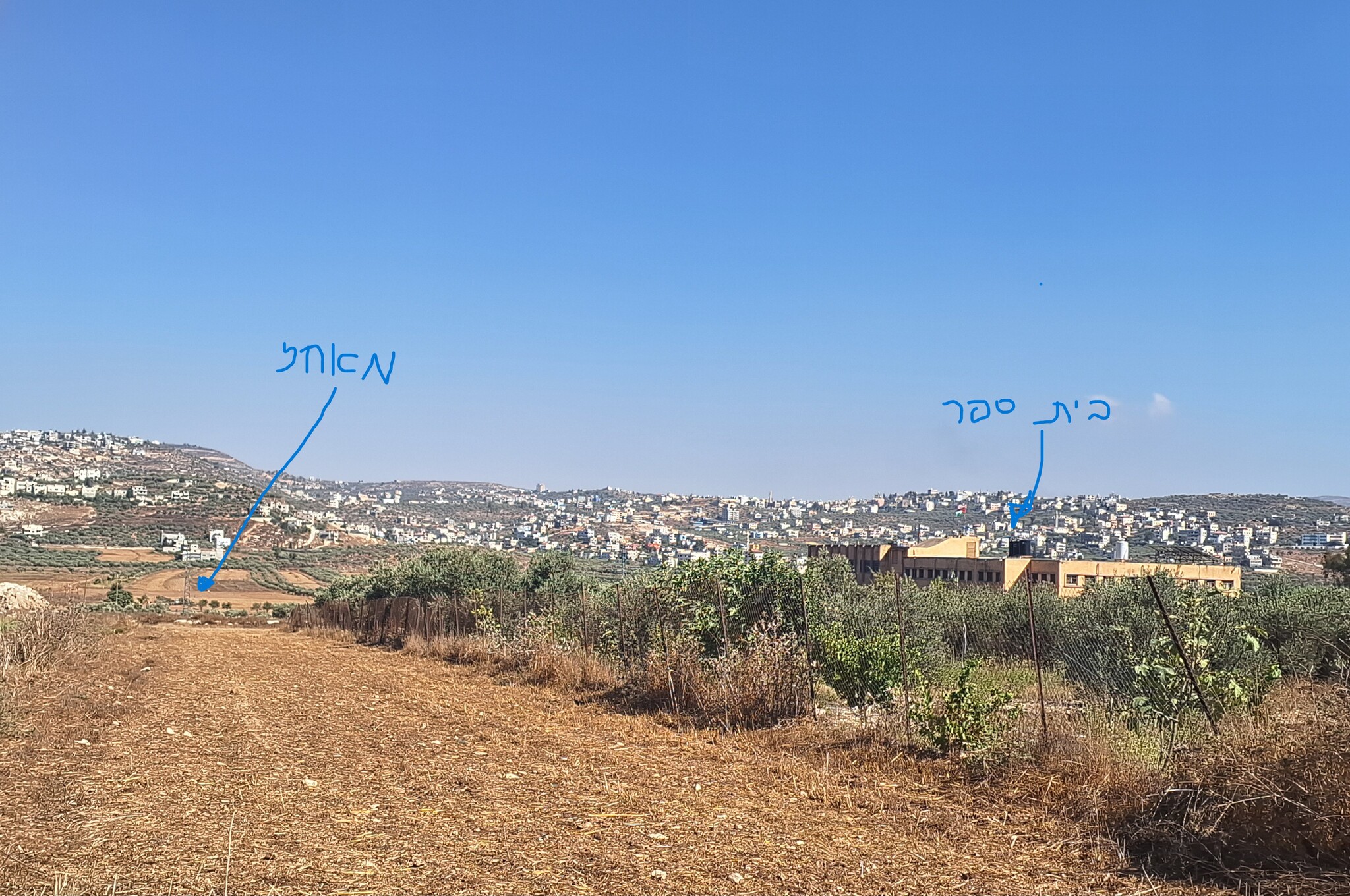 Ronit Dahan-RamatiAug-24-2026Huwara: The school on the outskirts of town and an outpost hidden among the trees
-
