
Beit Iba PM
BEIT IBA, Monday 2 August 2004 PMObservers: Ruthie and Maya (reporting) colour = red> This was a shift that began with a rather vociferous encounter with women settlers near the Bar’on industrial zone (we drove with a flag on our car – which was maybe not the wisest thing to do) Then, on to a crowded and pressured checkpoint – with many detained students who were sent back the way they’d come , and finally a cheerful wedding parade that passed through the checkpoint.13:00 – -We stopped at Qalqiliya — nearby, a huge roundabout is being built (perhaps a future border terminal?) on route 55. The Qalqiliya checkpoint was manned by border police; it was open and cars went through. A very long line of outgoing cars and trucks were being checked at random. Two cars were detained on the side (the drivers claimed they’d been there half-an-hour), as the passengers were young people. One was a driving school car ; the teacher complained of repeated delays at the checkpoints – he’d also been detained in the morning. There was no checking of in-going traffic.Jit Junction was clear. We continued towards Beit Iba and stopped at a unannounced road-block near the Bar’on industrial zone , where several soldiers and a jeep were checking taxi drivers and two buses. We learned that the taxi drivers’ “crime” was that they’d used the “sterile” settlers’ road from Beit Iba to Jit without permission , since they must earn a livelihood – they are from Sarra and Qadum [the Occupied Territories have two road systems —one, poorly maintained, slow, winding and narrow, for the Palestinians; the other, new, broad, fast highways, exclusively for the use of the Jewish Israeli settlers] . One was released without having his car confiscated. A pleasant soldier explained what was happening; the other soldiers were hostile. As the second taxi driver was about to burst out in rage, we tried to calm him down and take his phone number [so that we could help him even after we’d left the checkpoint]. While we were busy with that, a settler’s car parked next to mine [we have the licence number], and four extremely aggressive women settlers approached us, screaming at us in foul language and preventing us from entering our car as they hurled imprecations and charges at us: “Traitors!” “ Youre in the pay of the EEC!” “Arafat lovers!” “Tell your friends to stop the terror attacks!” “Let’s see you face to face with a family that’s lost a loved one in a suicide bombing!” We tried to keep cool, and even asked one of the soldiers – who’d been hostile towards us all along — if he’d help should we be attacked physically – “Certainly not!” he replied. Finally we managed quite literally to shake them off (one had stationed herself right in front of the bonnet, and the others were hanging on to the back of the car. And off we drove to Beit Iba 14:00 — Beit Iba As we parked our car we discovered a totally flat tire (pure coincidence?) We were immediately helped by a friendly Palestinian.The checkpoint was very crowded with pedestrians leaving Nablus – there were some 70-80 men, women and children waiting on line. This caused pressure and the crowd started pushing forward to be answered by the soldiers with shouts and counter-pushing. When the woman soldier arrived , she managed to ease the pressure, but kept on shouting, and constantly moved the stick that marked the beginning of the line , so that those waiting to go through were forced to stand directly in the sun. We reminded her that the shade awning had been put up so that people shouldn’t have to stand in the sun: “Then they shouldn’t push”, she answered. All this time the iron door of the soldiers’ checking box was banging away which added to the tumult.Eventually when the District Co-ordinating Office (DCO) representative had finished checking the vehicles, he helped with the pedestrians and the pressure eased considerably [the DCO is the army section that deals with civilian matters; it usually has representatives at the checkpoints, ostensibly to ease the lot of the Palestinians].The detainees were all young, many of them students at An-Najah university in Nablus: but it was Monday and not one of the two days when they may go through the checkpoints on production of nothing more than a student card [the university week in the Occupied Territories runs from Saturday to Wednesday – since the Moslem day of rest is Friday – the Israel army has an arrangement with An-Najah whereby holders of valid student cards may leave Nablus on Wednesdays and return on Saturdays without needing permits to go through the checkpoints]. After some time, groups of detainees were released and their ID cards were returned [after the General Security Services (GSS aka the Shabak or the Shin Bet) had cross-checked their details to ensure that they were not on a list of security suspects – this check often takes a considerable length of time] . But the students were sent back to wherever they had come from . The DCO representative, in answer to our query, said that the soldiers were relatively new here and hence didn’t know that the students could have been sent back straight away without holding them up for more than an hour. Every half hour another batch of detainees was released., but new ones kept coming.Among the detainees was a pharmacist from Asira Ash-Shamaliya employed in the big Nablus hospital: he had no permit , was detained for a while and then sent on his way. At the end of our stay, two taxi drivers from the Nablus side were detained and their keys were confiscated. We began making calls to find out if this was legal, but for various reasons the effort was fruitless. To crown this eventful afternoon – a parade of women and children marched merrily through the checkpoint singing and shaking and drumming on tambourines, with bags of sugared almonds atop their heads – even the hardest-hearted soldier could not help but smile at this wedding parade.We drove back via Anabta – the checkpoint was open and unmanned, only concrete blocks slowed down the traffic. One Israeli and one Palestinian vehicle went through. On the way home, we also passed through the terminal and roundabout at Jubara.
Beit Iba
See all reports for this place-
A perimeter checkpoint west of the city of Nablus. Operated from 2001 to 2009 as one of the four permanent checkpoints closing on Nablus: Beit Furik and Awarta to the east and Hawara to the south. A pedestrian-only checkpoint, where MachsomWatch volunteers were present daily for several hours in the morning and afternoon to document the thousands of Palestinians waiting for hours in long queues with no shelter in the heat or rain, to leave the district city for anywhere else in the West Bank. From March 2009, as part of the easing of the Palestinian movement in the West Bank, it was abolished, without a trace, and without any adverse change in the security situation.
 Jun-4-2014Beit-Iba checkpoint 22.04.04
-
Jit Junction
See all reports for this place-
The checkpoint is located on Route 60 near at the junction with Route 55, near the village of Jit. There was a checkpoint for vehicles passing between the north and south of the West Bank, which was abolished towards 2010. Since then, surprise checkpoints have been set up there from time to time with a police or Border Police vehicle, and vehicles and their passengers are inspected.
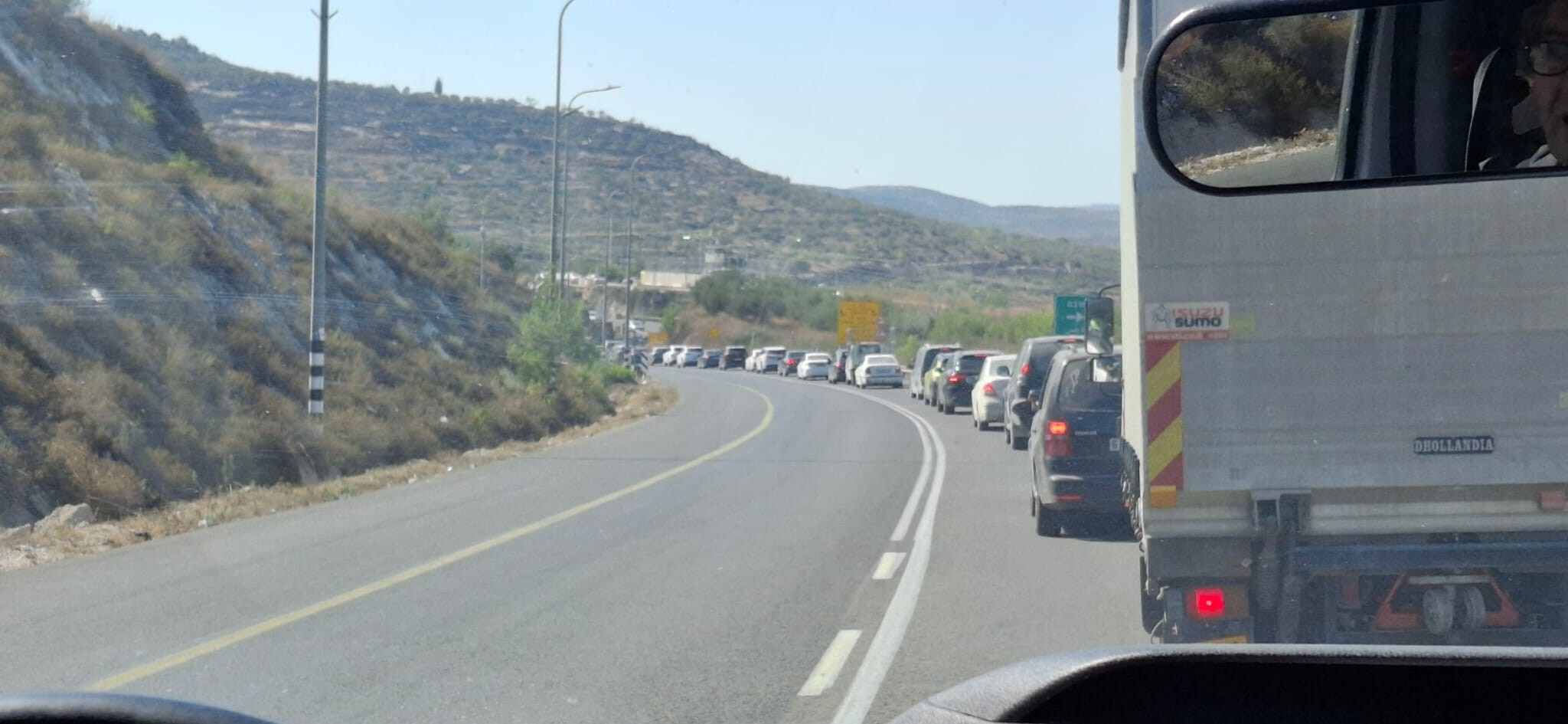 Anat PolakJul-17-2025Yitzhar Road, Jit Junction: traffic jam
-
