
Huwwara AM
HUWWARA, Tuesday 31 August 2004 AMObservers: Tal A., Dina A., Aharona M., Etti P. (reporting) colour=red>O7:50 — Jit junction There was an unannounced road-block here at which about 15 vehicles were stopped, including buses whose passengers were told to get off for checking. Huwwara South: Tal and Etti 08.05 We found six detainees who’d been waiting for three hours, since 05:00, in the detainees’ shelter [detainees are, typically, men aged from 16 to 30 or 35 who have no passage permits; their ID details are phoned through to the General Security Services (GSS, also known as the Shabak or the Shin Bet, the Hebrew acronym for the GSS) for checking against a central list of security suspects, and the answers are then relayed back to the checkpoints. This cumbersome process can take considerable time, and that can be prolonged even more if the soldiers wait to accumulate a batch of ID cards before passing them on to the GSS , or if they behave in a similarly tardy manner at the end of the process, waiting until they have a batch of GSS clearances before they release individual detainees. Meanwhile, the detainees are virtually prisoners at the checkpoint where the soldiers retain the ID cards until the entire process is completed]. The checkpoint commander, T., explained that there were problems in communications with the GSS. Among the detainees was a young man, with a pile of medical test results, who, according to his elderly father, had an appointment for surgery. T. said that after checking he could enter Nablus. The soldiers carried out the most meticulously thorough check of a porter carrying packages for a messenger service from Jerusalem. Even the smallest package was opened as if it contained at least an atom bomb. Nobody knew why the check was so strict.08:25 — Now there were 12 detainees, and there’d been no releases. The driver of a refrigeration truck with a permit up to today, found his vehicle with a smashed front window and four slashed tires after leaving it last night. T. said that the man had come at 20:00 yesterday and been advised to return, but he’d insisted on leaving the vehicle and going home to Nablus. It should be noted that the truck had been parked right under a light in the middle of the junction facing the watch tower. T. asked if we thought he’d done it and I said no, but the army was responsible for what had happened. T. was indifferent. I advised the driver to complain and give details. The driver tried to recruit help to inflate the tires but nobody would help and he eventually called a break-down truck. I told him to ask for receipts for all his expenses. Three European women from the World Council of Churches were waiting for checking. They told us that soon they would have people at the checkpoints!!09:00 — The line now numbered 50 people. The soldiers were shouting and inefficient and kept asking T. questions. But he also had to check cars and ambulances and special cases and communicate the detainees’ details for GSS checking. He was very quick, but he didn’t delegate authority and couldn’t change the soldiers’ conduct and they didn’t always obey his instructions. A jeep arrived with our old acquaintance Lieutenant N. from the District Coordinating Office (DCO) [the army section that handles civilian matters; it generally has representatives at the checkpoints, ostensibly to alleviate the lot of the Palestinians] . T. asked him to help and he dealt with the line. I took N. over to the truck and he said: “You know who did it…and it wasn’t the soldiers!” I agreed that it was settlers but said that that didn’t absolve the army of responsibility. N. told the driver to go to the DCO to submit a complaint and said he might get his expenses back. I took the telephone number of the driver’s Hebrew-speaking friend so that we can follow up.09:30 — Some detainees were released, but there were 12 new ones. A US citizen with a Palestinian ID needed to renew it. He was left for checking because the soldier who checked him “felt like it.” There was another, older man with him, a lawyer who’d argued with the soldiers and this apparently had annoyed the soldier. T. supported the soldier although he obviously didn’t agree with him.All this time, settlers kept appearing in cars or on foot, spitting, cursing, gesturing obscenely. They brought drinks and sweets to the soldiers. A car full of ultra-orthodox settlers driving on the Israeli lane encountered a porter with a hand-cart who was being checked : although they could have easily driven by him on the wide road, they chose instead to simply block his way. After T. asked what the problem was, they eventually drove on.A family – Israeli woman married to a Palestine and living in Israel — wanted to enter Nablus for the first time in four years…she was surprised to see the checkpoint and discover that she needed a DCO permit.10:15—The number of detainees was now 16, including one with a swollen arm whose mother was waiting for him, and another with a kidney-stone attack – also accompanied by his mother and in great pain. Another older man with Israeli papers [which might make it impossible for him to enter Nablus] discovered that sometimes it’s better to be a Palestinian and was sent to the DCO. A woman had come to the checkpoint with a child and a young daughter who claimed to be 15. The daughter was not let through because the soldiers decided she was 18 and needed her own ID card. The check had shown that according to the addendum to the mother’s ID, the girl had a document in the name of Imen and, according to her birth date, she was 18. Fortunately, one of the women detainees spoke fluent English and explained to the woman what the problem was. It turned out that she had yet another addendum (she has a number of children) and this daughter appeared there, and was in fact 15. We persuaded T. to let her through.A Palestinian Water Authority vehicle was detained so that one of the passengers, a man with a French passport, could be checked. Some of the detainees were released, including the kidney-stone sufferer, but there were people who’d been waiting for two hours. The Machsomwatch observers on the other side said that they too had asked the DCO representative what was going on and had been told that there were communications problems. A young Italian who hadn’t coordinated his visit with the appropriate authorities was sent to the DCO, as was a student who wanted to go from the American University to an-Najah University. A number of calls to the DCO were answered only reluctantly – it would be easier if they were to go there. The Israeli family whom we met up with later told us that there was a very long line and that they were there till evening. Huwwara North: Aharona and Dina 08:00—We arrived to find 13 detainees; we got no cooperation whatsoever from the soldiers.At 09:40, eight of the detainees were released. The DCO representative helped in a few cases: for example, there was a couple where the wife had a Jordanian passport , while the husband had Palestinian papers – they were passed through by A. after he’d talked to them. He dealt similarly with a family whose members had Israeli IDs and where the wife’s father had died; they, too, were allowed through.Fierce arguments broke out between taxi and van drivers over the few passengers, all because there is no parking lot here as there is on the southern side. The same problem crops up at every shift.An elderly woman who said she was born in 1943 was detained. A. gave the child travelling with her, who was crying, a chocolate yoghurt, called 2nd Lieutenant D. over and they finally decided to let her through. A DCO representative and an officer would undoubtedly have been of help in the cases we encountered at Huwwara South.All in all, it was quite a difficult watch, with a great deal of injustice and suffering for the Palestinians because of the army’s insensitivity and indifferences, and the inflexible rules which only the DCO or officers can bend.
Huwwara
See all reports for this place-
The Huwwara checkpoint is an internal checkpoint south of the city of Nablus, at the intersection of Roads 60 and 5077 (between the settlements of Bracha and Itamar). This checkpoint was one of the four permanent checkpoints that closed on Nablus (Beit Furik and Awarta checkpoints to the east and the Beit Iba checkpoint to the west). It was a pedestrian-only barrier. As MachsomWatch volunteers, we watched therre since 2001 two shifts a day - morning and noon, the thousands of Palestinians leaving Nablus and waiting for hours in queues to reach anywhere else in the West Bank, from the other side of the checkpoint the destination could only be reached by public transport. In early June 2009, as part of the easing of Palestinian traffic in the West Bank, the checkpoint was opened to vehicular traffic. The passage was free, with occasional military presence in the guard tower. Also, there were vehicle inspections from time to time. Since the massacre on 7.10.2023, the checkpoint has been closed to Palestinians.
On February 26, 2023, about 400 settlers attacked the town's residents for 5 hours and set fire to property, such as houses and cars. Disturbances occurred in response to a shooting of two Jewish residents of Har Bracha by a Palestinian Terrorist. The soldiers stationed in the town did not prevent the arson and rescued Palestinian families from their homes only after they were set on fire. No one was punished and Finance Minister Smotrich stated that "the State of Israel should wipe out Hawara." Left and center organizations organized solidarity demonstrations and support actions for the residents of Hawara.Hawara continued to be in the headlines in all the months that followed: more pogroms by the settlers, attacks by Palestinians and a massive presence of the army in the town. It amounted to a de facto curfew of commerce and life in the center of the city. On October 5, 2023, MK Zvi established a Sukkah in the center of Hawara and hundreds of settlers backed the army blocked the main road and held prayers in the heart of the town all night and the next day. On Saturday, October 7, 23 The "Swords of Iron" war began with an attack by Hamas on settlements surrounding Gaza in the face of a poor presence of the IDF. Much criticism has been made of the withdrawal of military forces from the area surrounding Gaza and their placement in the West Bank, and in the Hawara and Samaria region in particular, as a shield for the settlers who were taking over and rioting.
On November 12, 2023, the first section of the Hawara bypass road intended for Israeli traffic only was opened. In this way, the settlers can bypass the road that goes through the center of Hawara, which is the main artery for traffic from the Nablus area to Ramallah and the south of the West Bank. For the construction of the road, the Civil Administration expropriated 406 dunams of private land belonging to Palestinians from the nearby villages. The settlers are not satisfied with this at the moment, and demand to also travel through Hawara itself in order to demonstrate presence and control.(updated November 2023)
. Shoshi AnbarMay-18-2025Huwara: The old houses in Area C
-
Jit Junction
See all reports for this place-
The checkpoint is located on Route 60 near at the junction with Route 55, near the village of Jit. There was a checkpoint for vehicles passing between the north and south of the West Bank, which was abolished towards 2010. Since then, surprise checkpoints have been set up there from time to time with a police or Border Police vehicle, and vehicles and their passengers are inspected.
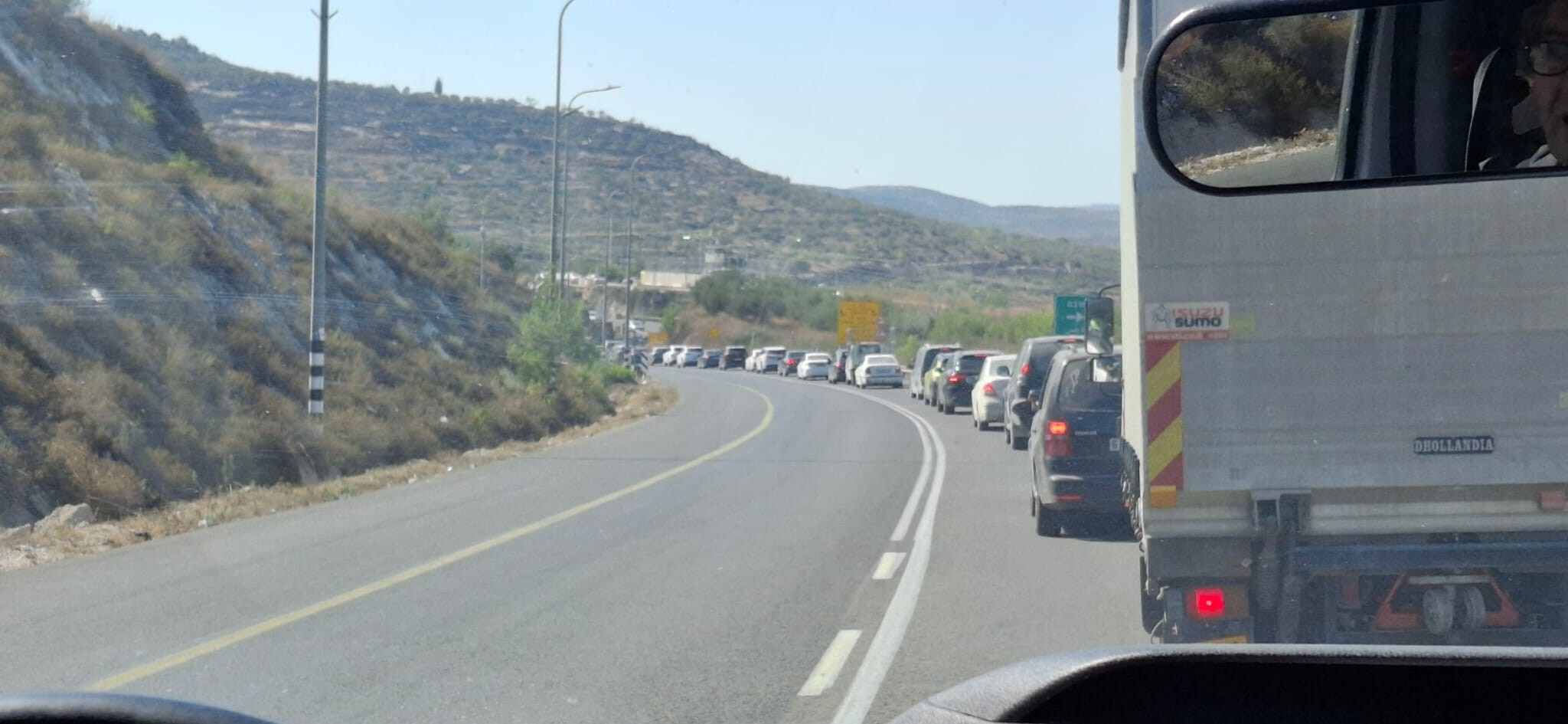 Anat PolakJul-17-2025Yitzhar Road, Jit Junction: traffic jam
-