Huwwara
Huwwara, Sunday 11.6.06 PMObservers: Judit B., Galit G., Noa P., Naomi L. (reporting with Galit)Za’atara Junction: 15:44 – a cab coming from Qalqiliya detained, all its passengers awaiting the return of their IDs. In the cab, an Egyptian subject with an invalid passport (expired a year ago) who is trying to reach his home in A-Ram where he has been living with his family for 4 years. He has no Palestinian ID and the soldiers are waiting for the Brigade HQ’s reply “what to do with him” (they don’t get such a “catch” every day… )Speaking with him we learn his 9-year old son is ill (“something in his head”) and is being treated alternately in Ramallah and Jerusalem Hadassa Hospital. All the other 6 passengers are held up on his account, until a decision will be taken about his fate.An hour later we were informed on our phone by his fellow travelers who received their IDs and proceeded on their way, that the Egyptian subject was taken off the cab and was still waiting at the CP.On our way home at 19:00 he was no longer there, and the soldiers said they had released him an hour and a half earlier.Instead, standing by the concrete pillar, was a young man with a magnetic card (clearing him with the security authorities who works at Barkan Industrial Zone and was on his way home. Detained for two hours already. We asked army hotline to speed up his check.A line of over 30 vehicles has accumulated coming from Nablus while we were there. The posts were ‘reinforced’ by Border Patrolmen, and since their arrival everything moves even more slowly.At Huwara –Burin (Yitzhar) Junction the vehicle line is not too long, unlike the unbearably long line on our way back this evening.Huwara CP-Besides the piles of garbage and filth on the floor, the back lockup where ‘honored’ detainees are held has been reinforced with an iron gate completely blocking the cell from view. Is this so that we will no longer see who’s inside?CP commander – R., DCO representative – A.Palestinians are staying away from the CP, this has become the unspoken rule. Whoever doesn’t absolutely have to go somewhere, just doesn’t come out. Because of the many checkpoints, because of the financial cost, because of despair.16:00 – the commander and his men callously turn back several elderly people and women who dared to open the side gate (“humanitarian line”) of their own initiative, and pass there. After getting everyone back into the line, the gate is locked and from now to the end of our shift, except for once, the gate was closed – to punish and chastise the locals not to open the gate themselves. This is what Roi himself told us, the CP commander. To the securing soldier, he said: “When they open the humanitarian gate themselves, you should see it.” Most of the women and elderly had to go through the turnstiles this time. Fortunately, the line was not terribly crowded.Last week I was called at home by a man who introduced himself as “doctor”, spoke perfect Oxford English in a very pained, insulted and angry voice. He said he had just left Huwara CP and went back to Nablus after refusing to go through the humiliating body search by loud, callous gum-chewing women-soldiers who make insulting snide comments. He is not willing to expose his bare body to women-soldiers while men soldiers are present at the CP. This is debasing and offensive and nowhere in the world has he seen the likes of it. Why, he asked, do women-soldiers search men and men-soldiers search women? I inquired at the army hotline, and their response was as follows: “There is no such thing. The women-soldiers are very courteous and do not tell anyone to lift their shift and expose their belly, nor open their trousers’ button in order to get dressed again.” The DCO too said this complaint had nothing to do with reality at the CP.And today: the checking posts at the men’s lines are womanned by MPwomen, some of the pedestrians are required to untuck their shirts and expose belly and back, all their pockets are emptied. At times women-soldiers touch their bodies with the manual magnetometer. Whoever does not leave the CP with his shirttails out of his trousers has to open his trousers and get dressed in view of the women-soldiers. They also fumble inside people’s bags, unzip all zippers, wallets are inspected, all this while a rifle barrel is pointed at them at a distance of 30 cm. Today the women-soldiers were quieter and more courteous. Still, how has the army not realized by now that body checks of men by women-soldiers is seen by them as a major offense to their dignity and they feel humiliated by this procedure??? Needless to mention that when the “humanitarian” gate is opened, women are checked by male-soldiers.16:15 – as there is no “humanitarian” gate, the lines crowd up in spite of the small number of pedestrians. Almost no vehicles. The system has dried up life here. Whoever doesn’t urgently need to cross, does not approach the CP.16:22 – an old man connected to an oxygen tank and accompanied by his two sons, arrives on foot, walking in tiny measured steps on the road all the way to the distant taxi park.16:34 – the women-soldiers at the checking posts are replaced by male-soldiers. The side line is opened after we asked several times, and closed again, not to be reopened until we leave.Palestinian citizens of Israel coming out of Nablus get a clarification talk by a MPman who explains they would need to get an entry permit to visit their families living in Nablus. His tone is reprimanding and patronizing, this is the very last time he lets them off so easily, next time he’ll summon police for them, etc. Fortunately for them, they were not detained and police wasn’t summoned.17:00 – The CP nearly empty.A., of the army’s “humanitarian” hotline asks if we know whatever happened to the Egyptian subject detained at Za’atara. We are happy to inform him that on our way out, we’ll make sure to ask the soldiers.Huwara-Burin (Yitzhar) Junction:18:30 – Godawful mess. Dozens of vehicles (over 40) coming from the west and from Huwara CP are crowding into 2 lanes, one soldier securing, one soldier checking, and one soldier doing nothing. The travelers westbound cannot proceed because passage is blocked by waiting vehicles. These block the cars moving to Nablus, and… Heavens! even settlers’ cars. Loud honks from all directions including army humvees who get so upset over the jam. As we stand near the checking post they start waving vehicles through without checking them. Some of the vehicles, at absolute random, are checked, nevertheless. We called the army hotline and asked to reinforce the junction, so checking would be more speedy. No go.The humvees passing by stopped to chat with the soldiers, thus slowing down business even more, and then disappeared. People inside cars aggravated and desperate, children flushed – another 5 minutes and they’ll be standing again, at the Za’atara CP.
A-Ram
See all reports for this place-
two kilometers south of Qalandiya and 300 metres north of Neve Yaacov Junction, in Dahiyat el-Barid Quarter. Checkpoint has operated since 1991, in a Palestinian area annexed to Jerusalem in 1967. The checkpoint has been inactive since the middle of 2009.
The wall was built on the road that led to Jerusalem. Since then the situation in the town has deteriorated. Houses are abandoned and half finished, most of the businesses have closed. Severe neglect around the fence and on the streets. Those who could left. Updated January 2024
-
Huwwara
See all reports for this place-
The Huwwara checkpoint is an internal checkpoint south of the city of Nablus, at the intersection of Roads 60 and 5077 (between the settlements of Bracha and Itamar). This checkpoint was one of the four permanent checkpoints that closed on Nablus (Beit Furik and Awarta checkpoints to the east and the Beit Iba checkpoint to the west). It was a pedestrian-only barrier. As MachsomWatch volunteers, we watched therre since 2001 two shifts a day - morning and noon, the thousands of Palestinians leaving Nablus and waiting for hours in queues to reach anywhere else in the West Bank, from the other side of the checkpoint the destination could only be reached by public transport. In early June 2009, as part of the easing of Palestinian traffic in the West Bank, the checkpoint was opened to vehicular traffic. The passage was free, with occasional military presence in the guard tower. Also, there were vehicle inspections from time to time. Since the massacre on 7.10.2023, the checkpoint has been closed to Palestinians.
On February 26, 2023, about 400 settlers attacked the town's residents for 5 hours and set fire to property, such as houses and cars. Disturbances occurred in response to a shooting of two Jewish residents of Har Bracha by a Palestinian Terrorist. The soldiers stationed in the town did not prevent the arson and rescued Palestinian families from their homes only after they were set on fire. No one was punished and Finance Minister Smotrich stated that "the State of Israel should wipe out Hawara." Left and center organizations organized solidarity demonstrations and support actions for the residents of Hawara.Hawara continued to be in the headlines in all the months that followed: more pogroms by the settlers, attacks by Palestinians and a massive presence of the army in the town. It amounted to a de facto curfew of commerce and life in the center of the city. On October 5, 2023, MK Zvi established a Sukkah in the center of Hawara and hundreds of settlers backed the army blocked the main road and held prayers in the heart of the town all night and the next day. On Saturday, October 7, 23 The "Swords of Iron" war began with an attack by Hamas on settlements surrounding Gaza in the face of a poor presence of the IDF. Much criticism has been made of the withdrawal of military forces from the area surrounding Gaza and their placement in the West Bank, and in the Hawara and Samaria region in particular, as a shield for the settlers who were taking over and rioting.
On November 12, 2023, the first section of the Hawara bypass road intended for Israeli traffic only was opened. In this way, the settlers can bypass the road that goes through the center of Hawara, which is the main artery for traffic from the Nablus area to Ramallah and the south of the West Bank. For the construction of the road, the Civil Administration expropriated 406 dunams of private land belonging to Palestinians from the nearby villages. The settlers are not satisfied with this at the moment, and demand to also travel through Hawara itself in order to demonstrate presence and control.(updated November 2023)
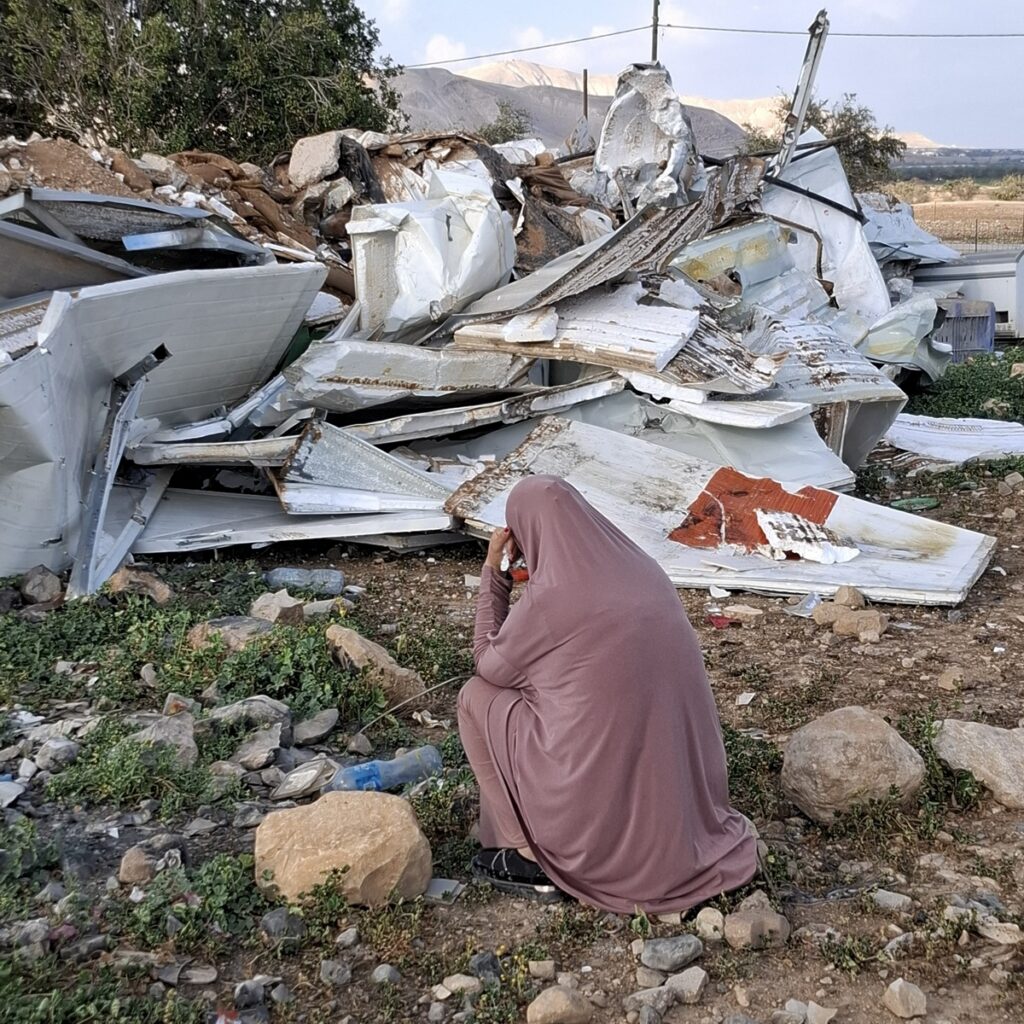
. Shoshi AnbarMay-18-2025Huwara: The old houses in Area C
-
Jerusalem
See all reports for this place-
The places in East Jerusalem which are visited routinely by MachsomWatch women are Silwan and Sheikh Jarrah. During the month of Ramadan, also the Old City and its environs are monitored.
-