Nuaman
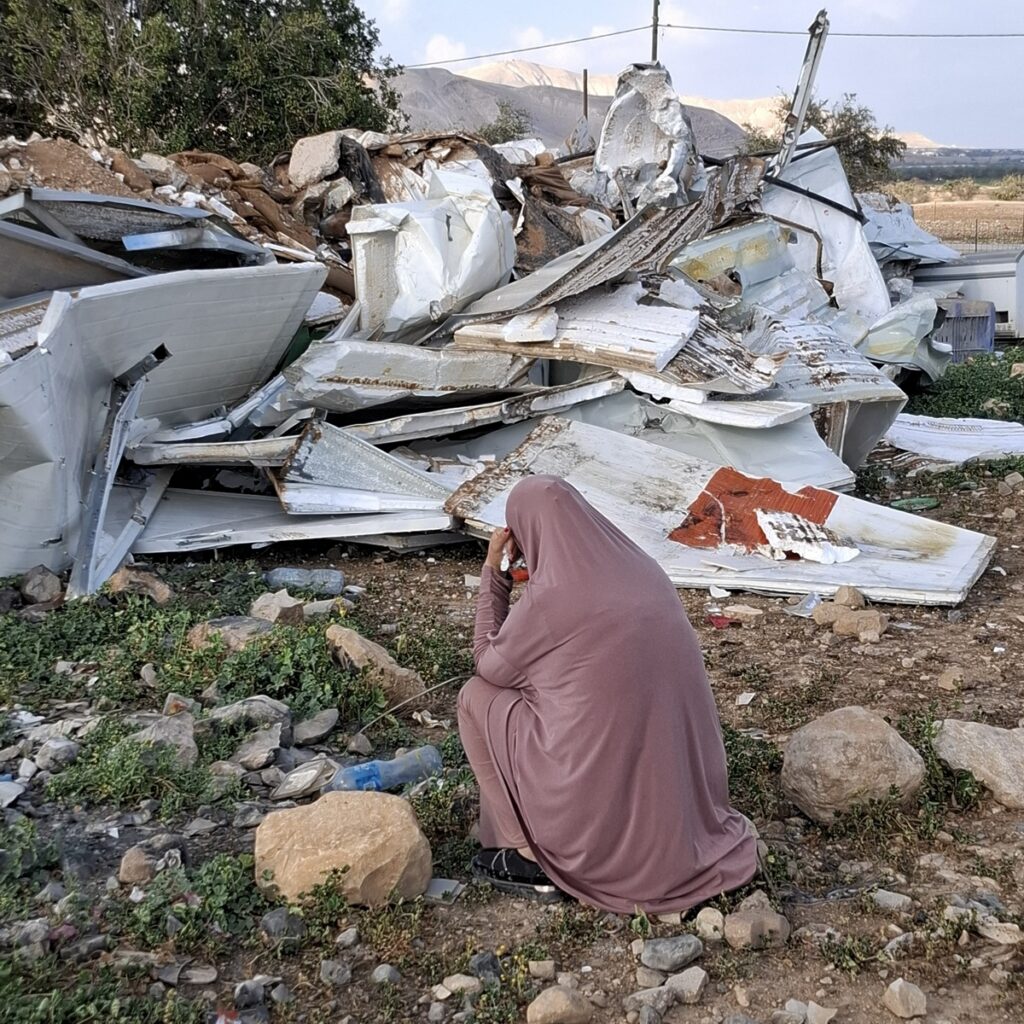
Bethlehem and vicinity: Nuaman, Wednesday 3.1.07 Observers: Tamar A (reporting)Guests: a “Hot” news crew I went on my shift to Nuaman escorted by a news crew from “Hot” (from Jerusalem’s local TV). The reporter had read the last “Matria” that Machsom Watch had published, dealing with the problems at the checkpoint and he thought he would do a report on the situation at the village. He arrived exactly at the right time because they had just started paving the road between Jerusalem and Tkoa/Nokdim (Libeman road), it goes out of Har Huma towards the south and is about to block the way to Jerusalem for those who live in Nuaman. We came as close as we could to the site where they are paving the road, with our car. We used to drive on the path that goes up on a hill, this path once led to Nuaman, but now both the hill and the path are gone, all that is left is a battle field of bulldozers that tear up bits of the rocky land so to straighten it. Y’ later told us that the plan is to lower that ground by 20 meters. This way the road, that comes all the way from Tkoa and Nokdim through the valley between Nuaman and El H’as, will be level the whole way, and the settlers won’t have to strain their engines while heading up to Jerusalem. What this means for Nuaman is that at the end of the road that led to Um Tuba, there will be a chasm. It’s true that usually the villagers from Nuaman can’t enter Jerusalem because they have “west bank” IDs, but some of them do have blue IDs or work permits, and there are also about 15 children that go to school at Um Tuba. One of the villagers told us that there is an alternative road, you drive souther to Nuaman through Beit Sahor and Bethlehm, enter Jerusalem through checkpoint 300- It takes half an hour to get to Um Tuba instead of the five minutes it took when using the direct road. In the mean time the contractor had left a pedestrian’s crossing. We looked for it but didn’t dare to climb over the area with the dirt which is about a meter away from the chasm. Then three women arrived, they were on their way back from Um Tubas, they went to that “path”. After seeing that we understood that there is no other option so we followed them. We had walked a couple of dozen meters and got to a place which is still free of checkpoint and settlers roads, there is even a path of several meters for pedestrians. But at the entrance to the village the road is blocked again. On the path they have dug three or four pits about one or two meters deep. The land had already dried up, but after it rains one might slip while climbing, especially if it’s a child heading to school of to the kindergarten. It also makes it more difficult taking the sheep and goats to the hill which is not far away. There is a gate at the entrance to the village, the army placed it there, it isn’t locked but that doesn’t make much of a difference due to all the new blockages. In fact the gate now plays a new roll, it is a railing that can prevent people from falling into the pit. We talked to Y’, who explained to the reporter what problems the village faces, and then we went to the checkpoint. Y’ started walking with us but didn’t want to go down to the checkpoint. “I don’t want to get into any trouble” he said. A couple of dozen meters away from the checkpoint the cameraman got the camera running, filming the road that leads to the checkpoint. A BP solider run towards us yelling “Your not allowed to film this!”. The reporter tried to explain that he is allowed to film inside the checkpoints, but the BP solider said assertively: “No one will film anything around here until I speak to the officer”. We could hear the officer’s voice on the radio saying that as long as we are not disturbing the normal functioning of the checkpoint, we are allowed to film there. The BP solider became reconciled eventually when the reporter told him that he served in the reserves with a BP soldier at a checkpoint, they separated as friends. Yet he still asked him: “Given the fact that you nearly shot us, how do you treat the Palestinians that pass here?” At the checkpoint were another BP soldier and two civilian security men. The reporter asked the security men why they were there: – “To guard the BP soliders”. -“??” – “So that events like the stabbing in Qalandian won’t happen again.””But at Qalandia it wasn’t a BP soldier that got stabbed, it was a security man.” “We’re here to make sure it doesn’t happen again.” In the mean while a car with four Nuaman residents arrived, they wanted to get back home. Everyone had to get out of the cars, stand next to it and show an ID to the BP soldier who was standing about a meter away from them. After that they opened the gate and they passed. The reporter wanted to hear about the problems at the checkpoint, but since everyone who was there, the BP soldiers and the security men, approached the car to listen to the answers, he only got a general answer that there are some problems. After a few minutes a woman arrived alone at the checkpoint. By the look on her face and the way she behaved, there was no doubt that she was very scared of passing: she was all alone with four armed men at dusk, and there is no one else at hearing distance. It was only by chance that we were there- the camera that filmed her every move might had increased her feeling of exposure. She was very withdrawn, her face was turned to the side, she wanted to open the gate since the guards were busy with the reporter. One of the BP soldiers came and opened it, she gave him her ID from as far as she could and without looking at him, she got it back and went on her way. We when left there was a full yellow moon in the above the village El H’as, it lit the checkpoint- this was an ideal picture to end a new item that deals with the destruction of nature and suffocation of life. The gate on the way to Jerusalem was open. We climbed around the pits and the chasm in the dark.
Jerusalem
See all reports for this place-
The places in East Jerusalem which are visited routinely by MachsomWatch women are Silwan and Sheikh Jarrah. During the month of Ramadan, also the Old City and its environs are monitored.
-