
Hebron, South Hebron Hills
South Hebron hills and Hebron
The Meitar checkpoint at 8.30 is empty. The filth surrounding it is shameful.
All the entrances to the villages along the area are open except for Abda and Deir razak. The entrance to Dahariya is open but an army vehicle is parked there. We went to meet the family of Atta Haber who live below the neighbourhood of Nofei Mamrei which is spread out over the entire beautiful valley which is full of vineyears which stretch as far as the settlement of Kiryat Arba. For now we can see that they have a sufficient amount of water but nothing is sure. Atta is fluent and intelligent but looks 80 years of 80 and not the 50 which he says he is. His face is full of wrinkles and his teeth like that of all the family are rotten.
We spoke for a long time. He understands and is familiar with all. Speaks English. He was also in Geneva with Nassar Nawaj’a from Susiya concerning the subject of human rights.
Their state is no worse than it was before but the combination of uncertainty and not being able to plan their lives is stronger than ever. He says that the young people are completely in despair. He asked us to go to another vineyard and to see if there are grapes (maybe the settlers have already stolen) and if there are to help him get permission from the DCO. If he receives it then Taayush and those of us (who can do so) should come and be at his side in case the settlers of Kiryat Arba would come to harass him. This is a vineyard which he is not allowed to approach because of the nearness to the road of Kiryat Arba. 7.5 dunam of the vineyard which he can only farm with a special permit. This year because of the many events in the area he has not been allowed to go there.
The vineyard is thirsty for water and the weeds are high, covering each corner of the ripe grapes. We cut a bunch and brought them to him so as to decide because we think that soon no one will buy these grapes. He said that the grapes were excellent and it would be possible to make thick grape jam (dabas) or raisins. He said he would ask for a permit and if he received it then we would try to help him when necessary. If there are more who are interested we will be in touch.
We went to Hebron…Kiryat Arba is celebrating and filled with decorations and posts and the way past the grave of Goldstein is blocked. The soldiers say
It is only possible to get into the area with special transport for those celebrating.
We passed up the opportunity to rub shoulders with those celebrating.
But the political view and the intentions of the people of the settlement are clearly understood from each post which is hung there.
At the entrance to the grave visitors are invited to the succah which has been built there.
.
The house of Shalom which is a house of contention and which they say is their property is to be They already have plans to build the house of peace (which is the house of contention)
There is a demand to build Mitpeh Avichai.
Secondly Amuna will not fall again…..Massada?
Many buses full of people arrive to fill the religious demands of this city. Many soldiers and police already secure the area from the gas station to the entrance to Kiryat Arba.
Who cares about 100.000 Palestinians who live in Hebron and the area?
Hebron
See all reports for this place-
According to Wye Plantation Accords (1997), Hebron is divided in two: H1 is under Palestinian Authority control, H2 is under Israeli control. In Hebron there are 170,000 Palestinian citizens, 60,000 of them in H2. Between the two areas are permanent checkpoints, manned at all hours, preventing Palestinian movement between them and controlling passage of permit holders such as teachers and schoolchildren. Some 800 Jews live in Avraham Avinu Quarter and Tel Rumeida, on Givat HaAvot and in the wholesale market.
Checkpoints observed in H2:
- Bet Hameriva CP- manned with a pillbox
- Kapisha quarter CP (the northern side of Zion axis) - manned with a pillbox
- The 160 turn CP (the southern side of Zion axis) - manned with a pillbox
- Avraham Avinu quarter - watch station
- The pharmacy CP - checking inside a caravan with a magnometer
- Tarpat (1929) CP - checking inside a caravan with a magnometer
- Tel Rumeida CP - guarding station
- Beit Hadassah CP - guarding station
Three checkpoints around the Tomb of the Patriarchs
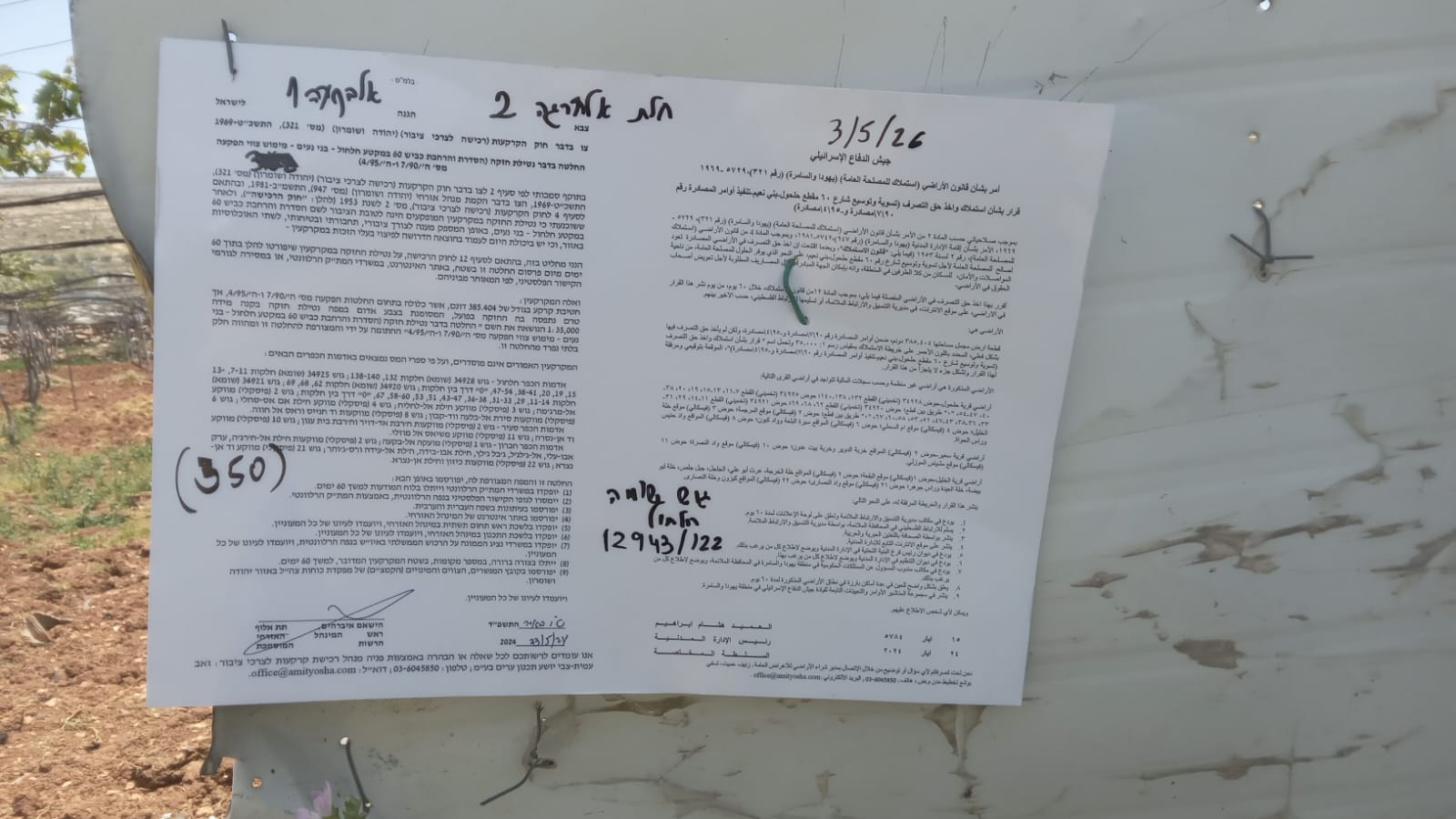 Muhammad D.May-13-2026Hebron - Request for compensation for land expropriation
-
South Hebron Hills
See all reports for this place-
South Hebron Hills
South Hebron Hills is a large area in the West Bank's southern part.
Yatta is a major city in this area: right in the border zone between the fertile region of Hebron and its surroundings and the desert of the Hebron Hills. Yatta has about 64,000 inhabitants.
The surrounding villages are called Masafer Yatta (Yatta's daughter villages). Their inhabitants subsist on livestock and agriculture. Agriculture is possible only in small plots, especially near streams. Most of the area consists of rocky terraces.Since the beginning of the 1980s, many settlements have been established on the agricultural land cultivated by the Palestinians in the South Hebron Hills region: Carmel, Maon, Susia, Masadot Yehuda, Othniel, and more. Since the settlements were established and Palestinians cultivation areas have been reduced; the residents of the South Hebron Hills have been suffering from harassment by the settlers. Attempts to evict and demolish houses have continued, along with withholding water and electricity. The military and police usually refrain from intervening in violent incidents between settlers and Palestinians do not enforce the law when it comes to the investigation of extensive violent Jewish settlers. The harassment in the South Hebron Hills includes attacking and attempting to burn residential tents, harassing dogs, harming herds, and preventing access to pastures.
There are several checkpoints in the South Hebron Hills, on Routes 317 and 60. In most of them, no military presence is apparent, but rather an array of pillboxes monitor the villages. Roadblocks are frequently set up according to the settlers and the army's needs. These are located at the Zif Junction, the Dura-al Fawwar crossing, and the Sheep Junction at the southern entrance to Hebron.
Updated April 2022
 Muhammad D.Jul-13-2026Michal with O.
-