
Qalandiya
Going home.

The suitcase, overnight bag, plastic bag and rolled rug tell us that –
a Gazan woman is on her way home.
The cab driver she hired (fare from Qalandiya to Erez Checkpoint is 300-350 NIS) stayed to watch over her luggage and she went over to the DCO, or in its Palestinian un-whitewashed name, the mukhabarat (Shabak, the Israeli General Security Services) to get her permit to get back home, to Gaza.
I found her there – at the place with the cleanest appearance and the filthiest essence – all tears after hearing she was blacklisted by the Shabak and as such, was not being issued a permit to cross the checkpoint.
“But she wants to get home… Her whole family is there… She had a permit to leave Gaza… But..” people tried to plead.
The soldier checked again, wrote something down on a piece of paper, handed it to the woman and said in a language she does not know, Hebrew: “Call this number, Rafat, he will help you”.
Everyone knows, even I know, that Rafat is the mukhabarat at Erez Checkpoint.
I wanted to ask the soldier why he doesn’t call Rafat, after all the army here is the same as the army there, and the mukhabarat here the same as there, but when I addressed him he said: “I don’t talk with you”. “You just did”, I said. “Very mature of you…” he answered. And a woman-soldier next to him added, “You aren’t even allowed to behere”.
In the atmosphere that ensued, realizing I could only make things worse for the woman, I left.
Going home.
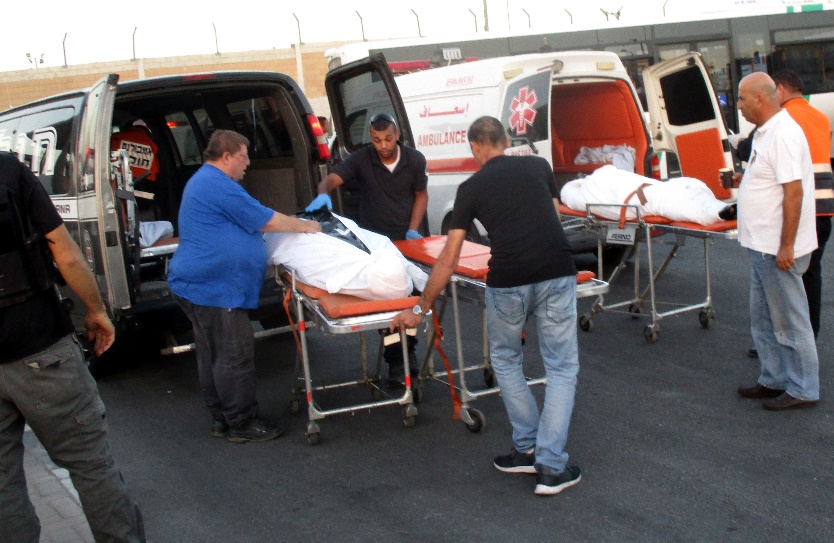
Two ambulances from the Occupied Territories were detained inside the vehicle lane.
“Waiting for bodies”, said a policeman.
The same rules and procedures apply to a dead body as to a living one.
The bodies were of three family members from Jenin who had died several days ago in a traffic accident at Zaatara Junction and had been sent by police order to be autopsied at Abu Kabir (Tel Aviv pathological institute). That is the procedure when the accident involves Jews’ vehicles.
On the other – Palestinian – side, near the checkpoint fence, stood family members of the victims and waited for their relatives.
After an hour and a half, the ambulance drivers were ordered to turn around, and drive to the Palestinian car park where the bodies would be transferred.
The ambulances maneuvered through the chaos of cars, the family members followed as did I, and we waited.
But the two ambulance drivers from Holon (Israel) who transported the bodies were afraid to cross the checkpoint to a place where they felt they would not be protected (a fear very well understood as the result of the brainwashing that Israelis undergo as a matter of course) and so an instruction was issued to get back to the “Jewish” side of the checkpoint. The Palestinian ambulance drivers maneuvered yet again among the dozens of cars, the family members hung on to the fence around the checkpoint and their eyes accompanied the bodies being hauled out and transferred to other ambulances back-to-back.
When the procedure was over, everyone returned to the Palestinian car park. Where several of the family members boarded the ambulances where their loved ones lay, and made sure the deceased were indeed theirs.


Qalandiya Checkpoint / Atarot Pass (Jerusalem)
See all reports for this place-
Click here to watch a video from Qalandiya checkpoint up to mid 2019 Three kilometers south of Ramallah, in the heart of Palestinian population. Integrates into "Jerusalem Envelope" as part of Wall that separates between northern suburbs that were annexed to Jerusalem in 1967: Kafr Aqab, Semiramis and Qalandiya, and the villages of Ar-Ram and Bir Nabala, also north of Jerusalem, and the city itself. Some residents of Kafr Aqab, Semiramis and Qalandiya have Jerusalem ID cards. A terminal operated by Israel Police has functioned since early 2006. As of August 2006, northbound pedestrians are not checked. Southbound Palestinians must carry Jerusalem IDs; holders of Palestinian Authority IDs cannot pass without special permits. Vehicular traffic from Ramallah to other West Bank areas runs to the north of Qalandiya. In February 2019, the new facility of the checkpoint was inaugurated aiming to make it like a "border crossing". The bars and barbed wire fences were replaced with walls of perforated metal panels. The check is now performed at multiple stations for face recognition and the transfer of an e-card. The rate of passage has improved and its density has generally decreased, but lack of manpower and malfunctions cause periods of stress. The development and paving of the roads has not yet been completed, the traffic of cars and pedestrians is dangerous, and t the entire vicinity of the checkpoint is filthy. In 2020 a huge pedestrian bridge was built over the vehicle crossing with severe mobility restrictions (steep stairs, long and winding route). The pedestrian access from public transport to the checkpoint from the north (Ramallah direction) is unclear, and there have been cases of people, especially people with disabilities, who accidentally reached the vehicle crossing and were shot by the soldiers at the checkpoint. In the summer of 2021, work began on a new, sunken entrance road from Qalandiya that will lead directly to Road 443 towards Jerusalem and Tel Aviv. At the same time, the runways of the old Atarot airport were demolished and infrastructure was prepared for a large bus terminal. (updated October 2021)
 Tamar FleishmanFeb-27-2026Qalandiya: On the way to prayer
-